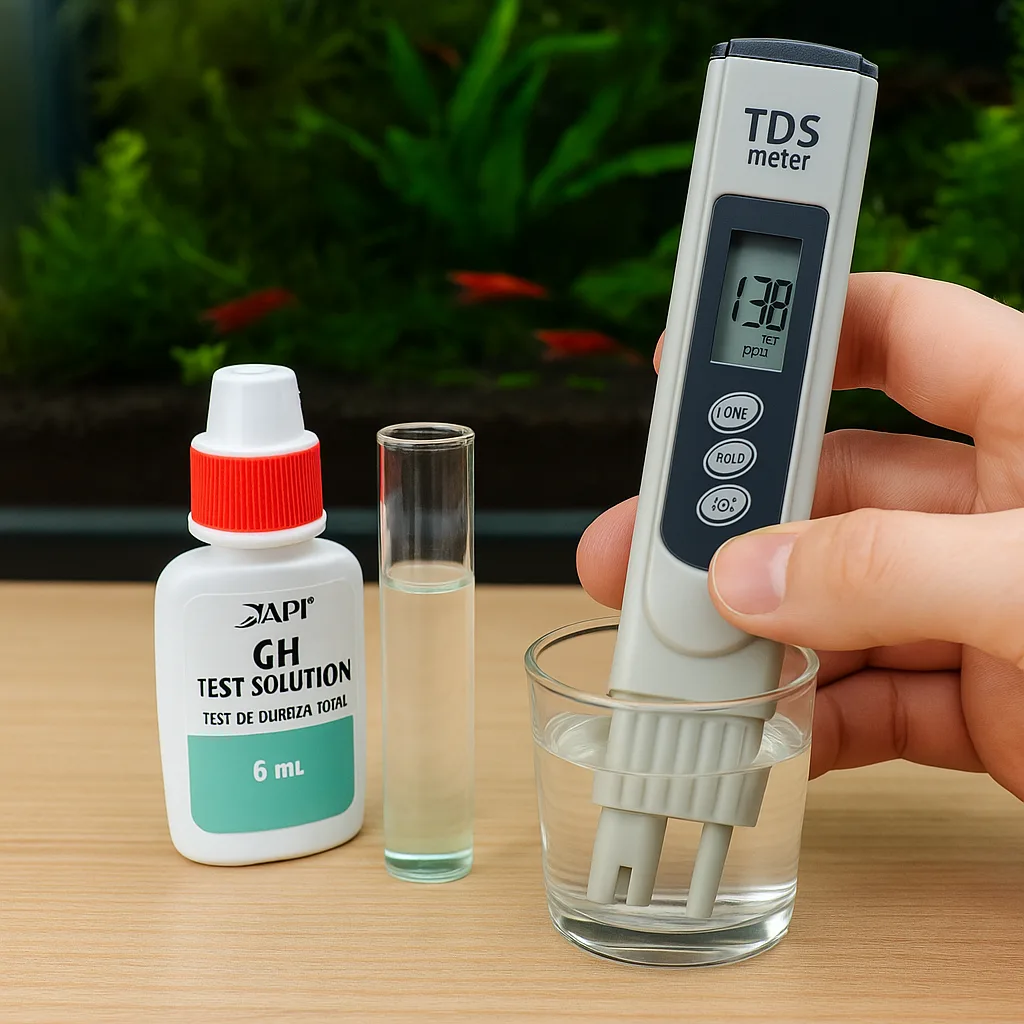
Quick answer: Use a liquid GH test kit (counting drops until the color shifts) to measure mineral content, and a digital TDS meter to read total dissolved solids in ppm. They measure related but different things: GH is just calcium and magnesium, while TDS is everything dissolved in the water. Both matter most for shrimp and other sensitive species, where small swings cause molting problems and deaths.
How to Test GH, KH, and TDS Correctly – Aquarium Water Guide
Water might look clear, but what’s really in it? If you’ve only been testing ammonia, nitrite, and nitrate — you’re missing a huge part of your tank’s chemistry. General Hardness (GH), Carbonate Hardness (KH), and Total Dissolved Solids (TDS) are critical for the long-term success of fish, shrimp, and plants.
This complete guide will walk you through what these parameters mean, how to test them correctly, how to adjust them safely, and what values you should aim for based on your tank type — all in beginner-friendly terms.
What Are GH, KH, and TDS?
GH (General Hardness): Measures the amount of calcium and magnesium in your water. It affects fish osmoregulation, shrimp molting, and overall mineral availability for plants.
KH (Carbonate Hardness): Measures the water’s buffering capacity. It keeps your pH stable and protects against rapid crashes.
TDS (Total Dissolved Solids): Measures the total amount of dissolved substances in water: minerals, salts, nutrients, and waste. It reflects overall “water density.”
GH vs TDS – What’s the Difference?
This confuses a lot of hobbyists. TDS is a general total, while GH is one specific part of that total:
- ✅ GH = calcium + magnesium only
- ✅ TDS = GH + KH + nutrients + salts + organics + waste
It’s possible to have low GH but high TDS if, for example, you’ve added lots of fertilizers or your tank is dirty.
How to Test GH
Use a liquid test kit — such as API GH/KH or Salifert GH. Test strips are unreliable for GH. You’ll be counting drops until the water changes color.
- Rinse test tube with tank water.
- Fill to 5 mL line.
- Add 1 drop of GH solution, cap and shake.
- Repeat one drop at a time until color changes from orange to green.
- The number of drops = your GH in °dGH.
How to Test KH
KH is tested the same way as GH, using the KH bottle from your kit.
- Use 5 mL of tank water in test tube.
- Add 1 drop of KH reagent, shake gently.
- Keep adding 1 drop at a time until the color changes from blue to yellow.
- The number of drops = your KH in °dKH.
How to Test TDS
You’ll need a digital TDS meter — often called a conductivity or EC meter. These are cheap, fast, and reliable.
- Turn on and calibrate (if needed).
- Rinse the probe in RO or distilled water.
- Dip into tank water and wait for reading to stabilize.
- Record the reading in ppm (parts per million).
Ideal GH, KH, and TDS Ranges by Tank Type
Use this chart to find your target zone. These are time-tested ranges for stability, health, and long-term success.
| Tank Type | GH (°dGH) | KH (°dKH) | TDS (ppm) |
|---|---|---|---|
| Neocaridina Shrimp (Cherry, Blue, etc.) | 6–10 | 3–6 | 200–300 |
| Caridina Shrimp (CRS, CBS, Bees) | 4–6 | 0–2 | 100–160 |
| Betta Tank | 3–8 | 3–5 | 150–250 |
| Discus / Softwater Fish | 1–4 | 0–2 | 80–150 |
| General Community (Tetras, Rasboras) | 4–8 | 2–5 | 150–300 |
| Livebearers (Guppies, Mollies) | 8–12 | 4–8 | 250–500 |
| Low-Tech Planted Tanks | 4–8 | 3–6 | 150–250 |
| High-Tech CO₂ Tanks | 3–6 | 2–4 | 120–200 |
| RO/DI Water (Base) | 0–1 | 0–1 | 0–10 |
How to Adjust GH, KH, and TDS
Need to fine-tune your values? Here’s how to safely raise or lower each parameter:
To raise GH:- Seachem Equilibrium
- Crushed coral or aragonite in your filter
- Salty Shrimp GH+ for shrimp tanks
- Crushed coral or baking soda (sparingly)
- Alkaline buffers (Seachem Alkaline Buffer)
- Any additive will raise TDS (salts, ferts, minerals)
- Use RO/DI or distilled water for top-offs or mixing
- Use peat moss or almond leaves to naturally lower hardness
Common Mistakes
- Using expired test kits
- Over-shaking or under-mixing drop tests
- Assuming TDS = GH (it doesn’t)
- Using tap water with unknown mineral content
- Skipping KH and then suffering pH crashes
Related Water Guides
- How to Cycle a Fish Tank
- Routine Maintenance Tips
- Diagnose Plant Growth Problems
- Water Success Steps for Beginners
Final Thoughts – Test Smarter, Not Harder
GH, KH, and TDS are often overlooked — until something goes wrong. Regular testing takes 5 minutes and can prevent fish stress, shrimp deaths, and unexplained algae or pH swings. Once you know your numbers, you’ll understand your water — and that means you’ll make smarter decisions for your livestock, your plants, and your sanity.
Need help decoding your results? Drop them in the comments and I’ll help you analyze what’s going on in your tank.
Frequently asked questions
How do I test GH and TDS?
For GH, use a liquid kit like API GH/KH or Salifert. Fill the test tube to the 5 mL line with tank water, then add the GH reagent one drop at a time, capping and shaking after each drop. Count drops until the color changes from orange to green; each drop equals 1 degree (dGH). For TDS, turn on a digital TDS meter, dip the probe into the tank water, and wait for the number to stabilize, then read it in ppm. Skip test strips for GH, since they are unreliable.
What is the difference between GH and TDS?
GH measures only calcium and magnesium, the minerals that drive fish osmoregulation and shrimp molting. TDS measures the total of everything dissolved: GH plus KH plus nutrients, salts, fertilizers, and waste. So GH is one slice of TDS, not the same thing. You can have low GH but high TDS if you dose heavy ferts or the tank is dirty, which is why you test both instead of assuming one tells you the other.
What tools do I need to test GH and TDS?
Two cheap tools. A liquid GH/KH titration kit (API and Salifert are the common ones) handles GH by drop count. A digital TDS or EC meter handles TDS and reads in ppm. Most TDS meters cost under $15 and last for years; rinse the probe in RO or distilled water before each use so old readings don’t carry over. Keep your liquid kit fresh, because expired reagents throw off the color change and give wrong GH numbers.
What GH and TDS should I target for fish vs shrimp?
It depends on the species. Neocaridina shrimp (cherry, blue) want GH 6-10 and TDS 200-300. Caridina shrimp (CRS, CBS, bees) are pickier, wanting GH 4-6 and TDS roughly 100-160, with many keepers holding around 100-130. For fish, a general community tank (tetras, rasboras) runs GH 4-8 and TDS 150-300, bettas sit around GH 3-8 and TDS 150-250, and livebearers like guppies want harder water at GH 8-12 and TDS 250-500. Softwater fish such as discus prefer GH 1-4 and TDS 80-150.
How often should I test GH and TDS?
Test both around water changes and whenever you mix new top-off water, since that is when values swing the most. TDS is fast with a meter, so checking weekly takes seconds and flags rising waste or evaporation creep before it stresses livestock. Shrimp tanks, especially caridina, deserve more frequent checks because a sudden TDS jump can trigger bad molts and deaths. Once a tank is stable and you know your tap or RO baseline, a quick monthly GH check is usually enough for hardy community fish.
How do I raise or lower GH and TDS?
To raise GH, add Seachem Equilibrium, crushed coral or aragonite in the filter, or Salty Shrimp GH+ in shrimp tanks. Any mineral, salt, or fertilizer you add will also push TDS up, since TDS counts all of it. To lower GH and TDS, cut the water with RO/DI or distilled water for top-offs and mixing, or use peat moss and almond leaves to bring hardness down naturally. Make changes gradually over days, because fast mineral swings are harder on shrimp and sensitive fish than the wrong stable number.
Author and editorial note
Written and maintained by Benjamin Thoden, founder of DBC Aquatics. This shrimp guide is reviewed through DBC Aquatics’ stability-first lens: cycle maturity, mineral consistency, molt safety, copper risk, grazing surfaces, and slow acclimation matter more than quick fixes. See our editorial standards for how guides are created, reviewed, and updated.
Leave a Reply