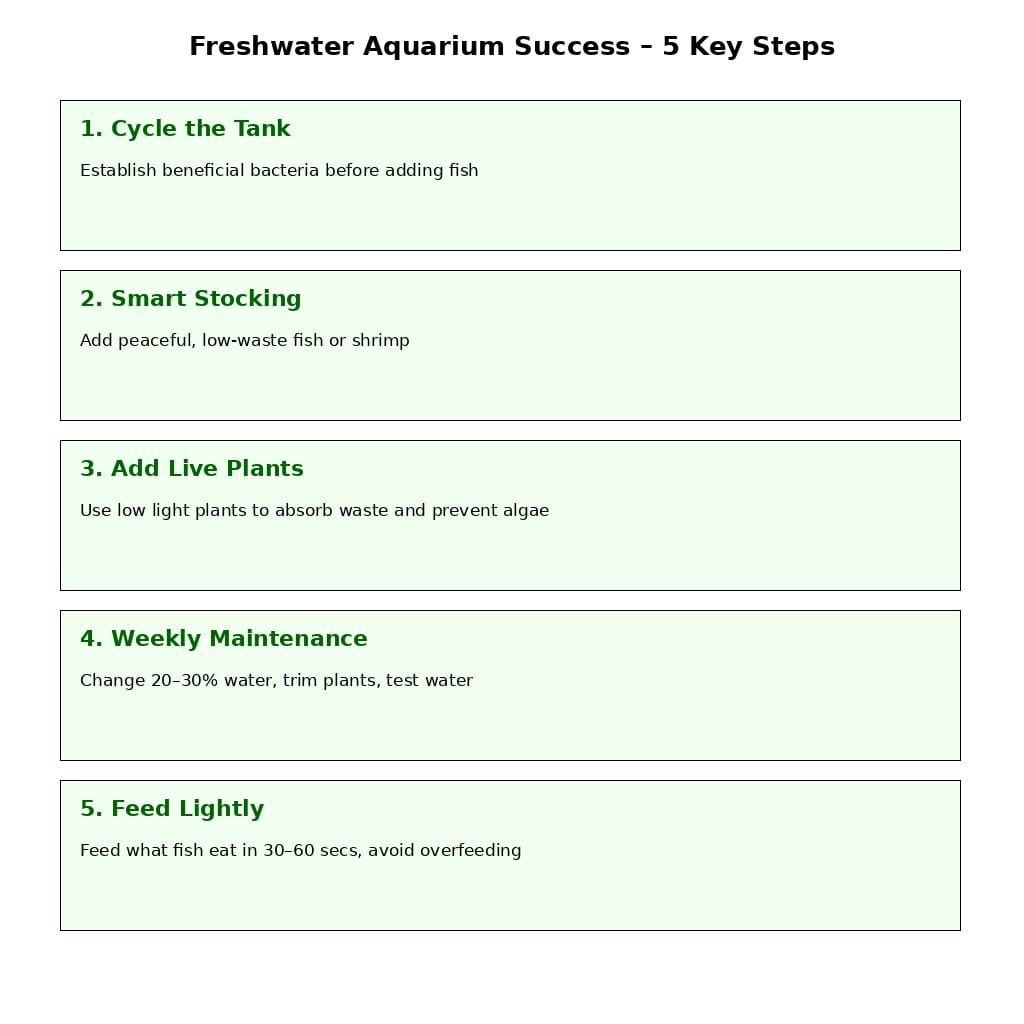
Quick answer: A clean, thriving freshwater tank comes down to five things done in order: cycle the tank before a single fish goes in, stock light and peaceful, add a few easy live plants, run a weekly water-change rhythm, and feed less than you think you should. Get those right and most of the problems beginners panic over — cloudy water, ammonia spikes, algae takeovers — never start. None of it needs expensive gear or years of experience. It needs patience and a routine.
Almost every struggling beginner tank I see fails for the same handful of reasons, and they’re all avoidable. The water looks fine, the fish were healthy at the store, and a week later something’s wrong — fish gasping at the surface, glass going green, a smell off the top. It’s rarely bad luck. It’s almost always one of the five fundamentals below getting skipped. Here’s the order I’d set up a tank in today, whether it’s a 20-gallon or a small nano.
Step 1: Cycle the tank before any fish go in
This is the step that decides whether everything after it goes smoothly, and it’s the one beginners skip most. A new tank has no way to process fish waste. Waste becomes ammonia, ammonia is toxic, and in an uncycled tank it climbs until it burns gills and kills fish — the classic “new tank syndrome.” Cycling is the process of growing the beneficial bacteria that convert that ammonia into nitrite, then into far less harmful nitrate, before any fish are exposed to it.
- Do a fishless cycle. Add a bottled bacteria starter and a small ammonia source (a pinch of fish food or bottled ammonia), then wait. No fish suffer while the bacteria establish.
- Test, don’t guess. A liquid test kit is non-negotiable here. You’re waiting for ammonia and nitrite to both read zero, with some nitrate showing — that’s a cycled tank.
- Expect 3-6 weeks. It takes time. You can cut it down a lot by seeding the filter with media from an established tank, which brings the bacteria with it.
If you take one thing from this whole guide, make it this one. The full walkthrough is in my tank cycling guide — read it before you buy fish, not after.
Step 2: Stock light, peaceful, and low-waste
A balanced tank isn’t a crowded one. Every fish you add is more waste for your filter and bacteria to process, so the fastest way to wreck water quality is to overstock on day one. Start light, add slowly over weeks, and pick species that stay small and get along.
- A solid 20-gallon community: a school of 10-12 ember or neon tetras, 6 corydoras catfish for the bottom, and a handful of cherry shrimp as cleanup. Peaceful, colorful, and well within what the tank can handle.
- Avoid the classic mismatches: goldfish (huge waste producers that want cold water), most cichlids (too aggressive or too big), and any mix of fin-nippers with long-finned tankmates.
- Add in stages. Introduce one group, wait a week or two and watch your parameters hold steady, then add the next. A sudden full stocking can stall a young cycle.
For tank-size-specific combinations that actually work together, see the small tank stocking guide.
Step 3: Add a few easy live plants
Live plants aren’t decoration — they’re working filtration. They pull up ammonia and nitrate directly as fertilizer, compete with algae for the same nutrients, and give fish cover so they’re less stressed. You do not need high light or CO2 to get this benefit. The easiest beginner plants are some of the most effective.
- Hardy and slow: Java fern and Anubias attach to wood or rock (never bury the rhizome) and tolerate almost any light.
- Fast nutrient-sponges: floating plants like Amazon frogbit grow quickly, soak up excess nutrients, and shade the tank to slow algae.
- Root feeders: Cryptocoryne and Vallisneria fill the substrate — give them root tabs if your gravel is inert.
A tank with even a few fast growers is far more stable than a bare one. My list of low-light aquarium plants covers the best beginner picks in detail.
Step 4: Run a weekly maintenance rhythm
Water changes are the single habit that separates tanks that thrive from tanks that limp along. They export the nitrate and dissolved organics that build up between feedings, top up minerals, and keep the water stable. A planted tank doesn’t change this — it slows it slightly. The routine is simple and takes fifteen minutes once it’s a habit.
| Task | How often |
|---|---|
| Change 20-30% of the water (dechlorinated) | Weekly |
| Vacuum waste out of the substrate | Weekly, during the water change |
| Test ammonia, nitrite, and nitrate | Weekly for the first few months, then occasionally |
| Wipe the glass and trim or thin plants | As needed |
| Rinse filter media in old tank water | Monthly — never under the tap, the chlorine kills your bacteria |
That last row catches a lot of people: rinsing your filter sponge under tap water can crash a cycle by killing the bacteria living in it. Always rinse it in a bucket of the water you just siphoned out. The full routine is in the aquarium maintenance guide.
Step 5: Feed less than you think
Overfeeding is the quietest killer in the hobby. Fish will beg every time you walk past, but a fish’s stomach is roughly the size of its eye. Uneaten food rots, spikes ammonia, and feeds algae and snails. Almost no one underfeeds a tank; nearly everyone overfeeds it.
- Feed once or twice a day, only what’s eaten in 30-60 seconds. If food hits the substrate uneaten, you gave too much.
- Skip a day a week. A weekly fast day is good for the fish and gives the tank time to process waste. Healthy fish handle it easily.
- Watch behavior, not just appetite. Clamped fins, gasping at the surface, hiding, or loss of color are early warnings — catch them before they become a crisis.
If you want the long list of what goes wrong and how to avoid it, I’ve collected the worst offenders in why aquarium fish die.
A realistic first-month timeline
New tanks are not instant, and the wait is where most beginners make mistakes out of impatience. Here’s roughly how a healthy first month actually goes:
- Week 1: set up, plant, and start the fishless cycle. No fish yet. Expect the water to go cloudy for a few days — that’s a harmless bacterial bloom, not a problem to fix.
- Weeks 2-4: the cycle works through ammonia, then nitrite, then settles. Keep testing. Patience here is the whole game.
- End of the cycle: ammonia and nitrite read zero, nitrate shows up. Do a large water change and add your first small group of fish.
- Ongoing: stock the rest in stages, settle into the weekly rhythm, and the tank gets more stable every week as plants root in and the biology matures.
Want a printable version of the whole setup? Grab the free aquarium survival checklist.
Frequently asked questions
How long before I can add fish to a new tank?
Plan on 3-6 weeks for a fishless cycle. The tank is ready when a liquid test kit shows ammonia and nitrite both at zero with some nitrate present. Seeding the filter with media from an established tank can shorten this to a week or two.
How many fish can I keep in a 20-gallon tank?
Stick to small, peaceful species and stock lightly — a school of 10-12 nano fish plus a small bottom group like corydoras and some shrimp is plenty. Avoid goldfish and large or aggressive species. Add fish in stages over several weeks rather than all at once.
Do I really need live plants?
You don’t, but they make a tank noticeably more stable. Plants absorb ammonia and nitrate directly and compete with algae for nutrients. Easy low-light species like Java fern, Anubias, and floating frogbit need no CO2 and very little care.
How often should I change the water?
About 20-30% once a week for most tanks, always with dechlorinated water. This exports nitrate and organics and keeps parameters stable. A planted tank can sometimes go a little longer, but a steady weekly rhythm is the simplest way to keep water safe.
Related beginner guides
- Tank Cycling 101
- Small Tank Stocking Guide
- 10 Low-Light Aquarium Plants
- Full Cleaning Routine
- Why Aquarium Fish Die
Author and editorial note
Written and maintained by Benjamin Thoden, founder of DBC Aquatics. This shrimp guide is reviewed through DBC Aquatics’ stability-first lens: cycle maturity, mineral consistency, molt safety, copper risk, grazing surfaces, and slow acclimation matter more than quick fixes. See our editorial standards for how guides are created, reviewed, and updated.
Leave a Reply