How Often Should You Change Aquarium Water? (Complete Guide)
Water changes are one of the most important — and misunderstood — parts of aquarium care. Skip them, and your water quality drops fast. Do too many, and you risk shocking your fish. So how often should you change your water? It depends on your tank size, stocking level, and filtration. This guide breaks it down with clear tips and timing for every type of setup.
General Water Change Guidelines
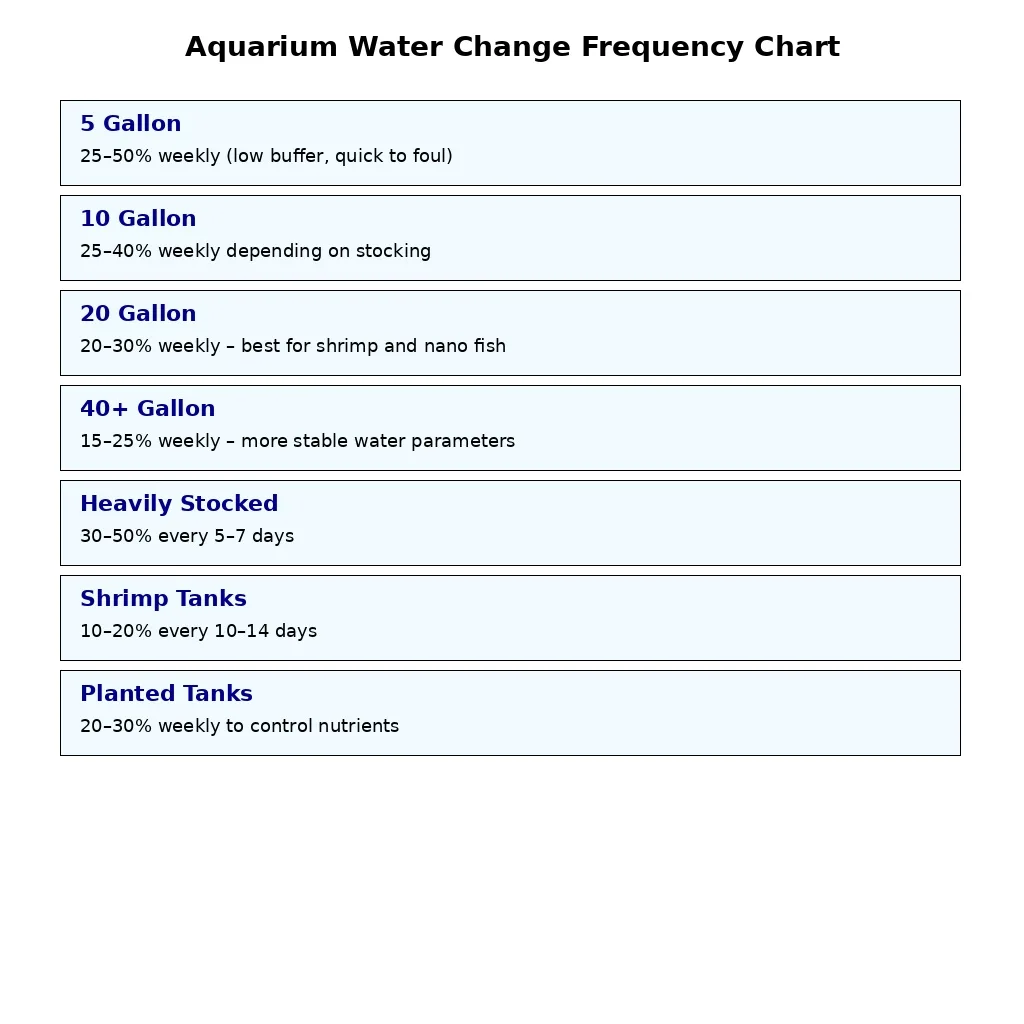
- Lightly Stocked Tanks: 15–25% once every 1–2 weeks
- Heavily Stocked Tanks: 25–50% weekly
- Shrimp-Only Tanks: 10–20% every 10–14 days
- Planted Tanks: 20–30% weekly to remove excess nutrients
- High Bioload Tanks: 30–50% every 5–7 days (cichlids, goldfish, etc.)
Water Change Frequency by Tank Size
- 5 Gallon: 25–50% weekly (low buffer, fills quickly with waste)
- 10 Gallon: 25–40% weekly depending on stocking
- 20 Gallon: 20–30% weekly is ideal for most setups
- 40 Gallon+: 15–25% weekly, larger tanks are more stable
Why Are Water Changes So Important?
- 🚫 Removes toxic nitrate buildup
- 🦠 Dilutes waste and uneaten food
- 🌱 Balances nutrients in planted tanks
- 🧬 Replenishes minerals and stabilizes pH
- 🐠 Prevents cloudy water, algae, and fish stress
Signs You’re Not Changing Water Enough
- Cloudy or tinted water
- Algae blooms (especially green hair algae)
- High nitrate test readings (40+ ppm)
- Fish gasping, sluggish, or hiding constantly
- Ammonia spikes despite cycled filter
Quick Water Change Tips
- ✔️ Always treat tap water with a dechlorinator like Prime
- ✔️ Match the new water’s temperature to the tank
- ✔️ Gravel vacuum only part of the tank each time
- ✔️ Don’t overclean — leave beneficial bacteria alone
- ✔️ Use a water test kit weekly to spot problems early
Related Water Quality Guides
- Cycling 101 – Build Beneficial Bacteria
- Weekly Cleaning Checklist
- Plants That Help Control Waste
- Smarter Stocking = Fewer Water Changes
Want help building a schedule based on your tank size and stocking? Drop a comment and I’ll help you dial in the right routine.
How to choose a water change schedule
Water changes should respond to the tank, not a random calendar. The right schedule depends on stocking, feeding, plant growth, nitrate, and how stable the tank stays between changes.
- Lightly stocked planted tanks may stay stable with smaller weekly changes.
- New tanks, crowded tanks, and messy feeders usually need more frequent checks.
- Emergency water changes should be partial, dechlorinated, and temperature matched.
- If nitrate keeps climbing, reduce feeding, clean trapped waste, or increase the regular water change size.
Test, adjust, and keep notes. The best schedule is the one that keeps the tank stable before fish show stress.
Signs your water change routine needs adjusting
A water change schedule should change when the tank gives you evidence. If nitrate keeps rising between weekly changes, the tank either needs a larger change, lighter feeding, more plant growth, better debris removal, or fewer fish. If fish act stressed after every change, the new water may be too cold, untreated, added too quickly, or very different in pH, GH, KH, or TDS.
Do not judge the routine only by whether the water looks clear. Clear water can still carry ammonia, nitrite, or high nitrate, and slightly tinted water from botanicals can be perfectly safe. The useful question is whether fish behavior, test results, and debris levels stay predictable from one week to the next.
For most beginner tanks, the safest upgrade is consistency. Pick a regular day, dechlorinate every bucket, temperature-match the water, clean only part of the substrate at a time, and keep notes for a month. After a few weeks, the pattern will tell you whether the tank wants smaller changes, bigger changes, or a better feeding routine.
Quick answer: Most beginner aquariums do well with a partial weekly water change, but the right schedule depends on nitrate, stocking, feeding, plants, and fish behavior.
Frequently asked questions
Is a weekly water change always enough?
Not always. A lightly stocked planted tank may need less, while crowded tanks, messy feeders, or new tanks may need more frequent changes and testing.
How much water should I change at once?
For routine maintenance, many tanks do well with 20 to 30 percent. In emergencies, use partial changes and match temperature and dechlorinator carefully.
What tells me to change water sooner?
Rising nitrate, ammonia or nitrite, gasping fish, odor, visible waste, or stressed behavior are signs to test and consider an earlier water change.
Author and editorial note
Written and maintained by Benjamin Thoden, founder of DBC Aquatics. This shrimp guide is reviewed through DBC Aquatics’ stability-first lens: cycle maturity, mineral consistency, molt safety, copper risk, grazing surfaces, and slow acclimation matter more than quick fixes. See our editorial standards for how guides are created, reviewed, and updated.
Leave a Reply