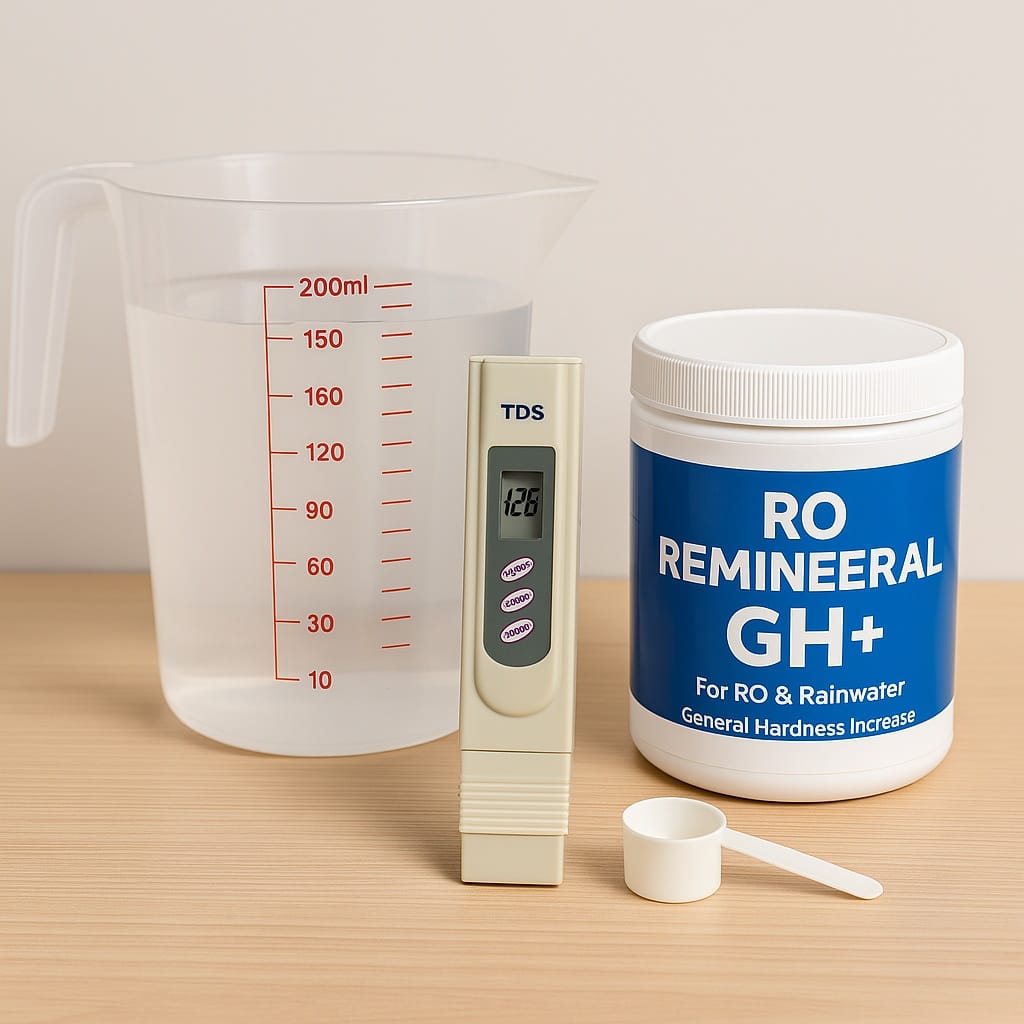
Quick answer: To remineralize RO water for caridina, add a GH+ remineralizer to pure RO water in a separate container, mix it until fully dissolved, then test TDS and GH until you hit your target before using the water for a change. Target roughly 100-130 TDS and 4-6 dGH, and use a GH+ product (not GH/KH+) so you do not add unwanted KH. Never dose minerals directly into the tank.
How to Remineralize RO Water for Caridina Shrimp (Step-by-Step Guide)
Caridina shrimp need soft, mineral-balanced water to breed, molt, and survive. Tap water is too inconsistent—and often contains copper or high KH. That’s why most breeders use RO (reverse osmosis) water, but RO is too pure on its own. The solution? Remineralization.
Here is how I would mix Caridina water in a real tank
With Caridina shrimp, I do not chase a perfect number by dumping minerals straight into the aquarium. I mix RO water in a bucket first, bring it to the target TDS, let it fully dissolve, then check the water again before it touches the tank. That small habit prevents most of the sudden swings that wipe out sensitive shrimp.
For a typical bee shrimp or crystal shrimp setup, I would start around 100-130 TDS with a GH-only remineralizer, then adjust based on the colony. If shrimp are molting cleanly, grazing normally, and babies are surviving, I leave the numbers alone. If I see failed molts, sluggish shrimp, or pH drifting up, I check GH, KH, TDS, substrate age, and the source water before changing anything.
DBC practical tip: Write the TDS of every water-change bucket on a piece of tape or in your phone notes. If the tank crashes later, those numbers tell you whether the problem started in the bucket, the substrate, or the tank itself.
This guide walks you through exactly how to remineralize RO water using GH+ salts for Caridina shrimp, from gear to measurements.
Table of Contents
- Why Use RO Water for Caridina?
- What You’ll Need
- Step-by-Step: Mixing Remineralized Water
- Target Parameters for Caridina Shrimp
- How to Store Remineralized Water
- Common Mistakes to Avoid
Why Use RO Water for Caridina?
RO water strips everything—including beneficial minerals—from your source water. This lets you rebuild your parameters from scratch, eliminating unwanted copper, chlorine, KH, and unknown hardness spikes that can kill shrimp or ruin breeding cycles.
- Tap water: Often has unpredictable KH and GH, leads to pH swings
- RO water: Starts at 0 TDS — perfect blank slate for shrimp
- Remineralization: Adds just GH (not KH) to create ideal soft water for Caridina
What You’ll Need
- RO or RO/DI water (0–5 TDS)
- GH+ remineralizer: Salty Shrimp GH+ or SL-Aqua Blue Wizard (not GH/KH+)
- TDS pen (digital)
- Digital kitchen scale (grams preferred)
- Mixing container (bucket, jug, or brute bin)
- Stirring stick or air stone
- Thermometer (optional but ideal)
Important: Do not add minerals directly to your shrimp tank. Always mix separately and test before adding.
Step-by-Step: Mixing Remineralized Water
Here’s the most reliable method:
- Fill your container with RO water (e.g. 5 gallons)
- Using your scale, add GH+ powder gradually
- Mix thoroughly with air stone or spoon
- Test the TDS with your pen after 5–10 minutes
- Adjust: Add more GH+ if TDS is too low, or dilute if too high
- Let the mix sit for 1–2 hours before use to stabilize
- Match temperature to tank before adding
Sample dosage guide (Salty Shrimp GH+): 1 level scoop (2g) per 10L raises TDS to ~100 ppm. Always test!
Target Parameters for Caridina Shrimp
| Parameter | Ideal Range |
|---|---|
| TDS | 100–140 ppm |
| GH | 4–6 dGH |
| KH | 0–1 dKH (should remain near zero) |
| pH (from substrate) | 5.8–6.4 (buffered by active substrate) |
How to Store Remineralized Water
- Keep it sealed in a clean container (food-safe plastic or glass)
- Label the container with TDS and date
- Use within 5–7 days for best results
- If it sits longer, retest TDS before using
Common Mistakes to Avoid
- Using tap or half-tap water: Inconsistent and may contain copper
- Using GH/KH+ instead of GH+: Adds unwanted KH that ruins pH stability
- Not testing TDS: Always test after mixing and before adding
- Mixing directly in the tank: Can shock shrimp and create uneven parameters
Final Thoughts
Properly remineralized RO water is the #1 secret to healthy, breeding Caridina shrimp. Once you get the hang of mixing, measuring, and matching parameters—you’ll never go back to guessing. Use this system and your shrimp will thrive long-term.
Want a printable cheat sheet for mixing GH+ with RO water at different volumes? Drop a comment and I’ll send one your way!
Keep reading
If the shrimp still look stressed
Remineralized RO water fixes the source water problem, but it does not fix every Caridina problem. If your numbers look right and the shrimp are still hiding, dying after molts, or acting weak, follow the links below before changing products again.
- KH, pH, and buffering in shrimp tanks – find pH swings and buffering mistakes
- Why pH rises in a shrimp tank – check substrate exhaustion, rocks, water changes, and KH creep
- Best Caridina remineralizers compared – pick a GH+ product that matches the tank
- Best remineralizers for Caridina – shorter product-focused guide
- Shrimp Care Hub – all shrimp setup and troubleshooting guides in one place
Frequently asked questions
How do I remineralize RO water for shrimp?
Fill a clean container with RO water (0-5 TDS), then add a GH+ remineralizer powder gradually using a digital scale. Stir or run an air stone, wait 5-10 minutes, and test TDS. Add more powder if it reads low or add more RO water if it reads high, then let it sit 1-2 hours to stabilize before use.
What TDS and GH should I target for caridina?
Aim for a TDS of about 100-130 ppm and a GH of 4-6 dGH. KH should stay near 0-1 dKH since active substrate handles the buffering and pH (usually 5.8-6.4). Use a GH+ remineralizer, not a GH/KH+ product, so KH stays near zero.
How much remineralizer do I use per gallon?
It depends on the brand, so always dose by TDS rather than a fixed amount. As a reference, about 2g of Salty Shrimp GH+ per 10 liters (roughly 2.6 gallons) raises TDS to about 100 ppm. Add it gradually, test with a TDS pen, and adjust to your target instead of trusting a single scoop.
Do I mix it in the tank or a separate container?
Always mix in a separate container, never in the tank. Adding minerals straight to the tank shocks the shrimp and creates uneven parameters before everything dissolves. Mix and test in a bucket or jug first, then add the finished water.
Should I remineralize before or during a water change?
Remineralize before the water change, not during it. Mix the RO water to your target TDS and GH, let it sit 1-2 hours, and match its temperature to the tank. Only then use it for the change so the shrimp see stable, correct parameters the moment the water goes in.
Can I just use tap water instead of RO?
Not reliably for caridina. Tap water has unpredictable GH and KH and can contain copper or chlorine that kills shrimp or wrecks breeding. RO starts at 0 TDS so you rebuild exactly the parameters you want, which is why RO plus a GH+ remineralizer is the standard for caridina.
Related shrimp & Caridina guides
Author and editorial note
Written and maintained by Benjamin Thoden, founder of DBC Aquatics. This shrimp guide is reviewed through DBC Aquatics’ stability-first lens: cycle maturity, mineral consistency, molt safety, copper risk, grazing surfaces, and slow acclimation matter more than quick fixes. See our editorial standards for how guides are created, reviewed, and updated.
Leave a Reply