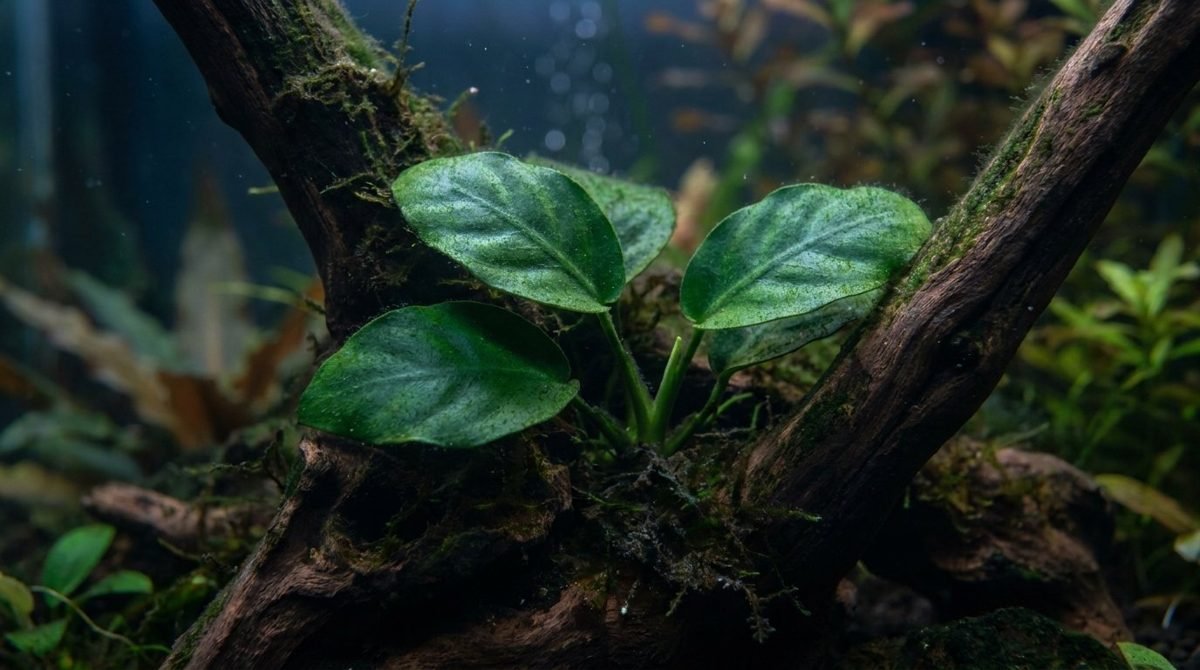
Quick answer: Anubias is a hardy, slow-growing rhizome epiphyte. You attach it to driftwood or rock with thread or gel super glue and never bury the rhizome, or it rots. Low light and no CO2 are all it needs — strong light just grows algae on its slow leaves. The leaves are tough enough that cichlids and goldfish leave them alone, which makes anubias one of the best plants for nano, cichlid, and shrimp tanks.
Anubias is the plant I hand to anyone who tells me they kill everything green they put in a tank. I’ve pulled it out of neglected rescue tanks — leaves caked in algae, rhizome shoved into gravel — rinsed it off, glued it to a piece of wood, and watched it carry on like nothing happened. It’s about as close to indestructible as an aquarium plant gets, as long as you understand the one rule that trips everyone up: you attach it, you don’t plant it.
This is the guide I give people who just bought their first anubias. It covers what the plant is, the care numbers, how to attach it without rotting the rhizome, why low light is the right call, the two problems anubias ever really has, and how to turn one plant into several.
What anubias is
Anubias is a slow-growing rhizome plant from West Africa, where it grows along stream banks attached to rocks and roots. That’s why it works as an aquarium epiphyte: instead of rooting into substrate, it grows from a thick horizontal rhizome with leaves and roots coming off it, and it pulls nutrients straight from the water column. The leaves are thick, leathery, and dark green — tough enough that fish which shred most plants tend to ignore it.
There are several types you’ll run into, and they’re all kept the same way:
- Anubias barteri. The classic full-size one, with broad heart-shaped leaves on a sturdy rhizome. Great as a driftwood centerpiece.
- Anubias nana. A smaller, compact form of barteri. The workhorse of the group and the one most people start with.
- Anubias nana ‘Petite’. A dwarf selection with tiny leaves, perfect for nano tanks and foreground rock work.
- Anubias ‘Coffeefolia’. A barteri variety with crinkled leaves that emerge coppery bronze before darkening to green, for a bit more texture.
A settled, happy anubias will also send up a small white flower on a stalk that blooms underwater — something most aquarium plants never bother with. It doesn’t mean anything’s wrong; it just means the plant is comfortable.
Anubias care at a glance
Anubias tolerates a wide range, so treat these as the comfortable middle rather than hard limits.
| Requirement | Anubias needs |
|---|---|
| Light | Low. Low light is enough and is actually safer — anubias grows so slowly that strong light just feeds algae onto its leaves. Shade from floating plants or taller stems suits it well. |
| CO2 | None required. It grows fine in a low-tech tank. CO2 speeds it up a little, but it’s completely optional. |
| Temperature | 72–82°F. Comfortable across the normal tropical range, so it fits almost any community tank. |
| pH | Roughly 6.0–7.5. Soft or moderately hard water is fine — it adapts to most tap water. |
| Placement | Attached to driftwood or rock, rhizome above the substrate. Never buried. The roots can go into substrate, but the rhizome cannot. |
| Fertilizer | Optional. A light all-in-one liquid fert feeds the leaves. In a stocked, fed tank it usually finds enough on its own. |
| Difficulty | Easy. Famously hardy and almost impossible to kill, as long as you don’t bury the rhizome. |
If you’ve kept any rhizome epiphyte before — java fern, bucephalandra — you already know how to keep anubias. The care is the same: slow, attached, and forgiving.
How to attach anubias
This is the one thing people get wrong, so I’ll be blunt: do not bury the rhizome in your substrate. The rhizome is the thick horizontal stem the leaves and roots grow from, and if you push it down into gravel or soil it suffocates and rots, and you lose the plant. The roots can go into substrate to anchor it — it’s only the rhizome that has to stay above and exposed to water. Anubias grows attached to a surface, not planted in the ground.
- Pick your hardscape. Driftwood and rough rock are ideal. The roots grip texture over time and the rhizome sits up in the water where it belongs.
- Keep the rhizome on top. Lay the plant so the rhizome rests against the surface and the roots face down. The rhizome must stay exposed — never under glue or pressed into substrate.
- Tie it with thread. Cotton thread or fishing line wrapped over the rhizome and around the wood holds it while the roots take hold. Cotton dissolves in a few weeks, by which point it’s anchored itself. This is my default.
- Or use gel super glue. Cyanoacrylate gel (the coral-fragging stuff) bonds anubias to hardscape in seconds and is aquarium-safe once cured. Dab a small spot on the underside of the rhizome, press it down, and hold for a moment.
- Give it time. New roots wrap the wood and the occasional leaf unfurls over the following weeks. Anubias is slow, so expect it to quietly grip and settle rather than flush out.
You can also just wedge it into a crevice between rocks and skip the thread and glue entirely. As long as the rhizome stays above the substrate and in the water, it’ll attach on its own.
Why low light matters
People assume more light means more growth, and with most plants that’s roughly true. With anubias it backfires. The plant grows so slowly that a single leaf can sit in the same spot for months, and under strong light that leaf becomes prime real estate for algae. You don’t speed anubias up much by blasting it — you just grow a beard on every leaf.
- Low light keeps the leaves clean. Faster plants outgrow algae; anubias can’t, so the fix is to not hand algae the light it needs in the first place.
- Shade is a feature here. Tuck anubias under floating plants, taller stems, or driftwood overhangs. It’s one of the few plants that prefers the dim corners of a tank.
- In a bright tank, place it carefully. Keep anubias in the shadow of your hardscape rather than directly under the light, with some flow over the leaves.
This is why anubias suits low-tech setups so well. Giving it less light is actively better for it.
Common anubias problems and fixes
Anubias has basically two failure modes, and both are easy to head off. Nearly every complaint I hear comes down to a rotting rhizome or algae on the leaves.
- Rhizome rot. A soft, brown, mushy rhizome means the plant is dying, and the usual cause is burying it in substrate. Lift it out, cut the rotted section back to firm green tissue with clean scissors, and reattach the healthy part to wood or rock with the rhizome above the substrate. Keep it exposed from now on.
- Black-beard or green-spot algae on the leaves. The old, slow-growing leaves collect it, almost always because the light is too strong for how slowly the plant grows. Dial the light down, move the anubias into shade, keep flow over it, and add grazers — Amano shrimp, nerite snails, or otocinclus pick at it. For a badly covered leaf, just trim it off; new growth comes in clean.
- Yellowing old leaves. An occasional leaf turning yellow and dropping is normal aging — just trim it. If a lot yellow at once, the tank is probably running lean on nutrients, and a light dose of all-in-one liquid fertilizer usually sorts it out.
The thread through all of it: keep the rhizome exposed, keep the light low, trim old leaves as they age out, and anubias is close to unkillable.
How to propagate anubias
Anubias propagates by rhizome division. It’s slow, like everything else about the plant, but it’s simple and free.
- Cut the rhizome into sections. Use clean, sharp scissors. Make sure each section has at least a few leaves and some roots of its own — a bare chunk of rhizome is much slower to take.
- Attach each division. Tie or glue each piece to wood or rock exactly like the parent, rhizome on top and roots down. That’s the whole process.
- Be patient. Each division grows into its own plant over the following months. One clump becomes several over a year with no real effort.
Dividing also keeps an older, leggy clump tidy, and it’s a cheap way to plant several tanks or share a piece once you have one established.
Is anubias right for your tank
For most tanks, anubias is one of the safest plants you can choose. Here’s where it shines and where I’d think twice.
- Nano tanks — yes. Nana and ‘Petite’ stay small and compact, so they hold scale in a little tank instead of taking it over.
- Cichlid tanks — yes. The rare plant that survives cichlids and goldfish. The leaves are too tough to be worth eating, and you glue it to rock so they can’t uproot it.
- Shrimp tanks — yes. Undemanding, no trimming chaos, and the leaves and roots host biofilm for shrimp to graze.
- Low-tech tanks — yes. No CO2 needed, low light preferred, forgiving on parameters. One of the best-looking plants you can keep in a simple setup.
- Anyone in a hurry — maybe not. If you want a tank to fill in fast, anubias will frustrate you. It’s slow by nature, and light just brings algae rather than speed.
If you’re building a low-light, low-tech tank around it, my low light plants guide covers the companions that pair well with anubias.
Anubias FAQ
Can I plant anubias in substrate, or do I have to attach it?
You attach it — never bury it. Anubias grows from a thick horizontal rhizome, and if you push that rhizome down into gravel or soil it suffocates and rots, and the plant dies. Tie or glue it to driftwood or rock instead, with the rhizome sitting above the substrate and exposed to water. The roots can run down into substrate to help anchor it, but the rhizome itself has to stay on top.
Does anubias need CO2 or high light?
No to both. Anubias grows fine in low light with no CO2, which is exactly why it’s a low-tech and nano staple. CO2 speeds it up slightly but isn’t required. High light is actually a mistake — anubias grows so slowly that strong light just feeds algae onto its leaves rather than driving useful growth. Low light keeps the plant healthy and the leaves clean.
Why is my anubias getting algae on the leaves?
Almost always too much light. The leaves grow so slowly that they sit in one spot for months, and under strong light algae like black-beard and green-spot settle on them. Move the anubias into shade, turn the light down or shorten the photoperiod, keep some flow over the leaves, and add grazers like Amano shrimp, nerite snails, or otocinclus. Trim the worst-covered old leaves; new growth comes in clean.
Why is my anubias rhizome rotting or melting?
The usual cause is the rhizome being buried in substrate. The rhizome needs to stay above the substrate and exposed to water, and when it’s buried it suffocates, turns soft and brown, and rots. Lift the plant out, cut the rotted part away back to firm green tissue with clean scissors, and reattach the healthy section to wood or rock with the rhizome on top. Keep it exposed from then on and it’ll recover.
How do I propagate anubias?
Divide the rhizome. Use clean, sharp scissors to cut the rhizome into sections, making sure each piece has a few leaves and some roots of its own. Tie or glue each division to fresh wood or rock, rhizome on top and roots down, exactly like the parent plant. Each section grows into its own plant over the following months. It’s slow, like everything with anubias, but it’s simple and free.
How fast does anubias grow?
Slowly — that’s its defining trait. Expect a new leaf every few weeks rather than visible spread day to day. A little CO2 and fertilizer nudge it along, but it’s a slow plant by nature and always will be. The upside is that it almost never needs trimming, holds its shape in small tanks, and won’t take over. Patience is the main thing anubias asks of you.
Keep reading
Author and editorial note
Written and maintained by Benjamin Thoden, founder of DBC Aquatics. This shrimp guide is reviewed through DBC Aquatics’ stability-first lens: cycle maturity, mineral consistency, molt safety, copper risk, grazing surfaces, and slow acclimation matter more than quick fixes. See our editorial standards for how guides are created, reviewed, and updated.
Leave a Reply