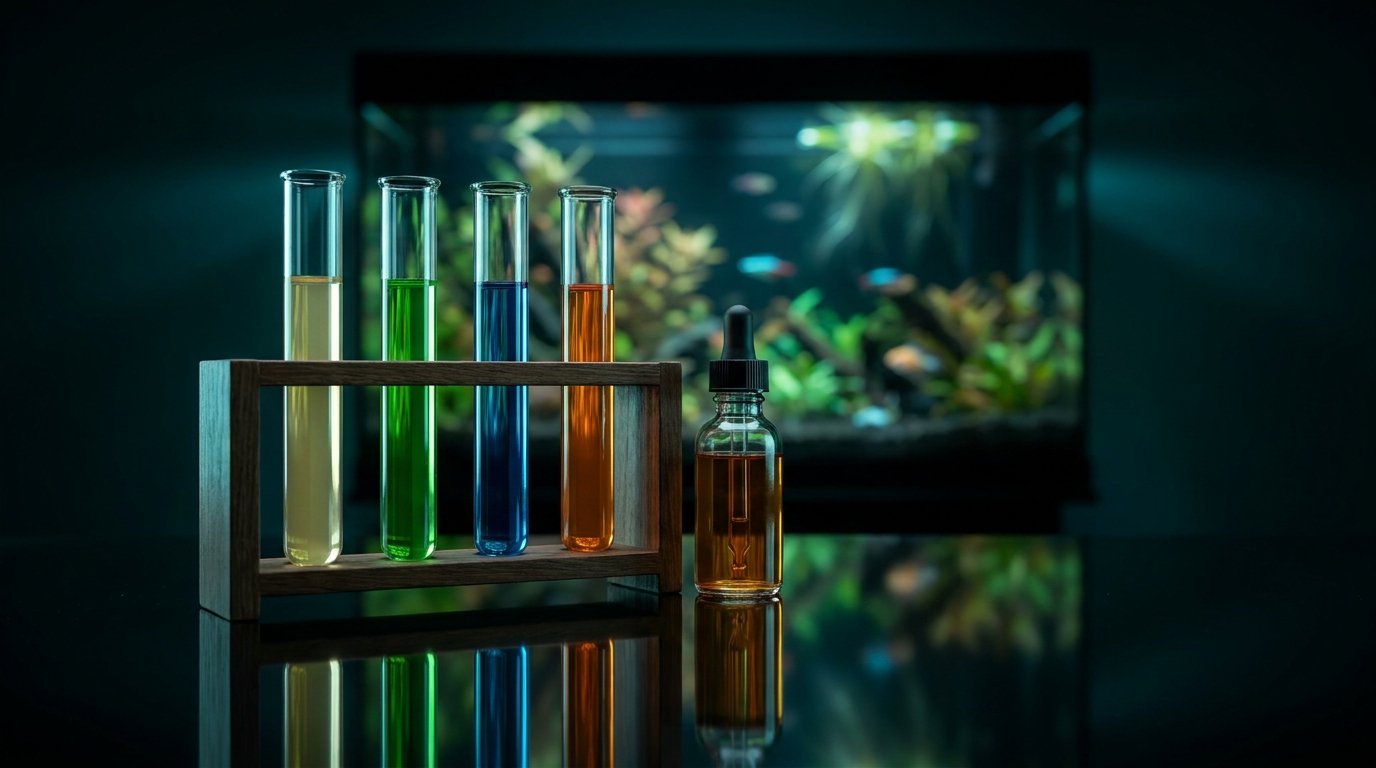
Quick answer: For almost everyone, the API Freshwater Master Test Kit — it’s liquid (accurate), tests the five parameters that matter, and works out to pennies per test. Strips are fine for a fast glance but unreliable for ammonia, the one thing that actually kills fish. Salifert is the upgrade if you want lab-grade precision.
I’ve lost count of how many fish I’ve pulled back from the edge, and almost every one of those rescues started the same way: with a test kit, not a net. The owner swore the water was fine. The fish “looked stressed” or were “just sitting at the bottom.” Then I’d run a liquid test and watch the ammonia tube turn green in front of them. That moment — when an invisible problem suddenly has a color — is why I’ll argue all day that a test kit is the cheapest insurance you’ll ever buy for a tank.
Here’s the part beginners hate to hear: a fish “looking fine” tells you nothing. The two things most likely to kill it — ammonia and nitrite — are completely invisible, odorless, and they can spike high enough to do real damage while your fish are still swimming around like nothing’s wrong. By the time the behavior changes, you’re already behind. A $30 kit tells you days earlier. I’ve watched people drop $200 on a tank, $80 on fish, and then guess at the water. That’s the part that doesn’t make sense to me.
So this is my honest ranking after years of using these on real rescues and answering thousands of beginner questions. I’ll tell you what to buy, what to skip, and where each kit quietly lets you down. If your fish are sick right now, go run a test first, then come back — start with my toxic water guide and the fish symptoms checker.
How I judged these
Four things, in this order. Accuracy — does it actually catch ammonia and nitrite when they’re low but rising, not just when they’re already lethal? Cost per test — because the kit you’ll actually use is the one that doesn’t feel expensive to run. What it tests — the five that matter for keeping fish alive are pH, high-range pH, ammonia, nitrite, and nitrate. Ease of use — if a kit is a pain, you won’t test, and a kit you don’t use is worthless. I weighted accuracy hardest because we’re literally trusting these readings with an animal’s life.
API Freshwater Master Test Kit — the one to buy
This is my default recommendation and it’s not close. It’s a liquid kit, which is the whole point — you add drops of reagent to a measured tube of tank water and read the color against a chart. Liquid reagents are far more accurate than strips, and the kit covers exactly what you need: pH, high-range pH, ammonia, nitrite, and nitrate. One box runs roughly 800 tests, so the cost-per-test drops to pennies. I’ve had a single kit last me well over a year across multiple tanks.
Now the honest gripes, because no kit is perfect. The nitrate test (bottle #2) has to be shaken hard for a full 30 seconds — I mean really beat it, bang the bottle on the counter — and so does the test tube after you add the drops. The crystals in that reagent settle and clump, and if you’re gentle with it, it reads low. Probably 80% of the “my nitrate is always zero” messages I get trace back to a lazy shake. Second gripe: the color charts are genuinely hard to read under warm yellow kitchen light. Read it against the white card in daylight or under cool white LED, not under a 2700K bulb. Third: it does not test GH or KH (general and carbonate hardness). If you want those — and shrimp and planted people do — you buy the separate API GH & KH kit. None of these are dealbreakers. They’re just the things nobody tells you in the reviews.
API Freshwater Master Test Kit
Liquid accuracy, the five parameters that actually matter, and pennies per test — it’s the kit I keep next to every tank.
Check price Affiliate linkTest strips — convenient, but don’t trust them with ammonia
Strips (Tetra EasyStrips, API 5-in-1) are fast and cheap, and I’ll be fair to them: dip, wait, read, done in 60 seconds. For a quick “is anything wildly off today” glance on an established, stable tank, that’s genuinely useful. I keep some around for exactly that.
But here’s the problem that matters. Most strips don’t even test ammonia, and the few that do are vague at best — a smear of color that’s nearly impossible to read in the low range where early trouble lives. Ammonia is the exact thing that kills fish, so a test that skips it or guesses at it is missing the whole point. Strips also degrade fast: leave the bottle open in a humid bathroom or kitchen and the pads start reading wrong within weeks. Cap them tight, keep them dry, and never trust a strip to clear a fish you’re worried about. Strips are a convenience tool, not an accuracy tool. If a strip and a liquid kit disagree, believe the liquid every time. When someone messages me about a tank where the water “tests fine” but fish keep dying, the culprit is very often a strip that read 0 ammonia when it wasn’t.
Aquarium Test Strips
Great for a 60-second glance at an established tank, but unreliable for ammonia — don’t bet a fish’s life on one.
Check price Affiliate linkSalifert — when you want real precision
Salifert kits are the hobbyist favorite for precision, and they earn it. They’re titration-style — you add reagent until the sample changes color, then read the value off how much you used — which gives finer increments than matching a color to a chart. Shrimp keepers and planted-tank people love them because those hobbies live and die on small parameter swings that API’s chart can’t quite resolve.
The trade-offs are real, though. Salifert is pricier per test and a bit more fiddly — more steps, more careful measuring, more “did I count that drop right.” For a beginner with a community tank, that precision is overkill and the extra fuss makes you test less, which is the opposite of what you want. I steer new keepers to API and only point them at Salifert once they’re chasing specific parameters on purpose. It’s the precision pick for people who fuss, and I mean that as a compliment.
Salifert Test Kits
Titration-style accuracy that shrimp and planted keepers swear by — more precise, pricier, and fussier than you need for a basic community tank.
Check price Affiliate linkLiquid vs strips vs digital: the honest breakdown
One more option worth a sentence: digital photometers like the Hanna checkers. They’re excellent and they remove the “what color is that exactly” guesswork — but for a freshwater beginner they’re overkill and overpriced, and most only read one parameter per unit. I’d also throw in a cheap always-on backup, the Seachem Ammonia Alert badge that sticks inside the glass and changes color if ammonia shows up between tests. It’s not precise, but as a constant early-warning light for the one killer that matters most, it’s a few dollars well spent. Here’s how they stack up:
| Test kit | Type | Best for | Tests it runs | Accuracy | Ease of use |
|---|---|---|---|---|---|
| API Freshwater Master | Liquid (drops + chart) | Almost everyone | pH, high pH, ammonia, nitrite, nitrate | High | Moderate — a few steps |
| Test strips | Dip strip | Fast glance on a stable tank | Usually pH, nitrite, nitrate, hardness — ammonia weak or missing | Low–moderate | Very easy |
| Salifert kits | Liquid titration | Shrimp / planted / parameter chasers | Individual parameters (buy per test) | Very high | Fiddly |
| API GH & KH kit | Liquid titration | Add-on for hardness | GH and KH only | High | Easy — count the drops |
| Seachem Ammonia Alert | Always-on badge | Constant backup warning | Ammonia presence only | Rough / qualitative | Set and forget |
So which should you actually buy?
New tank, just cycling? API Freshwater Master Test Kit, no debate. Cycling a tank is all about watching ammonia and nitrite rise and fall, and strips can’t track that reliably. You need the liquid ammonia and nitrite tests to know when it’s safe to add fish. This is the single most important tool while you’re cycling — more important than the heater you obsessed over.
Established, stable community tank? Still the API Master kit for your real weekly check, with strips as the optional 60-second “nothing’s on fire” glance between proper tests. If you want a constant backstop, stick a Seachem Ammonia Alert in the glass.
Shrimp or planted tank? API Master as your base, plus the API GH & KH kit, and graduate to Salifert for whatever parameter you’re dialing in. Hardness matters enormously for shrimp molting, and that’s the one the Master kit ignores.
Tight budget? Buy the API Master kit anyway. It’s cheaper per test than strips over its life because one box does ~800 tests, and it’s the one that’ll actually save a fish. If all you can spare is a few dollars today, grab strips and an Ammonia Alert badge so at least the worst killer is covered — then upgrade to liquid as soon as you can. For the full rescue toolkit, see my aquarium tools page, the broader aquarium rescue hub, and the step-by-step rescue blueprint.
FAQ
Are test strips good enough for a beginner?
For a quick glance on a stable tank, yes. For anything you’re trusting your fish’s life to — especially ammonia — no. Most strips don’t test ammonia well or at all, and ammonia is the killer. Use strips for convenience and a liquid kit for decisions.
How often should I test my water?
While cycling a new tank, every day or two so you can watch ammonia and nitrite move. On an established tank, once a week is plenty, plus any time a fish looks off or you’ve added livestock. Test before you panic-treat, not after.
Why does my ammonia always read 0 (or never reach 0)?
A reading of 0 on an established, cycled tank is correct and good — your bacteria are doing their job. If it never drops to 0, your tank isn’t fully cycled yet or you’re overstocked/overfeeding. If you suspect a false 0 from a strip, confirm with a liquid test before trusting it.
Do I need a GH and KH test?
For a basic community tank, not really. For shrimp, planted tanks, or if your fish keep struggling for no clear reason, yes — buy the separate API GH & KH kit. The Freshwater Master kit doesn’t cover hardness, and hardness drives a lot of hidden problems.
How long do liquid test kits last? What’s the shelf life?
Unopened, most liquid reagents are good for a couple of years, and a single API Master kit runs around 800 tests once you’re using it. Check the dates printed on the bottles. Store them capped, out of direct sun and heat. Strips are the opposite — they degrade fast once the bottle’s been opened in humidity.
Liquid vs digital — is a Hanna checker worth it?
For most freshwater beginners, no. Digital photometers are accurate but pricey, usually read one parameter per unit, and solve a problem (reading color charts) that a good liquid kit already handles for pennies. Liquid is the sweet spot of accuracy and value.
Educational guidance, not veterinary advice.
Author and editorial note
Written and maintained by Benjamin Thoden, founder of DBC Aquatics. This shrimp guide is reviewed through DBC Aquatics’ stability-first lens: cycle maturity, mineral consistency, molt safety, copper risk, grazing surfaces, and slow acclimation matter more than quick fixes. See our editorial standards for how guides are created, reviewed, and updated.
Related Rescue Guides
Product Reviews
Author and editorial noteWritten and maintained by Benjamin Thoden, founder of DBC Aquatics. This gear guide…
Aquarium Heater Safety & Failure Warning Signs
Heater failure is one of the most common — and dangerous — problems in the hobby.…
How to Choose the Right Filtration System (HOB vs Canister vs Sponge)
Quick answer: Pick your filter by tank size, stocking level, and how much maintenance you want…
Leave a Reply