Fish Gasping At The Top? Low Oxygen, Ammonia, And What To Do First
Watching your fish crowd the surface, breathing hard, can make you think they are about to die.
It is one of the most frightening things an aquarium owner can see because the tank may still look clean.
Before you tear apart the filter, dump in medication, or change everything at once, slow down. There is a safer order that protects the fish and protects the beneficial bacteria keeping the tank alive.
Quick Answer
If your fish are gasping at the top, increase oxygen first. Aim the filter output at the surface, add an air stone if you have one, open the lid if the room is warm, and stop feeding temporarily.
Then test ammonia and nitrite before you deep-clean the filter or add medication. Gasping can be low oxygen, but it can also happen when ammonia or nitrite is irritating the gills, when the water is too warm, when the tank was overfed, or when filter bacteria were damaged.
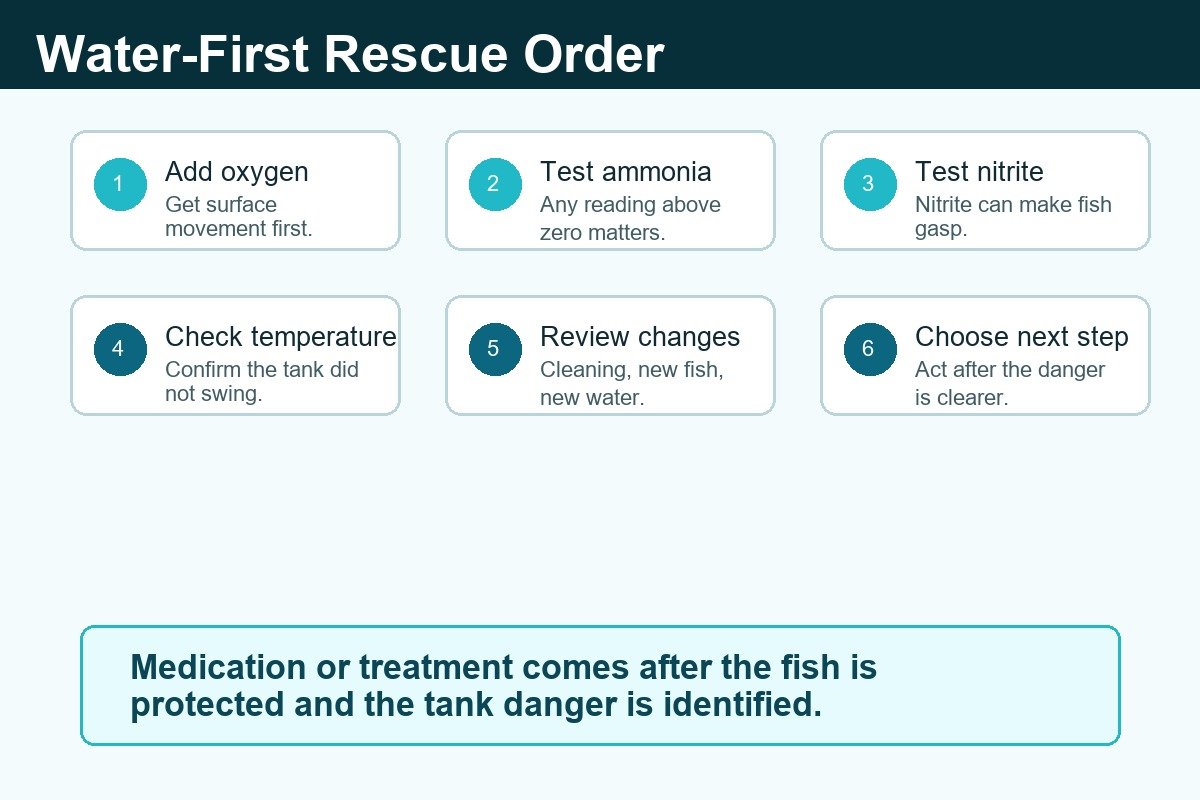
The safe order is:
- Add oxygen and surface movement.
- Stop feeding for now.
- Test ammonia and nitrite.
- Do a controlled partial water change if either is above zero.
- Protect the filter bacteria.
- Look for what changed in the last 48 hours.
Not sure which rescue path fits what you are seeing? Open the Aquarium Command Center to choose the closest symptom and see the first safe steps before you make another change.
Video support: If you are about to change more water, watch Ben walk through the controlled rescue order: Fish Dying? Do This Before You Change More Water.
THE DBC RULE
Test the water.
Protect the fish.
Then choose the next step.
First: Do Not Tear Apart The Filter
When fish are gasping, the filter is one of the first things beginners want to clean. That makes sense from the outside. The tank looks dirty, the fish look stressed, and the filter feels like the thing responsible for water quality.
But during a breathing emergency, a deep filter cleaning can make the tank worse.
Your filter is not just a dirt trap. It holds a lot of the beneficial bacteria that process fish waste. If you rinse that media under tap water, replace too much at once, or scrub everything clean while the tank is already unstable, ammonia and nitrite can climb even higher.
So the first move is not a deep clean.
The first move is stabilization:
- Add oxygen.
- Test the water.
- Protect the bacteria.
- Change water carefully if ammonia or nitrite is present.
Why Fish Gasp At The Surface
Fish pull oxygen from the water through their gills. When they crowd the surface, breathe fast, hang under the filter return, or stay near bubbles, they are telling you breathing is harder than it should be.
That can happen for several reasons.
| Cause | Why It Makes Fish Gasp | What To Check First |
|---|---|---|
| Low oxygen | Fish move toward the surface where oxygen exchange is strongest | Surface movement, air stone, filter flow |
| Ammonia | Ammonia irritates or burns gills | Ammonia test |
| Nitrite | Nitrite makes it harder for fish to use oxygen properly | Nitrite test |
| Warm water | Warm water holds less oxygen | Thermometer |
| Overfeeding | Extra food creates waste and can fuel oxygen loss | Uneaten food, cloudy water, ammonia |
| Filter trouble | Low flow or damaged bacteria can cause oxygen and waste problems | Filter output, media condition, recent cleaning |
| Chlorine/chloramine | Untreated tap water can irritate gills fast | Recent water change and conditioner use |
Clear water does not rule these out.
A tank can look clean and still have ammonia, nitrite, low oxygen, or chlorine stress.
Why Fish Gasp Before They Die
Fish do not breathe air the way we do. They pull oxygen through their gills from the water around them.
So when fish hang at the surface, breathe fast, or crowd the filter return, the real problem is usually this:
They are not getting oxygen safely through the gills.
That can happen in two different ways.
Sometimes the water does not hold enough oxygen. Warm water, weak surface movement, overstocking, overfeeding, or a clogged filter can all push fish toward the surface.
Other times, oxygen may be present, but the fish cannot use it well. Ammonia can irritate or burn the gills. Nitrite can interfere with oxygen transport inside the fish. Chlorine or chloramine from untreated tap water can also damage the gills quickly.
That is why bubbles alone do not prove the tank is safe.
You can add air and still have a water-quality emergency underneath it.
Emergency Rescue Order
1. Add Oxygen Now
Start here because it helps almost every version of this problem.
Do this:
- Aim the filter output upward so the surface ripples.
- Add an air stone or sponge filter if you have one.
- Open the lid if the tank is covered and the room is warm.
- Make sure the filter is actually moving water.
- Remove anything blocking flow.
You do not need violent splashing. You need steady surface movement.
If the fish improve quickly after oxygen is added, low oxygen was probably part of the problem. Still keep going. Oxygen can buy time without fixing ammonia, nitrite, heat, or a damaged filter cycle.
2. Stop Feeding Temporarily
Food adds waste.
In a breathing emergency, most fish are safer skipping food for a short period than sitting in water that is getting worse. Do not feed because you feel bad for them. Feed again after the water is stable and the fish are breathing normally.
3. Test Ammonia And Nitrite
If you only test two things right now, test ammonia and nitrite.
Ammonia and nitrite should both read 0 ppm in a safe aquarium.
If either one is above zero, treat the tank as unstable. Add oxygen, stop feeding, and do a controlled partial water change with dechlorinated water close to the tank temperature.
Nitrate matters too, but ammonia and nitrite are the emergency numbers when fish are gasping.
A Real Rescue Example
I have seen fishkeepers reach for medication because their fish looked sick overnight.
The fish were breathing hard, hanging near the top, and acting like something was wrong. Medication felt like the responsible move.
But the test kit told a different story.
Ammonia was not zero.
In that tank, medication would have added stress without fixing the real problem. Once oxygen improved, the water was corrected carefully, and the filter bacteria were protected, the fish had a better chance to recover.
That is the lesson here: gasping is not always a disease problem. Many times, it is the tank asking you to check oxygen and water quality first.
4. Check Temperature
Warm water holds less oxygen than cooler water. A tank that was fine last month can become stressful during a hot week, especially if the tank is covered, overstocked, overfed, or has weak surface movement.
Look at the thermometer, not just the heater dial.
If the tank is warmer than normal for your fish:
- Increase aeration first.
- Turn off extra heat sources if needed.
- Keep lights off temporarily if they are adding heat.
- Do not shock the tank with ice.
- Bring the temperature down slowly.
5. Do A Controlled Water Change If Needed
If ammonia or nitrite is present, do a partial water change.
Use dechlorinator. Match temperature as closely as you can. Keep oxygen high while you work.
Do not change everything at once unless you are dealing with an extreme toxin emergency and understand the risk. Most beginner emergencies are safer with controlled water changes repeated as needed, not one chaotic full reset.
6. Protect The Filter Bacteria
If the filter flow is weak, you can clean it gently.
Do this:
- Save a bucket of old tank water from the water change.
- Swish sponge or biomedia gently in that old tank water.
- Clear obvious clogs from the intake.
- Restart the filter and confirm strong flow.
Do not:
- Rinse biological media under untreated tap water.
- Replace all cartridges or media at once.
- Deep-clean every surface in the same day.
- Scrub the tank spotless during a gasping emergency.
The goal is to restore flow without removing the bacteria the tank needs.
7. Look For What Changed In The Last 48 Hours
The cause is usually hiding in the recent change.
Ask:
- Did you clean the filter?
- Did you add new fish?
- Did the power go out?
- Did the room get hot?
- Did someone overfeed?
- Did a fish die and hide behind decor?
- Did you change water without enough conditioner?
- Did you add medication?
- Did you stir the gravel hard?
- Did you replace filter media?
Write these down with your test numbers. They matter more than guessing.
What The Symptoms Usually Mean
| What You See | Most Likely Direction | First Move |
|---|---|---|
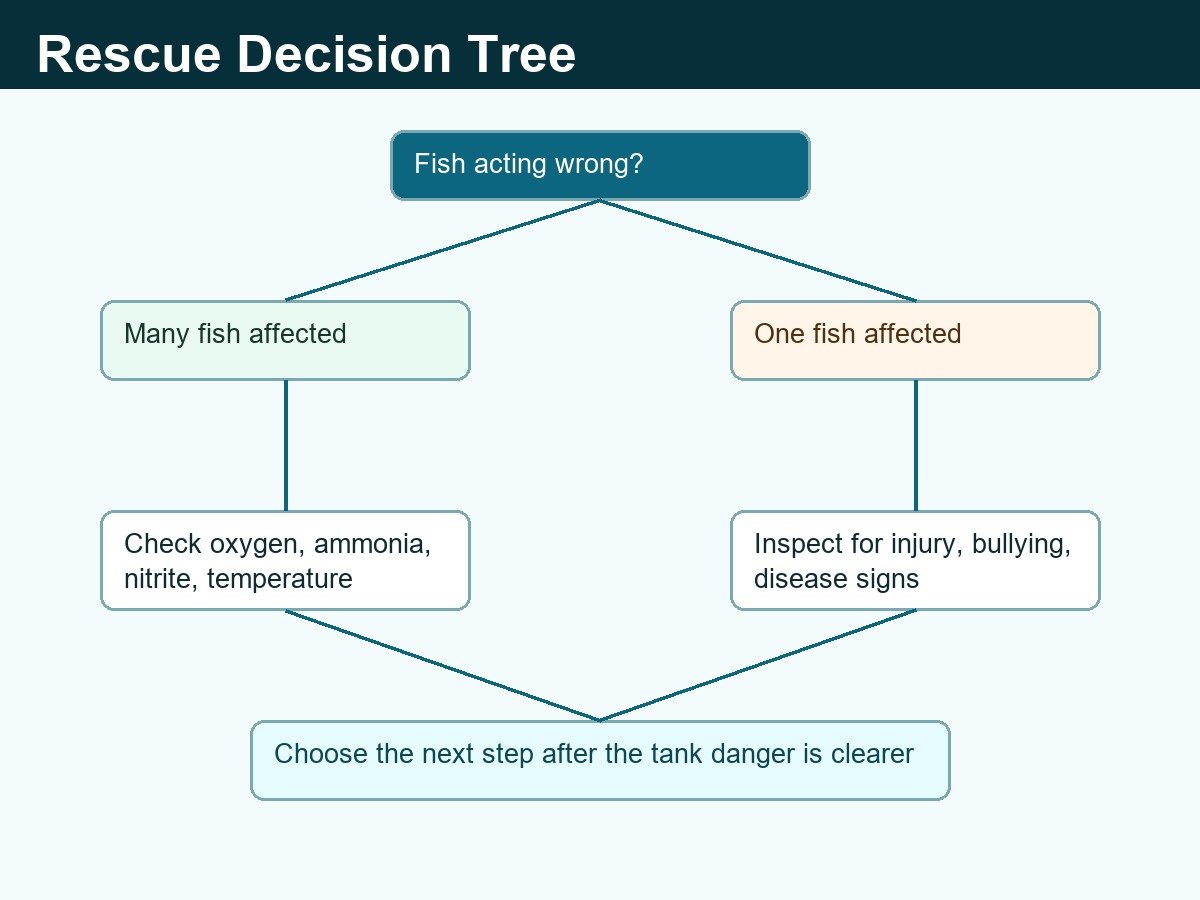
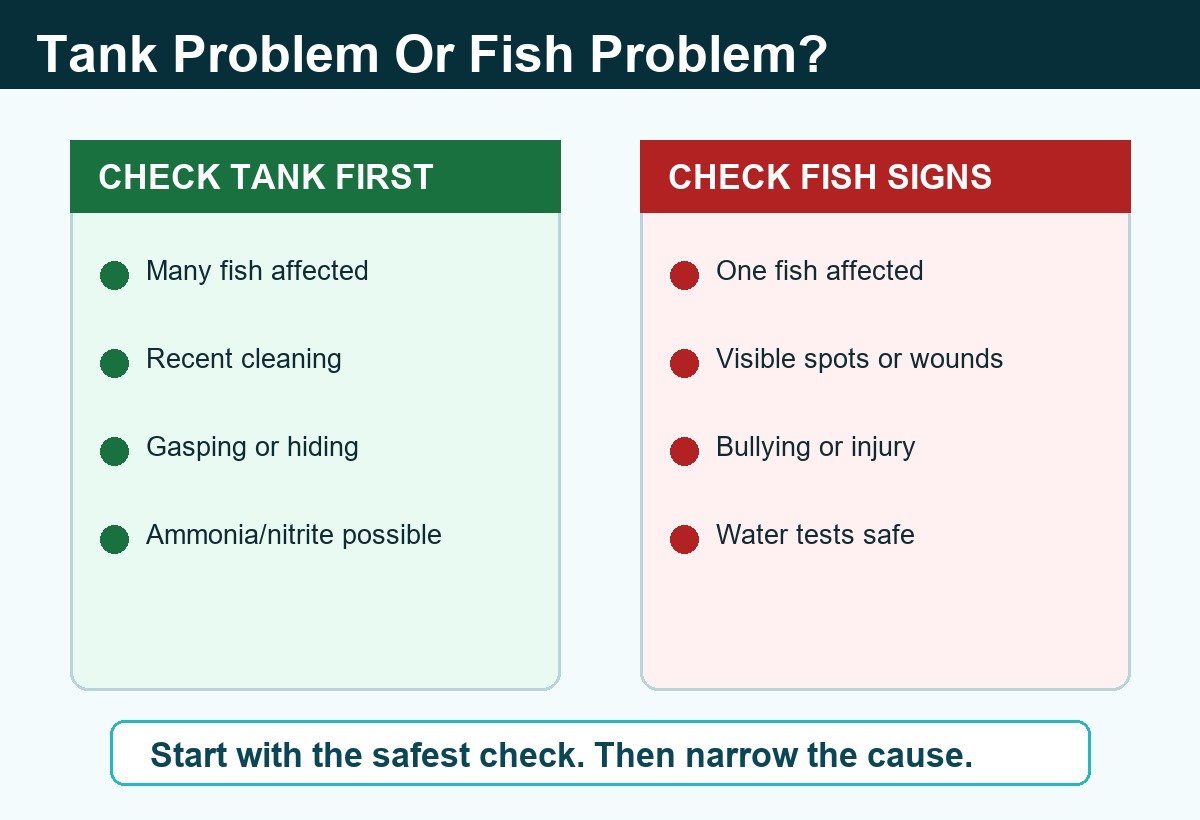
| All fish gasping at the top | Tank-wide oxygen, ammonia, nitrite, heat, chlorine, or filter issue | Add oxygen and test water |
| One fish gasping but others normal | Individual stress, injury, disease, bullying, or weaker fish | Still test water, then inspect that fish |
| Fish gasping after water change | Chlorine/chloramine, temperature shock, pH swing, oxygen drop | Add oxygen, confirm conditioner, test water |
| Fish gasping after filter cleaning | Bacteria loss, ammonia/nitrite spike, reduced flow | Add oxygen, test ammonia/nitrite, protect media |
| Fish gasping with cloudy water | Bacterial bloom, overfeeding, ammonia, low oxygen | Add oxygen, stop feeding, test ammonia/nitrite |
| Fish gasping in a new tank | Unfinished cycle, ammonia, nitrite | Test toxins and follow fish-in rescue steps |
| Fish gasping during hot weather | Low oxygen from warm water | Add air, increase surface movement, cool slowly |
When It Is Low Oxygen
Low oxygen is more likely when:
- The surface is still like glass.
- The filter flow is weak.
- The tank is warm.
- Fish are crowded near the filter output.
- It is worse overnight or early in the morning.
- Fish improve quickly after adding air.
The fix is usually surface movement, not just more equipment. Oxygen enters the water where the surface moves. A filter return pointed upward can help as much as an air stone if it creates steady ripple.
When It Is Ammonia Or Nitrite
Ammonia or nitrite is more likely when:
- The tank is new.
- Fish were added recently.
- The filter was cleaned or media was replaced.
- The tank was overfed.
- A fish died in the tank.
- The water looks clear but fish are breathing hard.
- Fish do not improve much after oxygen is added.
Ammonia irritates the gills. Nitrite makes it harder for fish to use oxygen properly. That is why these problems can look like low oxygen even when bubbles are moving.
If ammonia or nitrite is above zero, keep oxygen high, stop feeding, do controlled water changes, and protect the filter bacteria.
What Improvement Should Look Like
Improvement is usually gradual.
You want to see:
- Fish spending less time crowded at the surface.
- Breathing slowing down.
- Fish using more of the tank.
- Less hanging under the filter return.
- More normal posture and movement.
Fish may still act tired for a while, especially if ammonia or nitrite irritated their gills. Do not use that tired behavior as a reason to dump medication into the tank before the water is stable.
The Biggest Mistakes I See
These are the mistakes that make a gasping emergency worse:
- Deep-cleaning the filter while the tank is unstable.
- Rinsing biological filter media under tap water.
- Feeding because the fish “look weak.”
- Assuming clear water means safe water.
- Adding medication before testing ammonia and nitrite.
- Chasing pH while fish are already stressed.
- Replacing all filter media at once.
- Changing five things in the same hour.
The safest rescue order is simple:
oxygen, tests, controlled water change if needed, protect the filter, remove obvious waste, watch the fish.
24-Hour Rescue Checklist
Use this if fish are gasping right now.
- [ ] Add oxygen or increase surface movement.
- [ ] Stop feeding temporarily.
- [ ] Check temperature.
- [ ] Test ammonia.
- [ ] Test nitrite.
- [ ] Test nitrate if available.
- [ ] Confirm dechlorinator was used for recent water changes.
- [ ] Do a controlled partial water change if ammonia or nitrite is present.
- [ ] Keep filter media wet and protected.
- [ ] Remove uneaten food, dead fish, or rotting plant matter.
- [ ] Write down what changed in the last 48 hours.
- [ ] Keep oxygen high for the next 24 hours.
When To Get More Help
If your fish are still gasping after oxygen, water testing, and a controlled water change, gather the facts before guessing.
Write down:
- Tank size
- Temperature
- Ammonia
- Nitrite
- Nitrate
- pH if you have it
- Fish species
- How long the tank has been running
- What changed in the last 48 hours
- Whether the filter was cleaned recently
- Whether any medication was added
Then use the DBC Aquatics Symptoms Checker or Rescue Hub to work through the next step.
If your tank keeps bouncing from one emergency to the next, the Aquarium Rescue Blueprint is the structured rescue path so you are not trying random fixes while the fish are already stressed.
Frequently Asked Questions
Why are my fish gasping at the top of the tank?
Fish usually gasp at the top when breathing is harder than normal. The cause may be low oxygen, ammonia, nitrite, warm water, overfeeding, chlorine exposure, or filter trouble. Add oxygen first, then test ammonia and nitrite.
Should I clean my filter if fish are gasping?
Do not deep-clean the filter first. If flow is weak, gently clear clogs and swish media in old tank water. Do not rinse biological media under tap water or replace all media during an emergency.
Can ammonia make fish gasp?
Yes. Ammonia can irritate or burn the gills, making fish act like they cannot breathe. Any ammonia above 0 ppm should be treated as urgent.
Can nitrite make fish gasp even if there is oxygen?
Yes. Nitrite interferes with oxygen use in the fish’s body. That can make fish gasp even when the tank has bubbles or surface movement.
Why are fish gasping after a water change?
Common causes include chlorine or chloramine exposure, temperature shock, pH swing, low oxygen, or stirred-up waste. Add oxygen, confirm conditioner was used, and test ammonia and nitrite.
Why are fish gasping after I cleaned the tank?
Cleaning can disturb waste, reduce oxygen, or damage beneficial bacteria if filter media was rinsed too aggressively. Add oxygen, test ammonia and nitrite, and avoid another deep clean until the tank stabilizes.
Can overfeeding make fish gasp?
Yes. Uneaten food and extra waste can raise ammonia and feed bacteria that use oxygen. Overfed tanks can become cloudy, low in oxygen, and stressful for fish.
How fast should fish improve after adding oxygen?
If low oxygen was the main issue, fish may start leaving the surface within minutes to a few hours. If they keep gasping, test ammonia and nitrite immediately and look for a recent change.
What should I check first?
Check oxygen, ammonia, nitrite, temperature, conditioner, and recent changes first.
Should I medicate right away?
Not unless the water checks are safe and the symptom pattern clearly points to disease. Medication does not fix ammonia, nitrite, low oxygen, or chlorine exposure.
Can clear water still be dangerous?
Yes. Clear water can still contain ammonia, nitrite, low oxygen, or chlorine. Fish behavior matters more than how clean the tank looks.
When should I use the Aquarium Rescue Blueprint?
Use the Blueprint after the immediate emergency is under control, especially if the tank keeps cycling through the same problems.
Bottom Line
Fish do not care whether the problem is called ammonia, nitrite, low oxygen, heat, or a damaged filter cycle.
They only care that they can breathe.
That is why every rescue starts the same way:
Test the water. Protect the fish. Then decide what comes next.
Internal Rescue Path
Use the next DBC guide that matches what you find:
- If ammonia or nitrite is above zero, start with the ammonia spike emergency guide.
- If breathing hard or gasping continues after water checks are safe, use the fish gasping rescue guide.
- If symptoms are unclear, use the DBC Fish Symptoms Checker.
- If this feels like a tank-wide problem, go to the Aquarium Rescue Hub.
Rescue Checklist
Use the Aquarium Survival Checklist to work through the first checks without guessing.
Leave a Reply