Quick answer: Planted tanks need the right light intensity, measured in PAR, paired with a consistent photoperiod of about 6 to 8 hours. Low-light plants like Anubias, Java Fern, and moss do fine on modest LEDs (PAR 15 to 30), while high-light carpets and stem plants need PAR 60 or more plus CO2 injection. Throwing more light at a tank without matching CO2 and fertilizers just feeds algae instead of plants.
Lighting for Planted Aquariums – Complete Beginner’s Guide
If your aquarium plants are yellowing, melting, or just not growing — your lighting might be the problem. Whether you’re just starting a planted tank or upgrading from a basic hood, lighting is one of the most misunderstood parts of aquarium plant care.
Watch: Unlock the Power of Aquarium Lighting to Grow Plants Like Crazy
This guide will walk you through everything you need to know about lighting for freshwater planted tanks: from light spectrum and PAR ratings to photoperiod tips and recommended fixtures. Whether you’re running a 5-gallon shrimp setup or a full-on aquascape, we’ll help you get your lighting dialed in for success.
Why Lighting Matters for Aquarium Plants
Plants use light to photosynthesize — turning carbon dioxide and nutrients into energy and growth. Without the right kind of light, plants can’t thrive, no matter how many root tabs or fertilizers you add. Good lighting supports:
- 🟢 Healthy leaf growth and color
- 🌿 Compact, bushy plant structure
- 💨 Efficient oxygen production
- 💧 Nutrient uptake (prevents algae blooms)
- 📉 Long-term tank stability
What Type of Light Do Plants Need?
Not all light is equal. Plants prefer a full spectrum that mimics natural daylight, specifically within the 400–700nm wavelength range — known as **Photosynthetically Active Radiation (PAR)**. Within this range:
- 🔴 Red light (620–660nm): Encourages flowering and root growth
- 🔵 Blue light (430–470nm): Promotes compact, bushy growth
- 🌕 Green/yellow (500–600nm): Mostly reflected, adds color balance
Look for lights that are labeled as “full spectrum” with a color temperature of **6500K** (daylight) for the best results in planted aquariums.
Understanding PAR – Not Just Watts
For decades, hobbyists talked about watts per gallon — but with today’s LED technology, **watts are meaningless**. PAR (Photosynthetically Active Radiation) tells you how much usable light reaches your plants at specific depths.
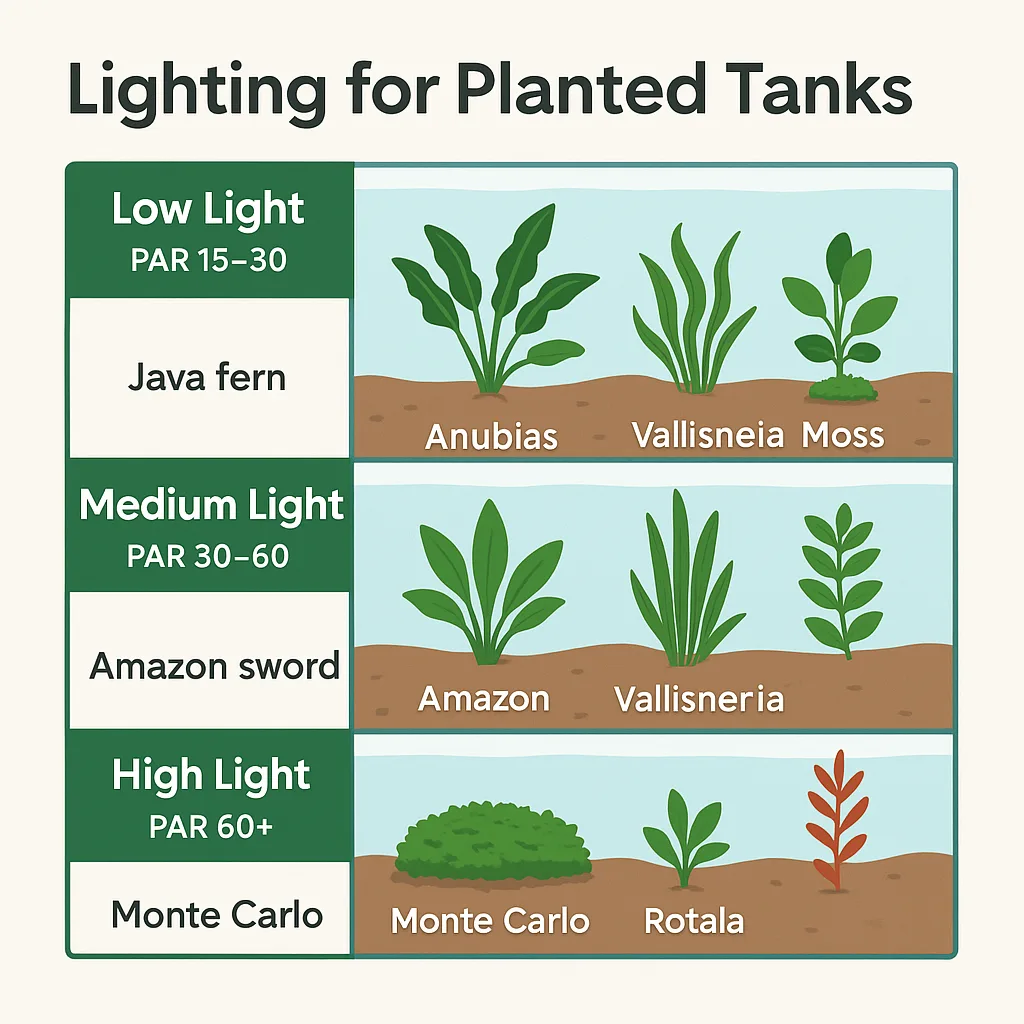
- Low light: PAR 15–30 (good for Java Fern, Anubias, Moss)
- Medium light: PAR 30–60 (Crypts, Amazon Swords, Val)
- High light: PAR 60+ (stems, carpets, CO₂-intensive setups)
Unfortunately, many cheap lights don’t list PAR values — and that’s a red flag. Brands that do (like Fluval, Chihiros, Twinstar, ONF, UNS) are usually worth the investment.
Light Intensity by Tank Depth
Light weakens the deeper it travels. That means tall tanks (like a 20g High) need stronger lights than shallow tanks (like a 20g Long).
- 🔹 10″–12″ depth: Low-to-medium light will reach most plants
- 🔹 16″–18″ depth: Need medium-to-high PAR to reach the substrate
- 🔹 24″+ depth: Consider high-power LEDs or supplemental lighting
How Long Should Aquarium Lights Stay On?
Many beginners run their lights too long — thinking more light = more growth. In reality, too much light = more algae. A consistent schedule is more important than long hours.
- Low light tank (no CO₂): 6–8 hours per day
- Medium light planted tank: 8 hours/day
- High light, CO₂-injected tank: 8–10 hours max, with precise fertilization
Pro Tip: Use a timer. Lighting should be automated — not based on memory or guesswork.
Best Aquarium Lights for Planted Tanks (2024)
These LED fixtures are highly rated by the planted tank community and deliver excellent PAR, color spectrum, and long-term reliability:
- 💡 Nicrew ClassicLED Plus: Budget-friendly, decent for low-light plants. Add root tabs and ferts.
- 💡 Fluval Plant 3.0: Fully programmable, great PAR, smartphone control. Suitable for medium-to-high light setups.
- 💡 Chihiros WRGB II: Color-accurate, intense output, customizable. One of the best values in mid-high setups.
- 💡 Twinstar Light III: Premium spectrum and sleek design. Ideal for serious aquascaping.
- 💡 Hygger Full Spectrum LED: Affordable alternative with good red/blue ratios for low-tech tanks.
Matching Light to Plant Types
Different plants need different lighting conditions. Here’s how to match your fixture to your flora:
- Low light (PAR 15–30): Java Fern, Anubias, Buce, Moss, Crypts
- Medium light (PAR 30–60): Amazon Sword, Vallisneria, Hygrophila, Rotala
- High light (PAR 60+): Dwarf Baby Tears, Monte Carlo, Red Ludwigia, carpeting plants
Do You Need CO₂ With High Light?
In a word — yes. The higher the light, the faster plants photosynthesize. Without enough CO₂ to match, they stall out, nutrients pile up, and algae takes over.
Rule of thumb: If you’re using a high-PAR light and growing stem plants or carpets, you need injected CO₂ or at least liquid carbon (like Seachem Excel).
Common Signs of Lighting Problems
- ☀️ Too much light: Algae blooms, especially green hair or black beard algae
- 🌫️ Too little light: Pale leaves, slow or no growth, melting stems
- ⚖️ Unbalanced spectrum: Plants stretch (leggy), poor coloration
Fix: Reduce photoperiod, reposition light, or upgrade to a better spectrum fixture.
Lighting and Algae – Finding Balance
Lighting alone doesn’t cause algae — but it plays a huge role. Algae thrives in unstable tanks with excess nutrients and uncontrolled lighting. To avoid outbreaks:
- Set consistent timer (6–8 hrs/day)
- Do regular water changes (25–30% weekly)
- Avoid overfeeding fish
- Keep plant biomass healthy and trimmed
Related Guides & Tools
- Beginner’s Guide to Aquarium Plants
- Fast-Growing Plants for Algae Control
- Fixing Common Plant Growth Problems
- Top Plant Mistakes to Avoid
Final Thoughts – Lighting Is the Engine of Growth
Your planted tank lives or dies by the quality of its light. It doesn’t have to be expensive or complicated — but it does need to be intentional. Match your light to your plants, keep your schedule consistent, and monitor growth over time. If you nail your lighting, the rest of your aquascape will follow.
Need help choosing the right light for your tank size or plant goals? Drop your tank specs in the comments — I’ll give you a custom lighting recommendation based on your setup.
Frequently asked questions
How much light do aquarium plants need?
It depends on the plants, and the useful measure is PAR (Photosynthetically Active Radiation), not watts. Low-light plants like Java Fern, Anubias, and moss grow at PAR 15 to 30; medium-light plants like Crypts, Amazon Swords, and Val want PAR 30 to 60; high-light carpets and stems need PAR 60 or more. Aim for a full-spectrum fixture around 6500K daylight color temperature.
How many hours should the aquarium light be on?
A low-light tank with no CO2 does well at 6 to 8 hours per day. Medium-light planted tanks run about 8 hours, and high-light CO2-injected tanks can go 8 to 10 hours max with precise fertilization. A consistent schedule matters more than long hours, so don’t assume more light means more growth.
What is the difference between low, medium, and high light?
The categories map to PAR ranges at the substrate. Low light is PAR 15 to 30 and grows easy plants like Anubias, Buce, and Crypts with no CO2 needed. Medium light is PAR 30 to 60 for swords and Vallis, and high light is PAR 60 and up, which only works long-term with CO2 injection and a full fertilizer routine.
Will more light cause algae?
Yes, if the light outpaces the CO2 and nutrients available. Plants can only use so much light, and the excess energy fuels algae instead. The fix is to match intensity and photoperiod to what your plants and CO2 setup can actually support, not to dim the light at random.
Do I need a special light or will any LED work?
A basic LED hood may keep low-light plants alive but often grows them slowly and leggy. Look for a full-spectrum fixture around 6500K that publishes its PAR values; many cheap lights hide PAR, which is a red flag. Brands like Fluval, Chihiros, Twinstar, and Nicrew list PAR and cover budgets from low-tech to high-tech aquascaping.
Should I use a timer?
Yes. Lighting should be automated so the photoperiod is identical every day rather than based on memory. A consistent on/off schedule keeps plant growth stable and helps prevent the algae blooms that come from erratic light hours. Most programmable LEDs have a timer built in, or you can use a simple plug-in outlet timer.
Author and editorial note
Written and maintained by Benjamin Thoden, founder of DBC Aquatics. This shrimp guide is reviewed through DBC Aquatics’ stability-first lens: cycle maturity, mineral consistency, molt safety, copper risk, grazing surfaces, and slow acclimation matter more than quick fixes. See our editorial standards for how guides are created, reviewed, and updated.
Beginner lighting schedule by tank type
Most lighting problems come from changing intensity and duration faster than plants can respond. Start conservative, watch new growth for two weeks, then adjust. More light without enough plant mass, nutrients, and CO2 usually means more algae, not better growth.
| Tank type | Starting photoperiod | Intensity target | Best for | Adjust if… |
|---|---|---|---|---|
| New low-tech planted tank | 6 hours | Low to moderate | Anubias, java fern, crypts, moss, floaters | Increase slowly only after plants show clean new growth. |
| Established low-tech tank | 7?8 hours | Moderate | Most beginner planted communities | Reduce if green dust, hair algae, or stressed slow plants appear. |
| High-tech CO2 tank | 6?8 hours | Medium to high PAR matched to CO2 | Carpets, red stems, dense aquascapes | Do not raise light until CO2 and fertilization are stable. |
| Algae recovery mode | 5?6 hours temporarily | Lower than normal | Tanks with algae pressure | Pair with manual removal, plant cleanup, and nutrient correction. |
PAR without a PAR meter
If you do not own a PAR meter, use plant response as your meter. Leggy stems and pale new growth can mean too little usable light or nutrients. Green spot algae, hair algae, and slow leaves getting covered often mean the light is too strong or too long for the current plant mass.
DBC adjustment rule
Change only one lighting variable at a time: duration, intensity, height, or spectrum. Give the tank 10 to 14 days before judging the result. Plants respond through new growth; algae often responds faster, which is why sudden big lighting upgrades can backfire.
Leave a Reply