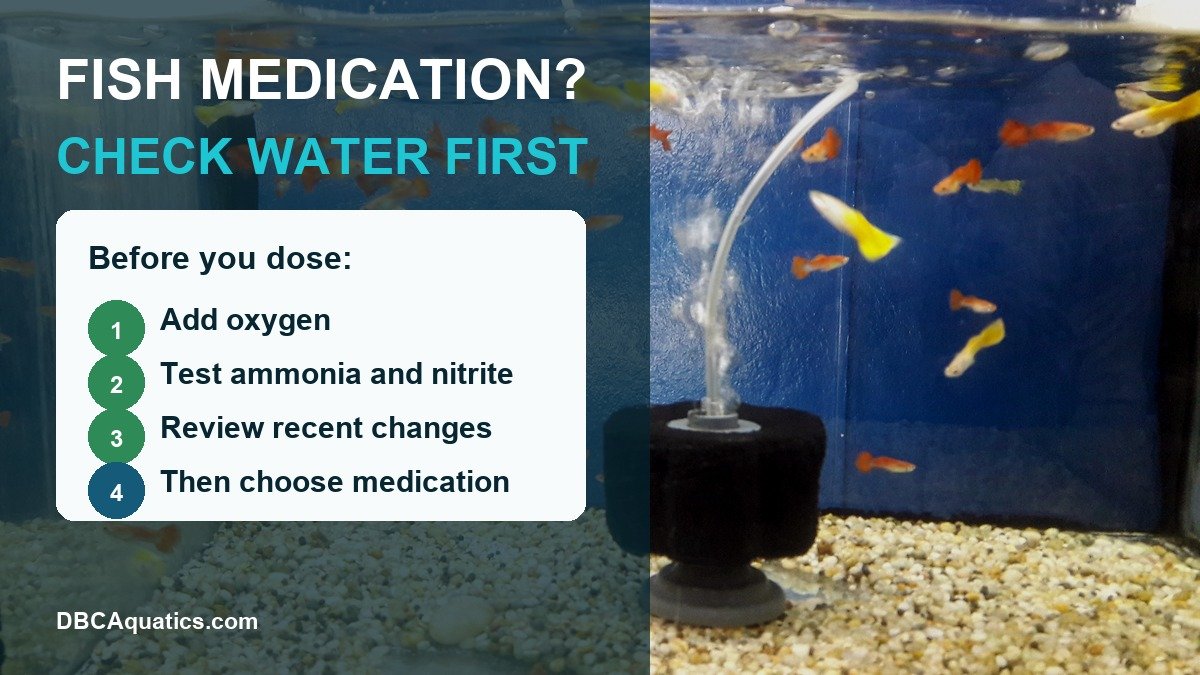
If your fish looks sick, I know how tempting it is to grab the first bottle of medication and dose the tank.
I have seen fishkeepers do it because they were scared.
The fish was breathing fast.
The fins were clamped.
The fish looked weak, pale, swollen, spotted, or just wrong.
And in that moment, medication feels like action.
Sometimes they are reacting to ammonia. Sometimes nitrite. Sometimes low oxygen. Sometimes chlorine, temperature shock, overfeeding, a recent filter cleaning, or a damaged biofilter.
If you medicate before you check those things, you can lose time, stress the fish harder, and treat the wrong problem while the real danger keeps moving.
So this guide is not just a list of fish medications.
It is a water-first medication decision guide.
A Real Rescue Example
This is the kind of mistake I see all the time.
A fish is clamped up, breathing hard, and sitting in one spot. The owner thinks, “That looks like fin rot,” so they reach for medication.
But when the water is finally tested, ammonia shows up.
At that point, the fish does not need a different bottle. It needs safer water, more oxygen, and a protected filter. Do the water rescue first. If the symptoms are still there after the tank is stable, then medication becomes part of the decision.
Quick Answer
Fish medication can help when the problem is parasites, ich, fungus, fin rot, bacterial infection, or internal disease.
But before you dose, check the things that can make fish look sick even when medication is not the answer:
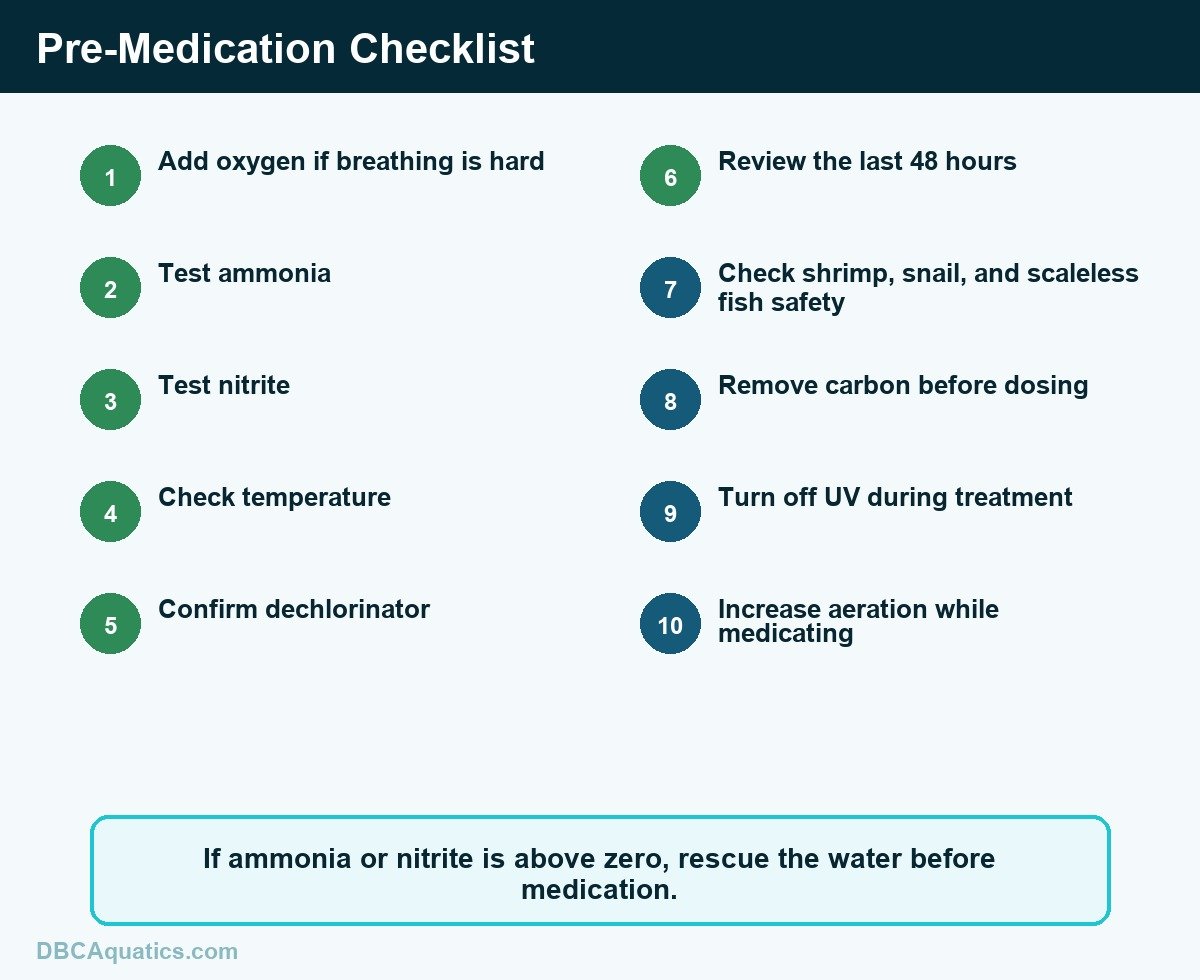
- Add oxygen and surface movement if fish are breathing hard.
- Test ammonia and nitrite.
- Check temperature.
- Confirm new water was dechlorinated.
- Review what changed in the last 48 hours.
- Look for disease signs after the tank checks are safe.
- Use a hospital tank when possible.
- Remove carbon and turn off UV before dosing most medications.
- Increase aeration during treatment.
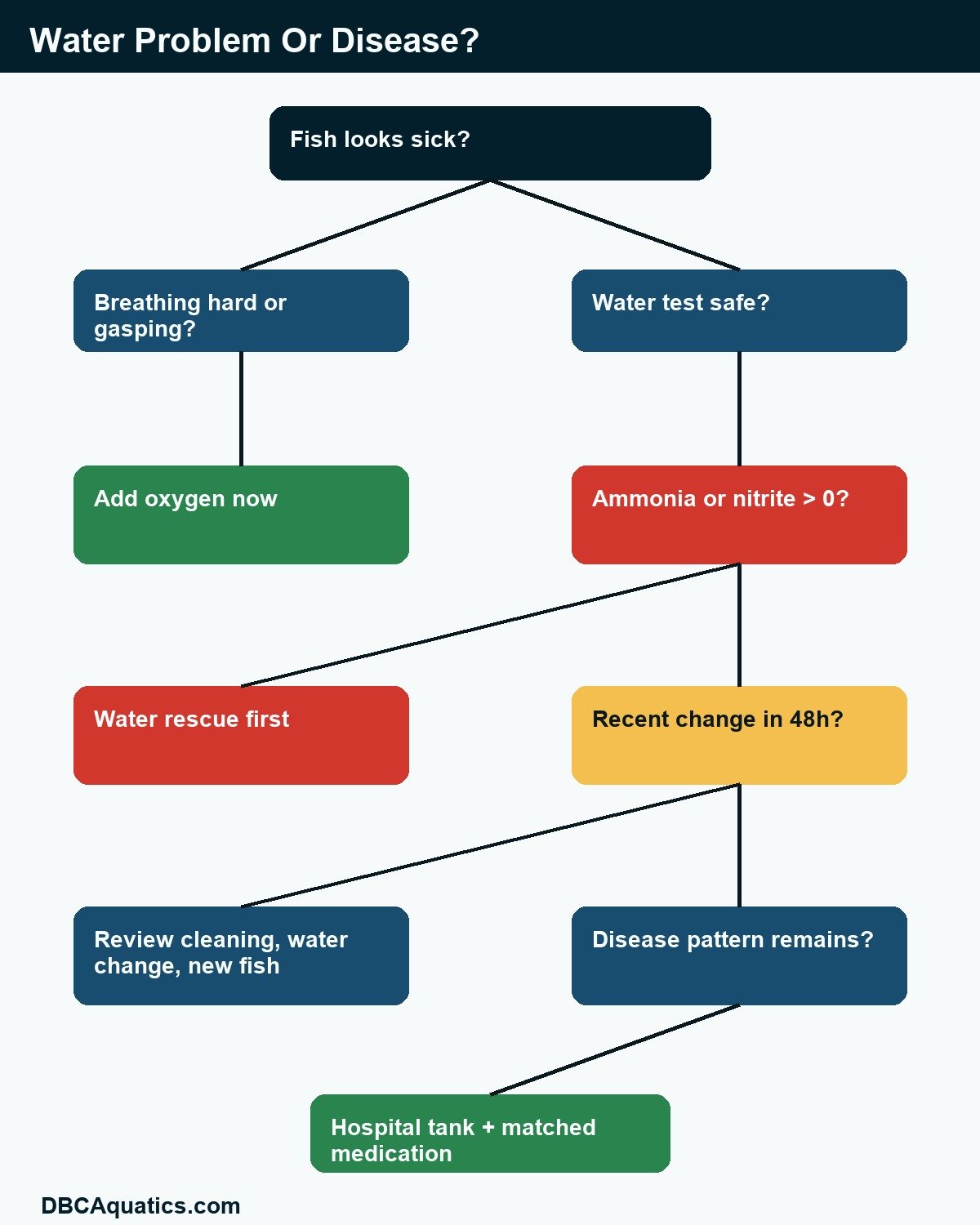
If ammonia or nitrite is above 0 ppm, start with the Water Quality Rescue Hub before medication.
If fish are gasping at the surface, start with oxygen and the fish gasping rescue guide.
If the fish got worse after cleaning the tank or filter, use the fish dying after cleaning guide before you assume disease.
Bottom Line
Medication is not the first step.
Your fish doesn’t care whether the bottle says “Ich” or “Fin Rot.” It cares whether you’re solving the right problem.
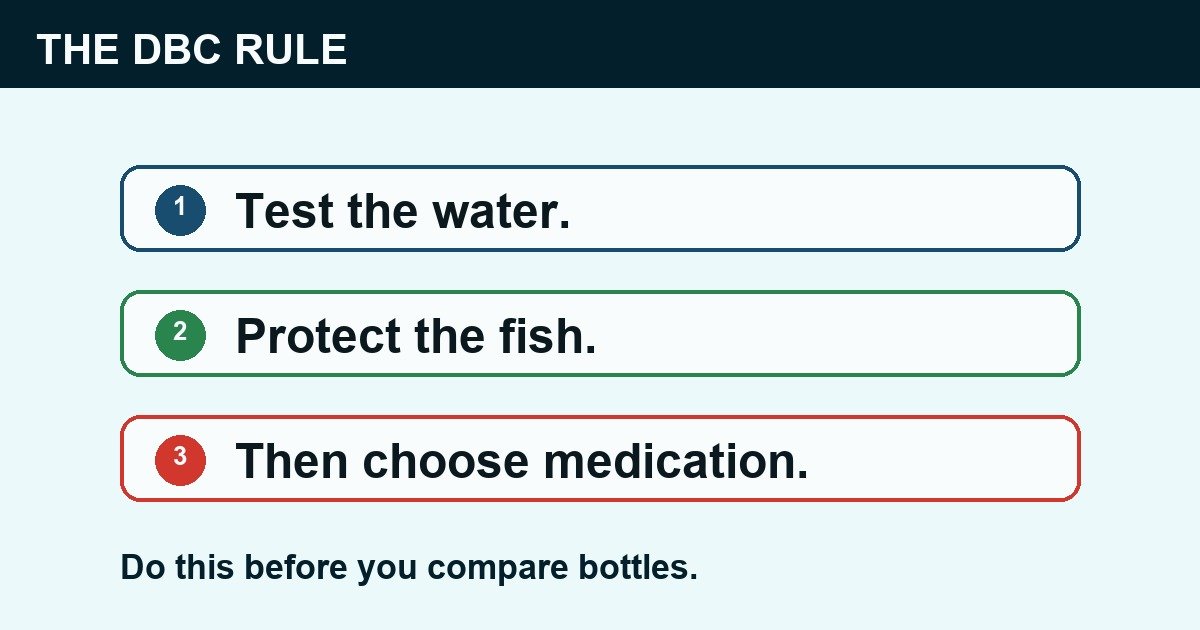
> THE DBC RULE > > Test the water. > > Protect the fish. > > Then choose medication.
Diagnosis is the first step.
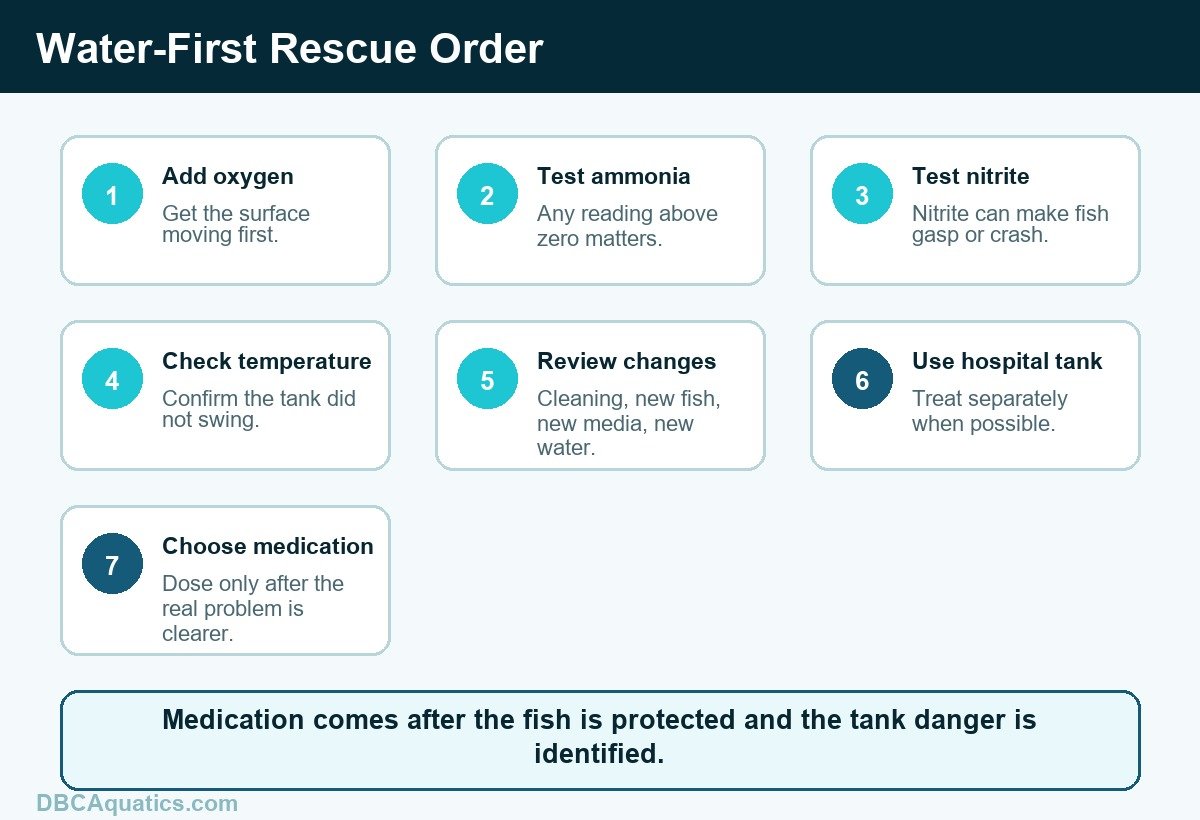
The safest order is:
Oxygen
-> Ammonia and nitrite test
-> Temperature and chlorine check
-> Recent change review
-> Symptom pattern
-> Hospital tank if possible
-> Medication choice
That order protects the fish from the most common mistake I see: treating symptoms before checking the tank.
The First 10 Minutes Before You Medicate
If your fish looks sick right now, do not start by comparing medication bottles.
Start here.
1. Get Oxygen Moving
If fish are gasping, breathing fast, hanging near the surface, sitting near the filter outlet, or acting weak, improve surface movement first.
Point the filter return toward the surface.
Add an air stone if you have one.
Open the lid if the tank is warm and safe to do so.
Oxygen will not cure ich, fin rot, or parasites. But it can buy time while you test the water.
2. Test Ammonia And Nitrite
Ammonia and nitrite should be 0 ppm.
If either one is above zero, medication is not the first rescue move.
| Test Result | What It Means | First Move |
|---|---|---|
| Ammonia above 0 ppm | Fish gills may be irritated or burned | Add oxygen, prepare a safe partial water change, and use the ammonia spike emergency guide |
| Nitrite above 0 ppm | Fish may struggle to use oxygen normally | Add oxygen, reduce nitrite safely, use the nitrite poisoning rescue guide, and avoid adding more stress |
| Both are 0 ppm | Disease, injury, bullying, temperature, chlorine, or recent changes become more likely | Continue diagnosis before choosing medication |
Clear water does not prove safe water.
3. Check Temperature
Look at a thermometer, not just the heater setting.
Ask:
- Did the heater fail?
- Did the heater stick on?
- Did the room temperature swing?
- Did a water change add colder or warmer water?
Temperature shock can make fish clamp fins, hide, breathe harder, or sit near the bottom.
4. Check Chlorine Or Dechlorinator Mistakes
If symptoms appeared after a water change, confirm the new water was conditioned correctly.
Chlorine or chloramine exposure can look like sudden illness because the gills are affected.
Do not assume parasites if the timing points to a water-change mistake.
5. Ask What Changed In The Last 48 Hours
This question solves a lot of aquarium mysteries.
Ask yourself:
- Did I clean the filter?
- Did I replace filter media?
- Did I do a large water change?
- Did I add new fish?
- Did I add new plants or decor?
- Did I overfeed?
- Did the power go out?
- Did the tank get warmer than usual?
If several fish look bad at the same time, think tank problem first.
If one fish is affected while the rest look normal, disease, injury, bullying, age, or internal problems become more likely.
What Not To Do
Do not panic-dose the display tank because one fish looks off.
Do not mix medications unless the product label or a qualified aquatic professional specifically supports that combination.
Do not ignore ammonia or nitrite because the fish has visible symptoms.
Do not leave activated carbon in the filter while dosing most water-column medications.
Do not run UV sterilizers during most medication treatments unless the medication label says it is safe.
Do not stop treatment early just because the fish looks better after one day.
Do not treat a water-quality problem like disease.
That last one is the big one.
Many sick-looking fish are not asking for medicine first.
They are asking you to fix the water, oxygen, or stress first.
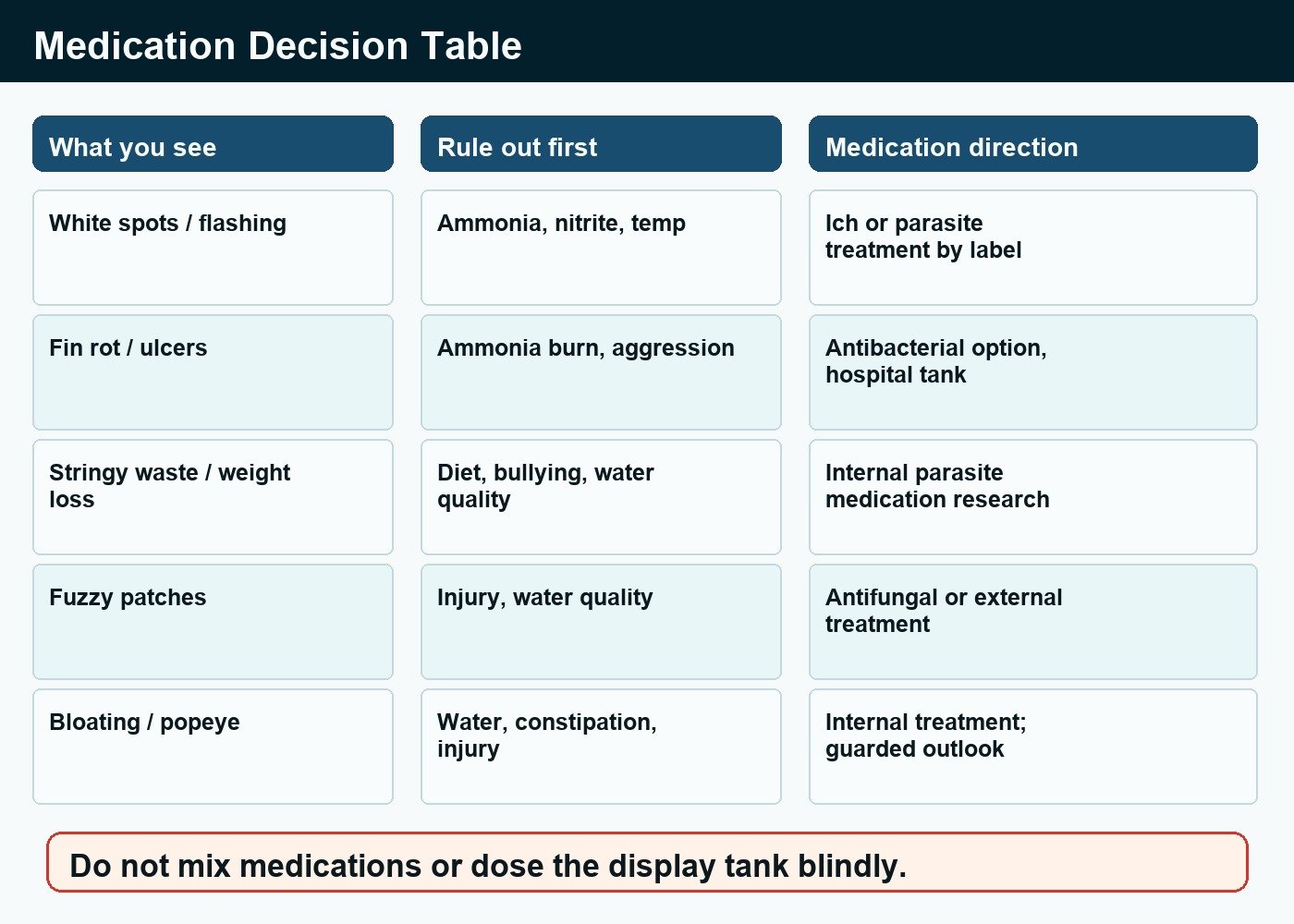
Medication Decision Table
Use this table after the first water and oxygen checks.
This is not veterinary advice. It is a practical fishkeeping decision guide so you know what to research and what to avoid.
| What You See | Rule Out First | Medication Direction To Research | What Not To Do |
|---|---|---|---|
| White salt-like spots, scratching, rapid spread | Temperature swings, ammonia, nitrite, and recent stress | Ich treatment such as Ich-X style products, following label directions | Do not stop treatment as soon as spots vanish; the parasite cycle may still continue |
| Dusty gold coating, flashing, rapid breathing | Low oxygen, ammonia, nitrite, and velvet-like stress signs | Velvet/parasite treatment options; consider hospital tank and strong aeration | Do not treat in a shrimp/snail tank without checking invert safety |
| Stringy waste, weight loss, worms, bloating | Starvation, bullying, poor diet, water quality | Internal parasite medication such as praziquantel/metronidazole-based options where legal and appropriate | Do not dose the whole display tank blindly if one fish can be isolated |
| Fin rot, cloudy edges, ulcers, cotton mouth | Ammonia burn, nitrite stress, aggression, torn fins | Antibacterial treatment matched to symptoms, such as Maracyn/Kanaplex-style products where appropriate | Do not mix antibiotics casually or dose without oxygen and water monitoring |
| Pineconing, severe bloating, popeye, lethargy | Water quality, constipation, organ failure, injury | Internal bacterial treatment may be researched, ideally in a hospital tank | Do not promise recovery; severe internal symptoms can be difficult to reverse |
| Fuzzy patches or mouth fungus | Injury, water quality, secondary infection | Antifungal or broad external treatment depending on exact signs | Do not assume every white patch is fungus; ich and injury can look different |
The Core Fish Medications To Understand
You do not need a giant medicine cabinet.
You need to understand what each type of medication is for, when it makes sense, and what must be checked before you use it.
1. Seachem ParaGuard
Best researched for:
- External parasites
- Some fungus-like problems
- Mild external bacterial issues
Possible signs:
- Flashing
- Rubbing
- Early fin damage
- External irritation
- Some surface-level fungal issues
What to check first:
- Ammonia
- Nitrite
- Oxygen
- Recent cleaning or water change
Safety notes:
- Often considered gentler than harsher parasite treatments, but still read the label.
- Best used in a hospital tank when possible.
- Not the answer for internal parasites.
2. API General Cure Or Similar Internal Parasite Medication
Best researched for:
- Internal parasites
- Protozoan issues
- Worm-like symptoms depending on active ingredients and local availability
Possible signs:
- Stringy waste
- Weight loss
- Bloated belly
- Scratching
- Eating but losing condition
What to check first:
- Is the fish being bullied away from food?
- Is the diet poor?
- Is water quality safe?
- Are only one or two fish affected?
Safety notes:
- Internal problems often respond better when food-based treatment is appropriate, but follow product directions.
- Quarantine is usually cleaner than dosing the entire display tank.
3. Fritz Maracyn Or Similar Bacterial Medication
Best researched for:
- Some gram-positive bacterial infections
- Early fin rot
- Cotton mouth style symptoms
- Some ulcers or external bacterial signs
Possible signs:
- Ragged fins that keep worsening
- White mouth patches
- Red sores
- Popeye in some cases
What to check first:
- Ammonia burn
- Nitrite stress
- Aggression
- Torn fins from decor or bullying
Safety notes:
- Antibiotics are not casual aquarium vitamins. Do not use antibiotics “just in case”; use them only when bacterial disease is reasonably suspected, avoid unnecessary or repeated antibiotic use, and follow product-specific instructions and species/invertebrate safety guidance.
- Use strong aeration.
- Watch ammonia during treatment.
- Do not mix antibiotics without a clear reason.
4. Ich-X Or Similar Ich Treatment
Best researched for:
- Ich
- Some protozoan issues
- Some velvet or fungal-type situations depending on the product and diagnosis
Possible signs:
- White salt-like spots
- Fish rubbing against objects
- Rapid spread through the tank
- Clamped fins and irritation
What to check first:
- Temperature
- Stress trigger
- Recent new fish
- Ammonia and nitrite
Safety notes:
- Many ich medications require extra aeration.
- Some are not safe for shrimp, snails, or scaleless fish.
- Follow the label carefully and complete the course.
5. Seachem Kanaplex Or Similar Internal Bacterial Medication
Best researched for:
- Some internal bacterial infections
- Dropsy-like symptoms
- Popeye
- Cloudy eyes in some situations
Possible signs:
- Pineconing
- Severe bloating
- Popeye
- Lethargy
- Not eating
What to check first:
- Ammonia
- Nitrite
- Constipation
- Injury
- Long-term poor conditions
Safety notes:
- Severe internal symptoms can be hard to reverse.
- Hospital tank treatment is usually safer.
- Do not promise yourself medication will fix a fish that is already deeply compromised.
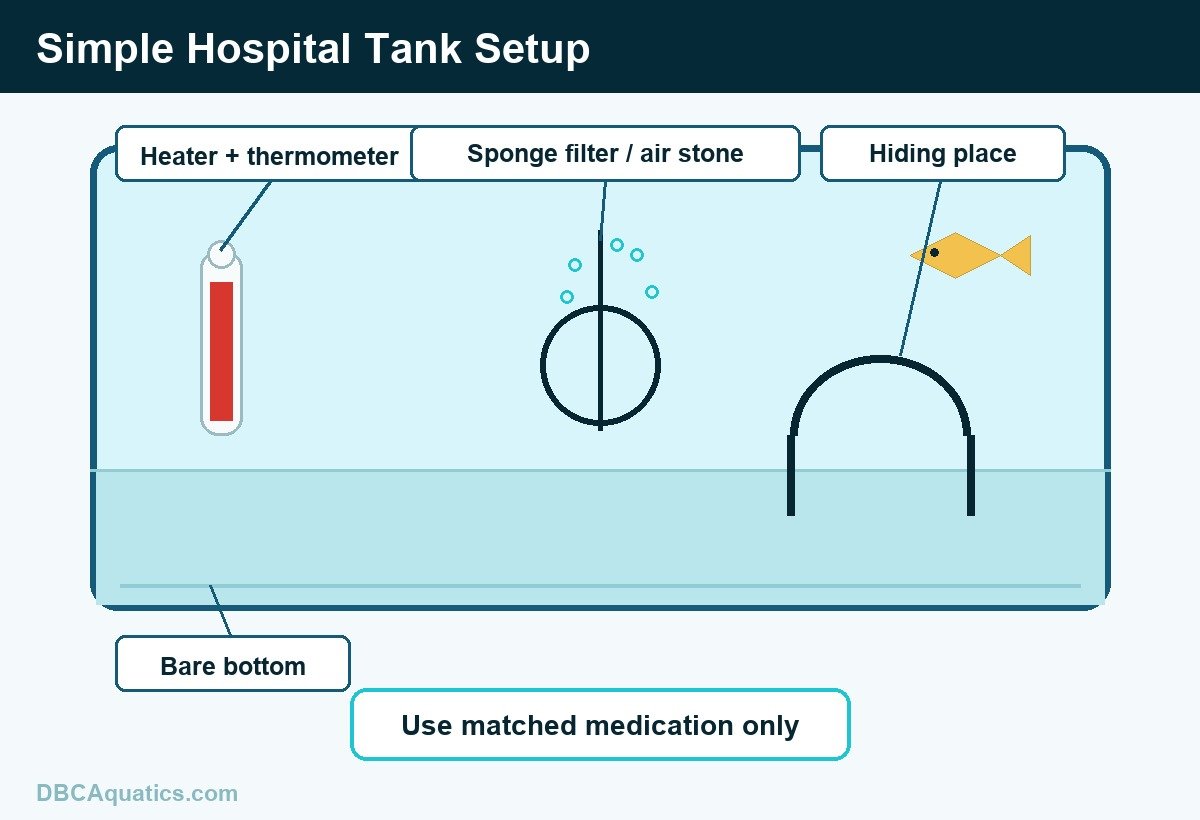
Hospital Tank Guidance
A hospital tank does not need to be fancy.
It needs to be safe, clean, heated if needed, and easy to observe.
Basic hospital setup:
- Clean container or small tank
- Heater if the species needs stable warm water
- Air stone or sponge filter
- Dechlorinated water
- Hiding place that will not absorb medication
- Lid or cover if the fish jumps
- Test kit nearby
Why use one?
- You can dose less medication.
- You protect shrimp, snails, plants, and beneficial bacteria in the display tank.
- You can watch one fish more closely.
- You reduce the risk of treating healthy fish unnecessarily.
Do not move a fish into a hospital tank if the move itself would be more stressful than the treatment.
If the fish is barely upright, gasping hard, or already crashing, stabilize oxygen and water first.
Carbon, UV, And Aeration Notes
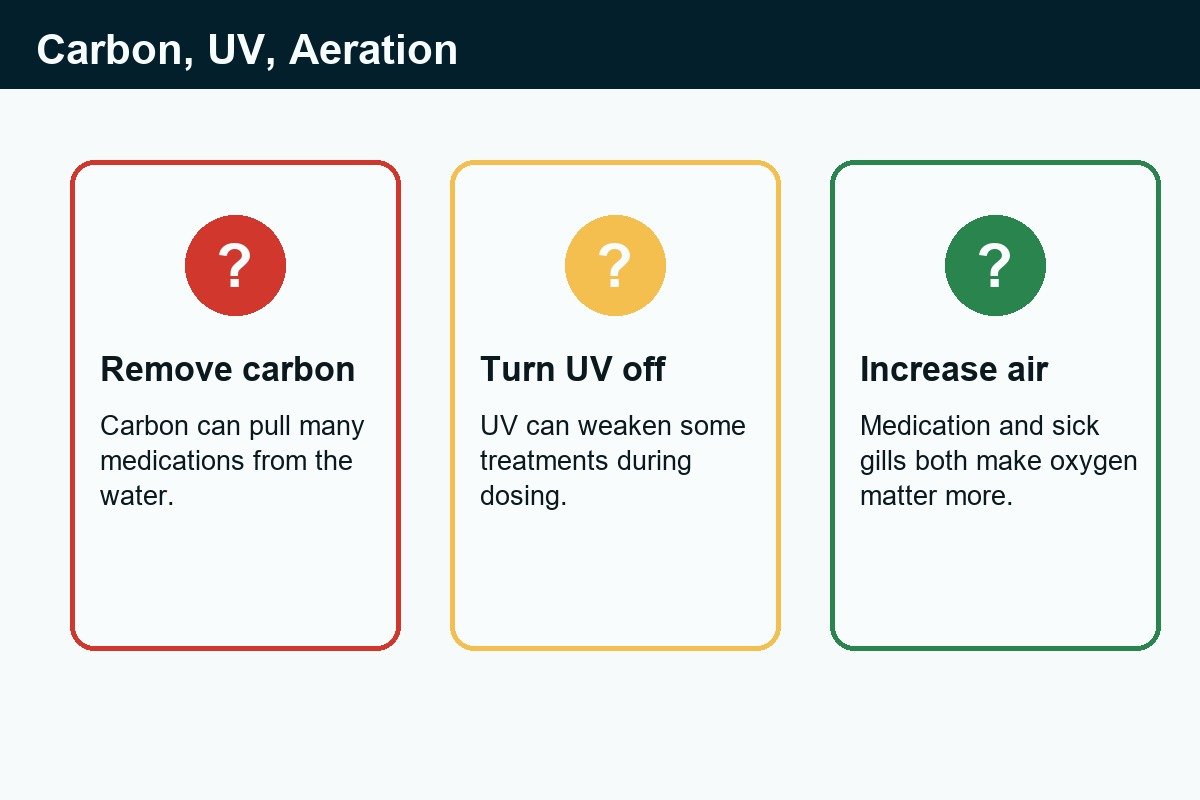
Activated carbon can remove medication from the water.
That means the tank may never receive the intended dose.
In most medication treatments, remove carbon before dosing and replace it after treatment is finished if you want to clear the medication.
UV sterilizers can also interfere with some medications.
Turn off UV during treatment unless the medication label clearly says otherwise.
Aeration matters because many medications reduce oxygen availability or add stress.
During treatment, I want more surface movement, not less.
If fish are already breathing hard, do not make oxygen the afterthought.
Shrimp, Snails, Plants, And Scaleless Fish
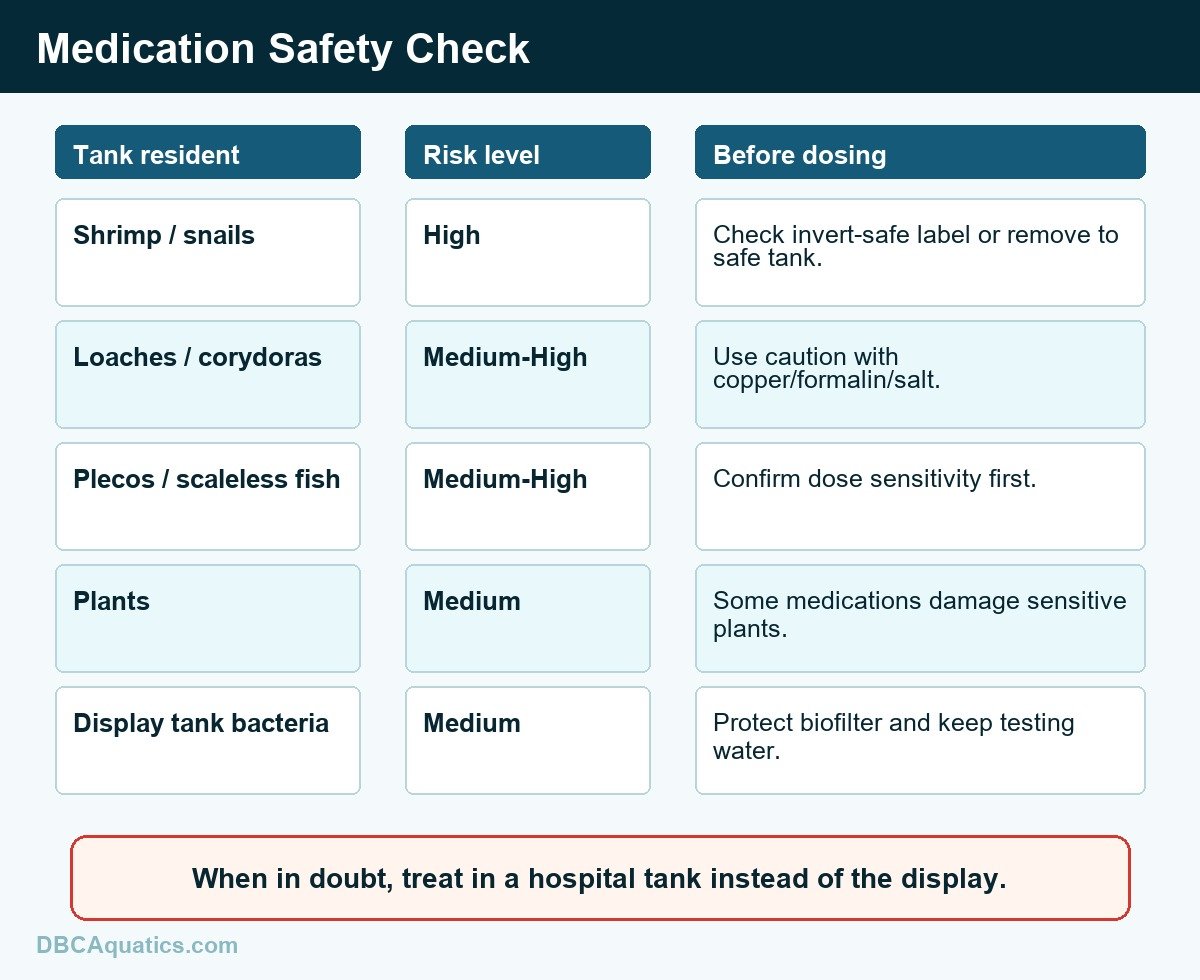
This is where many fishkeepers get into trouble.
Some medications that are fine for many fish can be dangerous for:
- Shrimp
- Snails
- Loaches
- Corydoras
- Plecos
- Other scaleless or sensitive fish
- Some plants
- Beneficial bacteria
Read the label before dosing the display tank.
If the tank has inverts or sensitive fish, a hospital tank is usually the safer route.
If the product says not safe for invertebrates, believe it.
When Medication Makes Sense
Medication makes more sense when:
- Ammonia is 0 ppm.
- Nitrite is 0 ppm.
- Temperature is stable.
- New water was conditioned.
- Oxygen is adequate.
- The filter is running.
- The symptom pattern points to disease.
- The fish can handle treatment.
- You know whether the main tank or hospital tank is safer.
Medication makes less sense when:
- Several fish suddenly act sick after a water change.
- Fish are gasping after filter cleaning.
- Ammonia or nitrite is above zero.
- The tank smells bad or looks unstable.
- You recently replaced filter media.
- You are guessing because the fish simply looks “off.”
If You Still Are Not Sure
Use the DBC Fish Symptoms Checker if you can see the symptom but do not know what it means.
Start at the Aquarium Rescue Hub if multiple things are happening at once.
If the fish are gasping, go to the fish gasping rescue guide.
If ammonia is showing, use the ammonia spike emergency guide.
If this started after cleaning, use the fish dying after cleaning guide.
Pre-Medication Checklist
Before you dose, make sure you can answer these:
| Question | Why It Matters |
|---|---|
| Is ammonia 0 ppm? | Ammonia can mimic disease and damage gills |
| Is nitrite 0 ppm? | Nitrite can interfere with oxygen use |
| Is the fish breathing normally? | Low oxygen can make treatment harder |
| Did anything change in the last 48 hours? | Recent changes often reveal the real cause |
| Is the medication safe for my fish, shrimp, snails, and plants? | Some treatments are not safe for every tank |
| Should I use a hospital tank? | It often protects the display tank |
| Did I remove carbon and turn off UV? | Carbon and UV can reduce medication effectiveness |
| Do I understand the full treatment course? | Stopping early can let the problem return |
If you want the rescue order in one place, use the Aquarium Survival Checklist.
Aquarium Rescue Blueprint CTA
If your tank keeps bouncing from one emergency to the next, the Aquarium Rescue Blueprint gives you the full recovery path after you get through the immediate problem.
That is the key.
Do the immediate rescue first.
Then build the system that helps you avoid needing medication as often.
Frequently Asked Questions
Should I medicate fish before testing ammonia and nitrite?
No. Test ammonia and nitrite first when possible.
If either one is above 0 ppm, treat the tank like a water-quality emergency before you treat it like a disease problem. Medication does not fix ammonia or nitrite.
Can fish medication make low oxygen or ammonia problems worse?
It can make the situation harder on the fish.
Medication adds stress, and some treatments reduce oxygen or affect the biofilter. If oxygen is already low or ammonia is already irritating the gills, the fish may struggle more during treatment.
When should I move a sick fish to a hospital tank?
Use a hospital tank when one fish needs treatment, the display tank contains shrimp/snails/sensitive fish, or the medication could harm plants, filter bacteria, or healthy tankmates.
Do not move the fish if the move itself is likely to be more stressful than stabilizing the display tank first.
What should I remove from the filter before dosing medication?
In most cases, remove activated carbon and similar chemical media because they can pull medication out of the water.
Turn off UV sterilizers unless the product label says otherwise.
Keep biological media wet and running. Do not throw away your beneficial bacteria during a medication panic.
How do I avoid mixing medications that should not be combined?
Read the labels and do not stack products casually.
If one medication is already in the water, finish the course or remove it according to label directions before starting another. Mixing medications can stress fish, reduce oxygen, or create unsafe combinations.
What if only one fish is sick?
If one fish is sick and the rest look normal, a hospital tank often makes sense.
Still test the main tank. One sick fish can be disease, injury, bullying, age, or an early warning that the tank is starting to slip.
What if all the fish look sick at once?
Think tank problem first.
Several fish acting sick at the same time often points to oxygen, ammonia, nitrite, chlorine, temperature, contamination, or a recent tank change.
Medication may still be needed later, but start with water and oxygen.
Final Takeaway
Fish medication can save fish when the diagnosis is right.
But the safest fishkeepers do not dose first and ask questions later.
They stabilize the tank.
They test the water.
They check oxygen.
They look at what changed.
Then they choose the treatment that actually matches the problem.
Most fishkeepers reach for medication because they care.
The goal is to turn that care into the right next action.
Author and editorial note
Written and maintained by Benjamin Thoden, founder of DBC Aquatics. This medication-decision guide is reviewed through DBC Aquatics’ water-first rescue lens: oxygen, ammonia, nitrite, temperature, recent changes, symptom pattern, hospital-tank context, label directions, species and invertebrate safety, and medication only when the evidence supports it. See our editorial standards for how guides are created, reviewed, and updated.
Leave a Reply