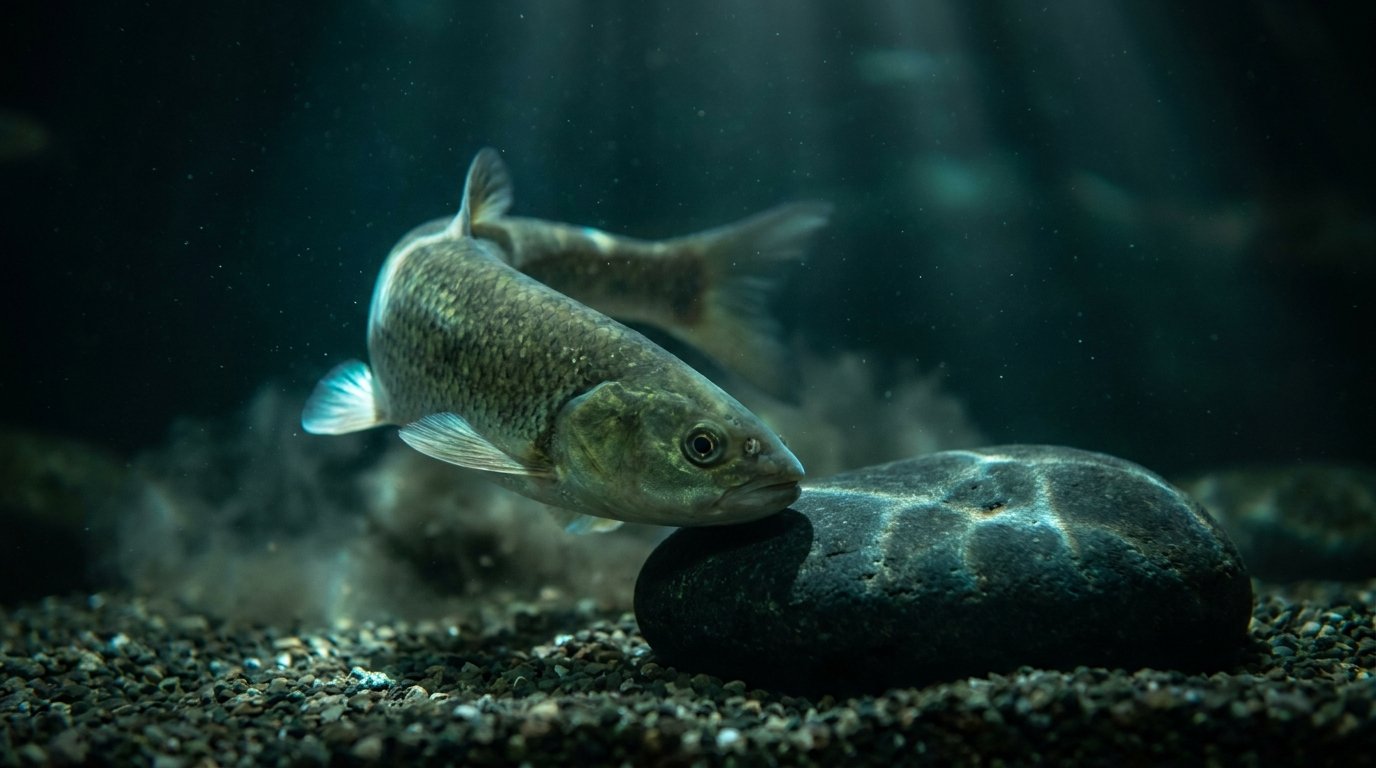
Quick answer: Flashing — a fish rubbing or scratching its body against surfaces — is a sign of gill or skin irritation, not a diagnosis. The two most common causes are invisible parasites (like ich, which irritates for days before white spots appear) and ammonia or nitrite burning the gills in clear water. Test your water before dosing any medication.
You walked past the tank and caught it out of the corner of your eye: one of your fish suddenly bolting sideways, scraping its flank against the gravel, then darting off as if nothing happened. A minute later it does it again, this time grinding its gills against a rock. This behaviour is called flashing, and if your stomach just dropped, take a breath. You are watching the earliest warning sign a fish can give you, which means you have caught the problem early enough to fix it.
Here is the single most important thing right now: do not pour ich medication into the tank. Flashing is a symptom of irritation, not a diagnosis, and the most common cause is not a parasite at all. Reaching for the meds before you test your water is the mistake that kills more flashing fish than the irritation itself. Stabilise first. Diagnose second. Treat last.
What flashing actually looks like
Flashing is a fast, deliberate scratch. A fish twists its body and rubs a specific surface against something solid: substrate, driftwood, plants, a heater, the glass, or the filter intake. The classic version is a quick “flash” of the pale belly as the fish rolls to one side mid-dart, which is where the name comes from. It is over in under a second, and a healthy fish in clean water does it almost never.
The number is what matters. An occasional single scratch over a whole day is within normal range. Repeated flashing, more than two or three times in a few minutes, or any fish that keeps targeting its gill covers, is abnormal and is a signal. Watch for the company it keeps: clamped fins held tight against the body, rapid gill movement, hanging near the surface or the filter outflow, hiding, or a faint film or excess slime on the skin. Note which fish, how often, and what they rub. You are gathering evidence, not panicking.
The hidden danger most owners miss
Flashing is the body’s response to something irritating the skin or gills, and the two surfaces share the same delicate, exposed tissue. That tissue gets attacked in two completely different ways that look identical from the front of the glass, and confusing them is how good fish die.
The first hidden danger is the parasite that is not visible yet. White spot disease (ich, Ichthyophthirius multifiliis) does not start as spots. It starts as microscopic parasites burrowing into the gills and skin, and the fish flashes for days before the first white grain ever appears. By the time you see spots, the infection is mature and the gills are already damaged. “No spots means no ich” is one of the most dangerous myths in the hobby. Flashing with no visible spots can absolutely be early ich, and it can also be flukes, which never produce spots at all.
The second hidden danger is water you cannot see anything wrong with. Ammonia and nitrite chemically burn gill tissue, and they do it in a crystal-clear tank with zero parasites. The fish flashes because its gills are inflamed and stinging, exactly the same behaviour as a parasite would cause. This is why so many owners dose ich meds, see no improvement, dose again, and lose the fish: the real problem was a number on a test kit, not a bug.
Ich flashes for 3 to 6 days before the first white spot appears, and the parasite is only killable in its free-swimming theront stage, which at 25C lasts roughly 24 to 48 hours before it must find a host. Treating early, during the flashing window, is the difference between catching it and chasing it.
Fish Flashing: Symptom-to-Solution
| What you see | Most likely cause | What to test | Immediate action | Long-term fix |
|---|---|---|---|---|
| Flashing, water looks clear, recent new tank / new fish / overfeeding / filter change | Ammonia or nitrite burn (gill irritation) | Ammonia, nitrite, pH, temperature | 25-50% dechlorinated water change; stop feeding | Finish cycling the tank; never clean filter media in tap water |
| Flashing for days, then tiny white grains like salt on fins and body | Ich (white spot), now mature | Confirm all water params first to rule out toxins | Raise temp slowly toward 28-30C if species allows; treat free-swimming stage | Quarantine new fish 2-4 weeks before adding them |
| Flashing plus very rapid gill movement or gasping, no spots | Gill flukes or ammonia burning the gills | Ammonia, nitrite first; then inspect gills | Water change to relieve gills; improve oxygen / surface agitation | Quarantine; targeted anti-fluke treatment only after testing |
| Flashing started right after a water change | pH or temperature swing, or chlorine/chloramine | Compare tap vs tank pH and temp; check dechlorinator was used | Match new water to tank temp; always dechlorinate | Pre-treat and temperature-match all top-up water |
| Flashing plus clamped fins, hiding, dull colour, low appetite | General water-quality stress | Full set: ammonia, nitrite, nitrate, pH | Partial water change; reduce stocking/feeding load | Regular weekly water changes and stable parameters |
| Flashing in a high-pH tank, mostly the newly added fish | Un-ionised ammonia spike (more toxic at high pH) | Ammonia plus pH together (read them as a pair) | Water change; do not chase pH with chemicals | Acclimate and stock slowly; let biofilter keep ammonia at 0 |
The top causes, at the mechanism level
Ammonia is the cause owners underestimate most, because the test number hides its real danger. Ammonia in water exists in two forms: ionised ammonium (NH4+), which is relatively harmless, and un-ionised ammonia (NH3), which is highly toxic and burns gills directly. The balance between them swings hard with pH and temperature. At pH 7.0 almost all of it is the safe form; at pH 8.0 the toxic fraction is roughly ten times higher, and warmer water pushes it higher still. That is why two tanks reading the same “0.5 ppm total ammonia” can have wildly different outcomes, and why a high-pH tank with new fish is on the danger list. If your test shows any ammonia at all, treat it as a chemistry emergency, not a nuisance. Our ammonia and nitrite poisoning guide walks through the exact thresholds.
Nitrite is the next domino, and it attacks from the inside. Nitrite crosses the gills and binds to haemoglobin, converting it to methemoglobin, which cannot carry oxygen. This is methemoglobinemia, the so-called “brown blood disease.” The fish is effectively suffocating in fully oxygenated water, so it flashes, hangs at the surface, and breathes fast. If your flashing fish is also gasping or hanging near the surface, nitrite or ammonia jumps to the top of your suspect list, well ahead of any parasite.
Only when the water is genuinely clean do parasites move to the front. Ich has a temperature-dependent life cycle: it speeds up dramatically as the tank warms, completing in about a week at 25C but in just a few days near 30C. It is only vulnerable to treatment in its free-swimming theront stage, because the feeding stage on the fish and the cyst stage in the substrate are both shielded. This is the science behind the classic heat method: warming the tank forces the parasite through its protected stages faster, exposing more theronts to treatment in less time. Flukes, by contrast, are flatworms that clamp onto gills and skin and never produce spots, which is why “flashing with rapid breathing but no spots” so often turns out to be flukes rather than ich. To work through these side by side, the Fish Symptoms Checker matches your exact combination of signs to the likeliest cause.
Finally, the water change itself can be the trigger. Tap water can swing the tank’s pH or temperature in minutes, and a sudden shift of even a few degrees or a fraction of a pH point will make fish flash from osmotic and respiratory stress. Worse, untreated tap water carries chlorine or chloramine, which is corrosive to gill tissue at the concentrations coming out of your faucet. If flashing started within an hour of your last water change, you are almost certainly looking at a temperature mismatch, a pH swing, or a missed dose of dechlorinator, not a disease. A reliable test kit and thermometer turn this from guesswork into a five-minute answer.
What to do in the first 10 minutes
Work this order. Do not skip ahead to treatment, no matter how tempting.
- Observe and count. Which fish, how often, what surfaces? Note any white spots, rapid gill movement, clamped fins, or surface-hanging. Spend two full minutes watching before you touch anything.
- Test the water. Ammonia, nitrite, nitrate, and pH, with a liquid kit if you have one. Read ammonia and pH together; the higher the pH, the more dangerous any ammonia reading is.
- Check the temperature. Confirm it is stable and correct for your species, and recall whether it changed recently or right after a water change.
- If toxins are present, do a partial water change. Change 25-50% with temperature-matched, dechlorinated water. This is the single fastest way to relieve burning gills and buys your fish time.
- Only then consider treatment. If the water is genuinely clean and stable, and signs point to a parasite, treat the most likely cause deliberately, not a shotgun of every medication at once.
What NOT to do
Do not dose ich medication before testing. If the real cause is ammonia or nitrite, the meds do nothing for the burn, and many parasite treatments reduce oxygen or stress the biofilter, making a water-quality problem worse.
Do not stack multiple medications at once. Mixing treatments can be toxic, crashes your beneficial bacteria, and leaves you with no idea what helped or harmed. One deliberate intervention at a time.
Do not do a giant water change with cold, untreated tap water. You will swap one stressor for two: a temperature swing and a chlorine hit. Match the temperature and always dechlorinate.
Do not assume “no spots” means “no parasite.” Early ich and gill flukes both cause flashing with no visible spots. Absence of spots rules nothing out. If you are losing fish or the situation is escalating, our emergency rescue guide covers the next steps.
Fish Flashing FAQ
My fish is flashing but there are no white spots. Is it still ich?
It can be. Ich begins as microscopic parasites in the skin and gills, and fish typically flash for 3 to 6 days before the first white spot appears. No spots does not rule out ich, and it never rules out gill flukes, which cause flashing without any spots at all. Test your water first, because ammonia and nitrite cause identical flashing in a clear tank.
Can perfectly clear water still make a fish flash?
Yes. Ammonia and nitrite are invisible and chemically burn gill tissue, causing flashing in water that looks spotless. This is why testing the water comes before any medication. A liquid test kit reading even 0.25 ppm ammonia is enough to irritate gills, especially in a high-pH tank.
Should I add ich medication right away to be safe?
No. Dosing blindly is the most common fatal mistake. If the cause is water chemistry, the medication does nothing for the burn and can lower oxygen or harm your biofilter, making things worse. Test the water and observe first, then treat only the most likely cause.
My fish started flashing right after a water change. What happened?
Almost always a temperature swing, a pH shift, or missed dechlorinator. Tap water can change the tank’s pH or temperature within minutes, and chlorine or chloramine corrodes gills. Match new water to tank temperature and always use a dechlorinator before adding it.
How fast do I need to act on flashing?
Quickly, but calmly. Flashing is the earliest warning sign, which means you have a head start. Test the water within minutes and do a partial water change the same day if toxins are present. If it is early ich, the flashing window is your best chance to treat before the infection matures.
Does raising the temperature cure flashing?
Not by itself. Raising temperature only helps with ich, by speeding the parasite through its protected stages so it spends more time in the treatable free-swimming stage. It does nothing for ammonia, nitrite, or chlorine, and warmer water actually makes ammonia more toxic. Diagnose the cause before changing temperature.
Recommended gear
Liquid Water Test Kit
Flashing is often ammonia or nitrite burning the gills, not parasites. Test before you treat — a liquid kit tells you the truth in minutes.
Check price Affiliate linkContinue Your Diagnosis
- Fish Symptoms Checker — find the cause fast
- Aquarium Rescue Hub
- Ammonia & Nitrite Poisoning
- Aquarium Rescue Blueprint — the exact rescue system
Educational guidance, not veterinary advice.
Author and editorial note
Written and maintained by Benjamin Thoden, founder of DBC Aquatics. This plant guide is reviewed for low-tech practicality: correct placement, light level, substrate or rhizome needs, melt risk, algae pressure, and what a beginner can maintain consistently. See our editorial standards for how guides are created, reviewed, and updated.
Related Rescue Guides
How Overfeeding Quietly Kills Aquarium Fish
Overfeeding rarely kills fish at the dinner table. It kills days later through ammonia spikes, overnight…
Fish Gasping but Water Tests Fine? The Hidden Oxygen Problem
Oxygen problems are the most misdiagnosed crisis in beginner tanks. Learn the four hidden causes and…
Why Are My Fish Dying? (When Water Tests Fine)
Ammonia zero, nitrite zero, nitrate low — and fish are still dying. Here are the real…
Leave a Reply