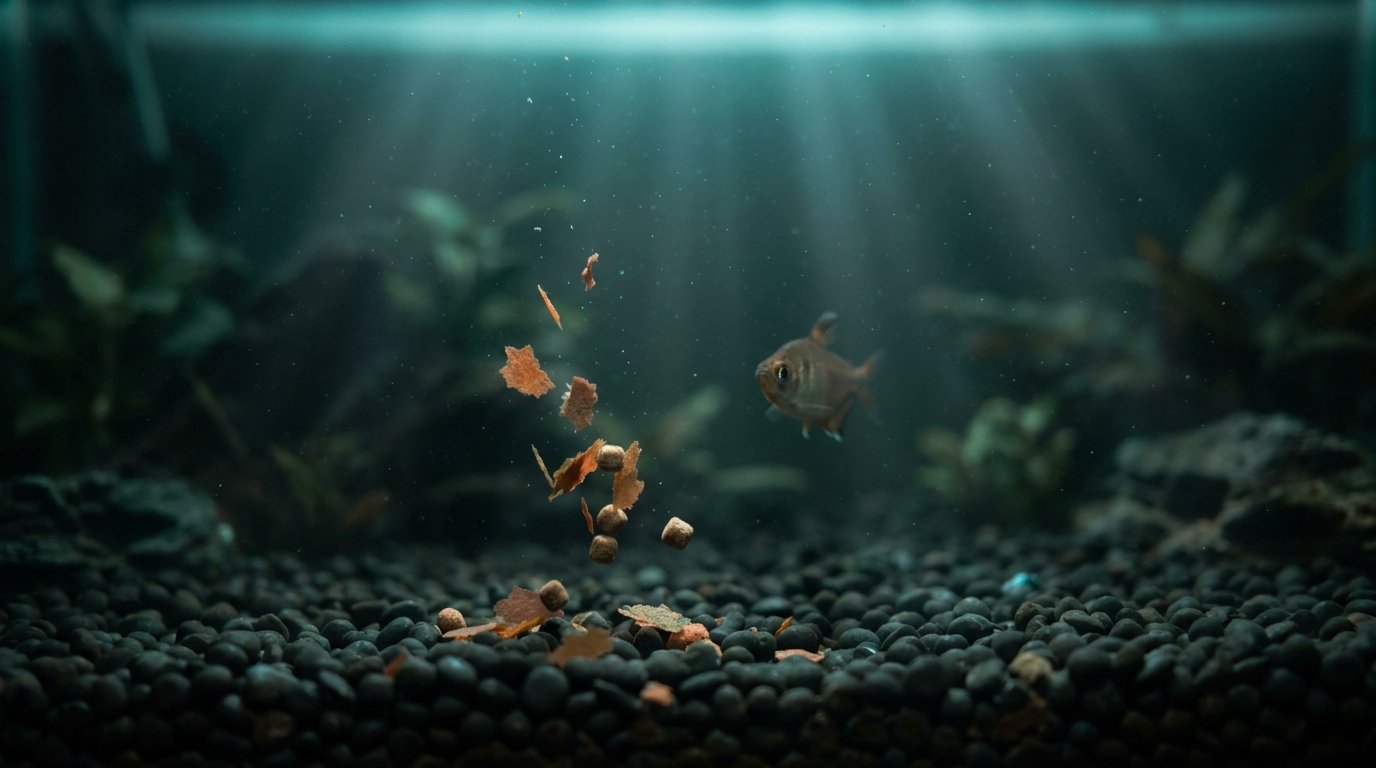
Quick answer: Overfeeding rarely kills fish at the dinner table — it kills days later. Uneaten food and extra waste spike ammonia, fuel algae, and drive overnight oxygen crashes. Feed only what your fish finish in about a minute, once or twice a day, and water quality (and the fish) usually recover within a week.
If fish are gasping after overfeeding, start here
If fish are gasping at the surface after a heavy feeding, cloudy water, or food sitting in the gravel, treat it like an oxygen and ammonia emergency before you feed again. Overfeeding can cause ammonia spikes, low oxygen, cloudy water, and fish stress because extra food rots, feeds bacteria, and uses up oxygen.
DBC Aquatics teaches overfeeding as a hidden rescue problem, not just a feeding mistake. The safest order is oxygen first, ammonia and nitrite tests next, then feeding changes after the fish are stable.
- If fish are already gasping, use the fish gasping rescue guide.
- If ammonia or nitrite is above zero, follow the ammonia spike emergency guide.
- If several symptoms are happening at once, run them through the DBC Aquatics Symptoms Checker or start at the Aquarium Rescue Hub.
Overfeeding is the single most common reason beginner tanks crash — and almost nobody catches it, because the damage never happens at feeding time. The pinch of flakes you drop in today looks harmless. The fish swarm it, you feel like a good keeper, and you walk away. Three days later the water is cloudy, a fish is gasping at the surface, and you are standing at the tank googling “fish suddenly dying” — never once connecting it to the food. That delay is exactly why overfeeding stays invisible. It is not a feeding problem you can see; it is a chemistry problem that unfolds overnight, in the gravel, where you are not looking.
This is the hidden root cause that quietly connects nearly every beginner emergency: the ammonia spike, the oxygen crash, the algae takeover, the mystery deaths. Fix the feeding and you remove the fuel behind all of them at once.
Why Overfeeding Is the #1 Invisible Beginner Mistake
Here is the trap: fish always act starving. A fish that ate ten minutes ago will still rush the glass and beg the moment you walk up. They have no “full” signal the way a dog does — in the wild, food is unpredictable, so the instinct is to eat whatever appears, whenever it appears. Your fish is not telling you it is hungry. It is telling you it is a fish.
So a well-meaning beginner reads that begging as need and adds “just a little more.” Multiply that by two or three feedings a day, plus the partner or kid who “already fed them,” and a small tank is suddenly processing several times the waste it was built to handle. Nothing looks wrong — until the biology behind the glass falls over.
The Hidden Chain: How a Pinch of Flakes Becomes a Dead Fish
Overfeeding does not kill fish by stuffing them. It kills them by poisoning the water in a chain reaction that runs for days after the food hits the surface. Understanding this exact sequence is what separates a keeper who fixes the cause from one who keeps treating symptoms:
1. Uneaten food rots. Anything not eaten in a few minutes sinks into the gravel and decomposes. Excess food the fish does eat just becomes more waste — overfed fish produce dramatically more poop. Either way, organic matter piles up where you cannot see it.
2. Decomposition releases ammonia. Rotting food and waste break down into ammonia, which is acutely toxic to fish even at fractions of a part per million. A tank that was cycled and stable can be pushed past its bacteria’s capacity overnight — the classic “my water was fine, now it’s not.”
3. Bacteria bloom and oxygen crashes. Here is the part almost no beginner knows: the bacteria and microbes that break down all that extra food consume oxygen to do it. A heavy feed can trigger a bacterial bloom (that milky, cloudy water) that strips dissolved oxygen out of the tank — which is why overfed fish often end up gasping at the surface even though nobody added a single fish. The food, not the stocking, ate their oxygen.
4. Nitrate and phosphate feed algae. What the cycle eventually converts the waste into — nitrate and phosphate — is fertiliser. Excess food is excess fertiliser, and within a week or two the glass goes green or brown. Algae is rarely a “light” problem; it is usually a feeding problem wearing a disguise.
5. Stress opens the door to disease. Ammonia burns gills, low oxygen exhausts the fish, and swinging water chemistry hammers the immune system. Now the ich, fin rot or fungus that was always present in trace amounts finally takes hold. The fish that dies “of disease” was set up to lose days earlier — at the surface, with a pinch of flakes.
If your fish are already in this spiral, stop here and stabilise first: our aquarium rescue guide walks you through the emergency steps before you change anything else.
The Other Victim: What Overfeeding Does Inside the Fish
Water poisoning is the big killer, but overfeeding has a second, more direct route to harm — and it is brutal for bettas, goldfish and other round-bodied fish. Dry flakes and pellets expand when they hit water. Feed a fish more than it can process and that food swells inside the gut, distending the intestine until it presses on the swim bladder — the organ that controls buoyancy. The result is a fish that suddenly floats sideways, sinks to the bottom, or bobs at the top: classic “swim bladder disorder” that is, far more often than not, simply constipation from too much food. Over the long term, chronic overfeeding also drives fatty liver disease, shortening lifespan even in fish that never show an obvious symptom.
How Much and How Often to Really Feed
The honest answer is “far less than you think.” Practical rules that actually work:
The 2–3 minute rule, with a twist. Feed only what your fish finish in about two to three minutes. But do not dump it all at once — add a small pinch, watch them eat it before it reaches the gravel, and only then add another. The second nothing is being eaten on the way down, stop. Anything hitting the substrate is overfeeding.
Once a day is plenty — and skipping days is good. Most community fish thrive on one modest feeding a day. A weekly fast day (no food for 24 hours) lets their digestive system clear and lets the tank’s bacteria catch up. A healthy fish can safely go one to two weeks without food, so a missed day on holiday is never the emergency a beginner fears — overfeeding before you leave is the real danger.
New tanks: even less. In a tank that is still cycling, the bacteria colony is tiny and easily overwhelmed. Feed every other day, sparingly, until the cycle is established. If you are unsure whether your tank is truly ready, see why fish die even when the water “tests fine.”
The Signs You Are Already Overfeeding
Use this table to translate what you are seeing into what is actually happening and what to do about it. You can also run your symptoms through our fish symptoms checker.
| What you see | Likely cause | What to test | Immediate action | Long-term fix |
|---|---|---|---|---|
| Food on the gravel minutes after feeding | Portion far too large | Visual check at 3 min | Siphon out leftovers now | Switch to pinch-and-watch feeding |
| Cloudy, milky water (often after a big feed) | Bacterial bloom consuming oxygen | Ammonia, dissolved O2 if possible | Stop feeding 2–3 days; add aeration | One small feeding/day |
| Fish gasping at surface, water “looks fine” | Decomposition stripped oxygen | Ammonia + temperature | Increase surface agitation; 25% water change | Reduce feed and bioload |
| Sudden ammonia reading in a cycled tank | Waste overwhelmed the bacteria | Ammonia + nitrite | Water change, dose conditioner | Cut feeding by half |
| Persistent green/brown algae returning fast | Excess nitrate/phosphate from food | Nitrate, phosphate | Manual removal + water change | Less food = less fertiliser |
| Fish floating, sinking or bobbing sideways | Expanded food pressing swim bladder | Observe, no test needed | Fast 2–3 days, then feed a shelled pea | Pre-soak pellets; smaller portions |
| Sludgy, smelly gravel; brown mulm | Accumulated uneaten food | Smell/visual; nitrate | Gravel-vacuum thoroughly | Feed less; vacuum weekly |
Fix It This Week: The Overfeeding Reset Checklist
You do not need new equipment to fix this — you need a week of discipline. Work through these in order:
| Day | Action |
|---|---|
| Day 1 | Do not feed at all. Gravel-vacuum to pull out trapped food and mulm. Test ammonia and nitrite. |
| Day 2 | Still no food (a fast does not harm healthy fish). Do a 25–30% water change. Clean or rinse filter media in old tank water only. |
| Day 3 | Resume with ONE tiny pinch — the pinch-and-watch method. If anything hits the gravel, you fed too much. |
| Day 4 | One small feeding. Retest ammonia/nitrite to confirm they are dropping back to zero. |
| Day 5 | Designate one fixed feeding time and, ideally, one feeder in the household. Hang a note on the tank: “Already fed.” |
| Day 6 | Make this a permanent weekly fast day. Observe the fish — begging is normal and not a reason to feed. |
| Day 7 | Final 25% water change. Water should be clearing and fish calmer. Lock in one small feeding a day going forward. |
Remember the safety order in any aquarium emergency: stabilise the water first, test to find the real number, diagnose from evidence, and only then treat. None of this is veterinary advice — if a fish is seriously ill, a qualified aquatic vet is the right call. For the full framework, see the aquarium rescue blueprint.
Frequently Asked Questions
How long can my fish go without food?
A healthy adult fish can safely go one to two weeks without eating. Skipping a day — or running a deliberate weekly fast day — is good for them and for your water quality. Overfeeding before a holiday is far more dangerous than not feeding at all while you are away.
My fish always act starving right after I feed them. Am I underfeeding?
Almost certainly not. Fish lack a “full” signal and will beg whenever you approach the tank, regardless of how recently they ate. Begging behaviour is instinct, not hunger. Judge portions by the 2–3 minute rule and what reaches the gravel, never by how eager the fish look.
Can overfeeding cause an ammonia spike even in a fully cycled tank?
Yes. A cycled tank only has enough beneficial bacteria to process its normal waste load. A sudden heavy feed — or steady overfeeding — produces more ammonia than the colony can keep up with, pushing levels into toxic territory overnight. This is one of the most common causes of “my water was fine yesterday.”
Why is my fish floating sideways or sinking after eating?
Dry flakes and pellets swell with water. Too much food expands inside the gut and presses on the swim bladder, causing buoyancy problems that look like swim bladder disease but are really constipation. Fast the fish for two to three days, then offer a shelled, cooked pea. Pre-soaking pellets before feeding helps prevent it.
Is cloudy water always caused by overfeeding?
Not always, but excess food is the most common trigger. Decomposing food fuels a bacterial bloom that turns water milky and, critically, consumes oxygen while it does. If your water clouded up after a big feed or a missed cleaning, cut feeding, vacuum the gravel, and add surface agitation to protect oxygen levels.
How do I stop someone else in the house from overfeeding the fish?
Pre-portion the food or use a small measuring scoop, set one fixed feeding time, and put a visible note on the tank reading “Fed today.” Most double-feeding happens because two people each think the fish missed a meal. One designated feeder solves the problem instantly.
Recommended gear
Gravel Vacuum Siphon
Overfeeding buries the substrate in rotting food. A gravel vacuum removes the waste that drives your ammonia, algae, and oxygen problems.
Check price Affiliate linkAuthor and editorial note
Written and maintained by Benjamin Thoden, founder of DBC Aquatics. This maintenance guide is reviewed around repeatable home checks: water tests, temperature, filter bacteria, oxygen, feeding, debris, and routines a beginner can actually keep. See our editorial standards for how guides are created, reviewed, and updated.
Related Rescue Guides
Why Are My Fish Dying? (When Water Tests Fine)
Ammonia zero, nitrite zero, nitrate low — and fish are still dying. Here are the real…
Why Your Aquarium Fish Keep Dying — And How to Stop It
Quick answer: Most aquarium fish don't die from disease — they die from invisible water problems,…
Ammonia, Nitrite, and Nitrate: What Every Aquarist Needs to Know
Quick answer: Ammonia and nitrite poisoning often looks like disease: gasping, red or inflamed gills, lethargy,…
Why Your Fish Are Gasping: Diagnosing Oxygen, Ammonia, and Water Quality Problems
Quick answer: Fish gasping at the surface almost always means low dissolved oxygen or gill damage…
Leave a Reply