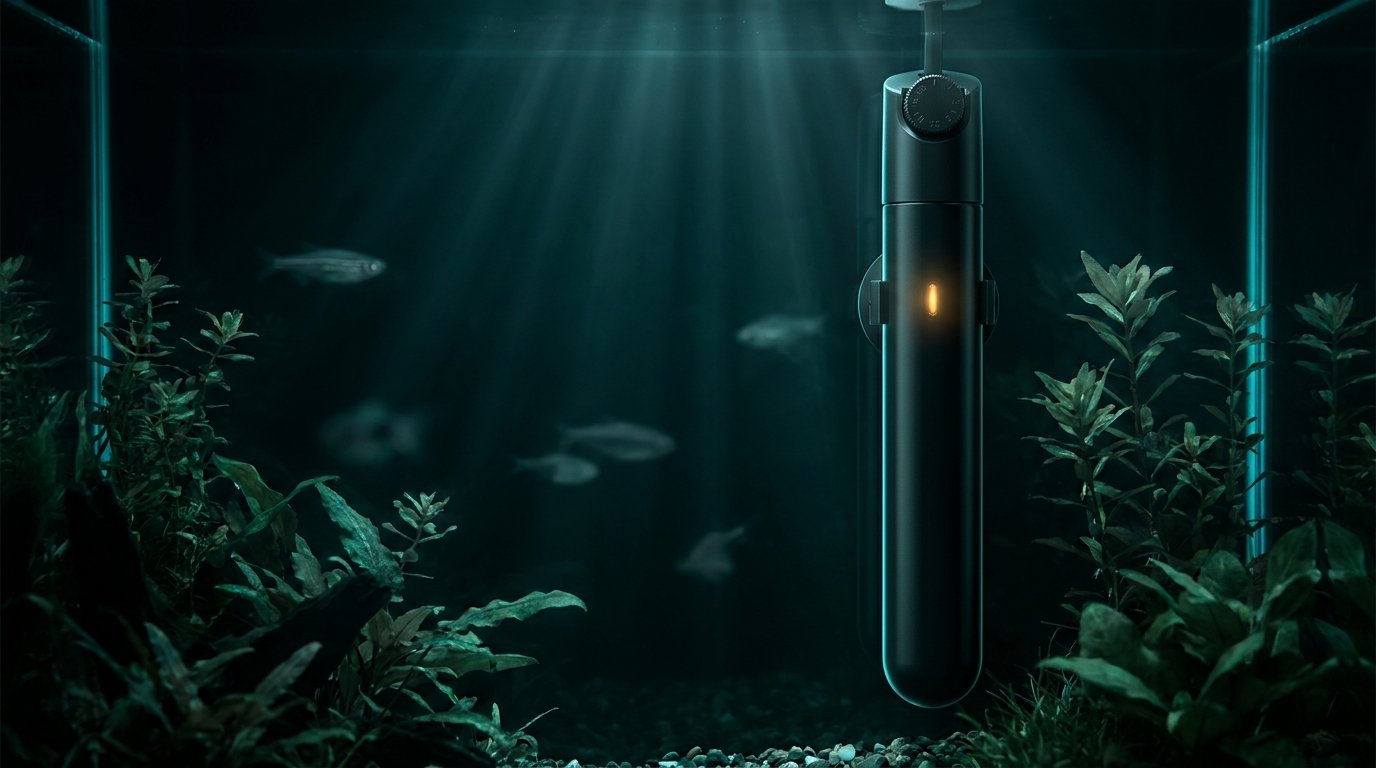
Quick answer: For most tanks, a reliable adjustable submersible like the Eheim Jager, paired with a separate thermometer. If the tank is stocked or valuable, add an external temperature controller (Inkbird) — it’s the cheapest insurance against a heater that sticks ON and cooks everything. Shatter-resistant heaters (Cobalt Neo-Therm) are worth the extra few dollars for big or rambunctious fish.
I’ve pulled more dead fish out of “perfectly fine” tanks because of a heater than any other single piece of gear. Not filters. Not bad water. Heaters. People obsess over which filter to buy and then drop in the cheapest heater on the shelf, and that’s the one part of the setup that can quietly kill everything in the tank overnight.
I run a small aquarium rescue out of my house. Tanks come to me because something already went wrong, and a shocking number of those “somethings” trace straight back to a heater. So I’m not writing this from a spec sheet. I’m writing it from the tanks I’ve watched crash — the ones where I walked in and the water was 64°F and the fish were sitting on the bottom barely moving, and the ones where the glass was warm to the touch and everything was already dead and the water smelled cooked.
Here’s the thing I want you to take away before you read another word: the best heater is the one you don’t trust. No heater is a “set it and forget it” device. I’ll tell you which ones are the most reliable, because reliability is the whole game — but the real protection is in how you set the whole thing up, not which box you buy.
The thing nobody tells you: heaters fail two ways
Every heater dies eventually. The question is how it dies, and both ways are bad.
Stuck OFF is the slow killer. The thermostat quits, the heater stops firing, and the tank drifts down to room temperature over a day or two. Tropical fish don’t drop dead at 68°F, so you might not notice right away — they just get sluggish, stop eating, and their immune systems tank. Then ich blooms, because ich loves a chilled, stressed fish, and a week later you’ve got a full outbreak you can’t explain. I’ve traced more “mystery ich” cases to a dead heater than to new fish. If your fish are hanging near the heater or acting cold, that’s a real symptom — I wrote about it over on fish hanging near the heater.
Stuck ON is the scary one. The thermostat contacts weld shut, and now the heater is just a heating element that never turns off. The tank climbs and climbs. Here’s the part people miss: warm water holds less dissolved oxygen, so your fish are cooking and suffocating at the same time. By the time you notice them gasping at the surface, it’s often too late. A 20-gallon can hit lethal temps in an afternoon with a stuck 100-watt heater. This is the single most common way I’ve seen an entire tank wiped out — and almost every one of those calls ended at fish dying with no obvious cause.
So here’s my number one rule, and I mean it more than any product recommendation in this article: never trust the heater’s own dial or built-in thermostat alone. Always run a separate thermometer so you can see the real temperature. And on any tank that’s stocked or that you’d be heartbroken to lose, run an external temperature controller — a unit that the heater plugs into, that reads the actual water temp and cuts power if the heater runs away. That one device, which costs about the same as a decent dinner, has saved more of my tanks than any “premium” heater ever has.
How I judged these
I don’t care about app connectivity or fancy LED displays. I care about three things, in this order. Reliability — does the thermostat hold up over years, and when it fails, does it tend to fail off (recoverable) rather than on (catastrophic)? Accuracy — is the temperature it holds close to the number on the dial, and does it stay stable? Durability — can it survive a clumsy water change, a big fish slamming into it, or being bumped against the glass? Everything below is sorted by how it actually behaves on real tanks over real time, not by the marketing.
Eheim Jager — the reliable default
The Eheim Jager (you’ll see it spelled Jäger) is the heater experienced keepers keep coming back to, and I’m one of them. It’s a fully submersible glass heater with a big, well-marked dial that’s genuinely accurate — when I set it to 76°F, the water sits at 76°F, which is more than I can say for most heaters under $20. The thermostat has a reputation for lasting years, and the build quality feels like a tool instead of a toy.
The one real weakness is the glass. If it ever runs while exposed to air — say, during a water change when the level drops below the heater — the thermal shock can crack it. The fix is simple and free: always unplug the heater before a water change and give it a few minutes to cool before it goes back under. Do that and a Jager will outlast three cheap heaters.
Eheim Jager Adjustable Heater
The accurate, long-lasting glass submersible I default to on most tanks — just unplug it before water changes so the glass never cracks.
Check price Affiliate linkShatter-resistant heaters — worth it for bigger or rowdier tanks
Glass is fine for a calm community tank. But the second you’ve got big cichlids, a goldfish that body-slams everything, a turtle, or kids who help with water changes, glass becomes a liability. That’s where a shatter-resistant heater earns its keep. The Cobalt Neo-Therm is the one I reach for — it’s a flat, slim plastic-bodied heater that’s accurate, holds temperature well, and won’t shatter if a fish drives it into the glass or it gets knocked while exposed.
It costs a few dollars more than a comparable glass heater, and honestly it’s worth it for the durability alone. The flat profile also hides better against the back wall. My only gripe is the indicator light is bright enough to annoy you on a bedroom tank, but that’s a minor complaint for a heater I trust around rough fish.
Shatter-Resistant Heater (Cobalt Neo-Therm)
A tough, accurate flat heater I trust around big or clumsy fish where glass would eventually get smashed.
Check price Affiliate linkThe real upgrade: an external controller
If you only spend extra money on one thing after the heater itself, make it this. An external temperature controller like the Inkbird is a separate box with its own probe that you drop in the tank. You plug the heater into the controller, set your target temp on the controller, and turn the heater’s own dial up a couple degrees past your target. Now the controller is in charge: it powers the heater on and off based on the real water temperature, and — this is the whole point — it kills the power the instant the temperature climbs past your set ceiling. If the heater’s internal thermostat welds shut, the controller still shuts it off. The stuck-ON scenario that wipes tanks just… can’t happen.
I run a controller on every tank I actually care about. It turns a cheap titanium heater into a safe one and turns a good glass heater into a near-bulletproof one. It is the single best dollar-for-dollar safety upgrade in this entire hobby, and it’s not close.
Inkbird Temperature Controller
The box that cuts power before a stuck heater can cook your tank — the cheapest insurance you’ll ever buy for live fish.
Check price Affiliate linkAnd whether or not you run a controller, you need a way to read the actual temperature with your own eyes. The heater dial is a suggestion, not a fact. A cheap digital thermometer with a probe lets you catch a drifting tank days before the fish tell you. I check mine every time I feed. This is non-negotiable gear, not an accessory — it lives on my aquarium tools list for exactly that reason.
Digital Aquarium Thermometer
A few dollars to see the real water temperature instead of trusting a dial that lies — get one for every tank.
Check price Affiliate linkWhat size heater do you need?
The rule of thumb is 3 to 5 watts per gallon. So a 20-gallon tank lands somewhere around 60 to 100 watts. But that rule lies to you if you stop there, because it ignores the two things that actually matter: how cold your room is, and how far above that room temperature you’re trying to heat.
A 20-gallon in a warm 72°F living room that you’re holding at 78°F barely has to work. The same 20-gallon in a 60°F basement, held at 78°F, has to fight twelve degrees of cold air all day long, and a 50-watt heater there will run nonstop and burn itself out. So lean toward the higher end — closer to 5 watts per gallon — if your room runs cold or swings a lot at night.
Here’s the counterintuitive part: an undersized heater is more dangerous than a slightly oversized one. An undersized heater runs constantly, never gets to rest, and wears its thermostat out fast — and a tired thermostat is the one that sticks. A slightly oversized heater paired with a controller is the safest combination there is, because the controller handles the on/off and the heater never has to strain. When in doubt, size up and add the controller.
Comparison at a glance
| Heater type | Best for | Reliability | Accuracy | Watch out for |
|---|---|---|---|---|
| Glass submersible (Eheim Jager) | Most community tanks | Excellent | Excellent | Glass cracks if run dry — unplug before water changes |
| Shatter-resistant (Cobalt Neo-Therm) | Big or rowdy fish, turtles, kids | Very good | Very good | Bright indicator light; costs a few dollars more |
| Budget shatter-resistant (Hygger) | Tight budgets, extra/backup tanks | Decent | Decent | More dial drift; verify with a thermometer |
| Titanium + controller | Large or valuable tanks | Excellent (with controller) | Only as good as the controller | Crude or no built-in thermostat — must run a controller |
| Preset (locked ~78°F) | Basic betta or simple community | Good | Fixed, can’t adjust | Useless if you need a specific or custom temp |
One word on the budget Hygger heaters since people always ask: they’re genuinely fine for what they are, and the shatter-resistant build is a real plus at that price. I’d just never run one on a valuable tank without a thermometer babysitting it, because the dial accuracy drifts more than I’d like. As a cheap backup heater for emergencies, though, I keep a couple around.
So which should you actually buy?
Small betta or simple community tank. An Eheim Jager in the right wattage plus a digital thermometer covers you completely. If you genuinely never need to change the temperature, a preset heater is fine too — just know you’re locked to roughly 78°F. Either way, the thermometer is mandatory.
Stocked community tank you’d hate to lose. Jager plus a thermometer plus an Inkbird controller. This is my standard build and the one I’d put on my own living-room tank. The controller is what lets you sleep at night.
Big or valuable tank, big or rough fish. Go shatter-resistant (Neo-Therm) or titanium, and run a controller — no exceptions on a tank this size, because a single stuck heater here is a very expensive, very sad morning. Titanium plus an Inkbird is nearly indestructible.
Cold room or basement. Size up toward 5 watts per gallon, seriously consider splitting the load across two heaters (more on that in the FAQ), and run a controller so the oversized heater doesn’t overshoot. If you’ve already had a tank crash and you’re rebuilding, my full aquarium rescue blueprint walks through stabilizing temperature first, before anything else.
FAQ
What size heater do I need?
Start with 3 to 5 watts per gallon, then adjust for your room. A warm room lets you stay near the low end; a cold room or basement pushes you toward 5 watts per gallon or more. An undersized heater runs nonstop and wears out fast, so when you’re unsure, size up slightly and pair it with a controller.
Do I really need a temperature controller?
On a basic betta tank, no — a good heater and a thermometer are enough. On any stocked or valuable tank, yes. A controller is a separate box that cuts power if the heater runs away, which is the only thing that reliably prevents the stuck-on failure that cooks entire tanks. It’s the cheapest insurance in the hobby.
Why did my heater cook my fish / stick on?
The thermostat contacts welded shut, so the heating element never turned off and the tank kept climbing. Warm water also holds less oxygen, so the fish overheat and suffocate at the same time. It’s the most common way a whole tank dies overnight, and an external controller is what prevents it.
Glass vs titanium vs preset — what’s the difference?
Glass submersibles like the Eheim Jager are accurate and affordable but crack if run dry. Titanium is nearly indestructible but has a crude or nonexistent thermostat, so it must be run with a controller. Preset heaters are locked to about 78°F — fine for a simple tank, useless if you need a specific temperature.
Should I run two heaters?
On larger tanks, yes, and I recommend it. Splitting the wattage across two heaters means each one works less hard, and if one sticks off the other keeps the tank from crashing while you notice. Two heaters plus one controller running the pair is a very safe setup for a big or valuable tank.
Where should I place the heater?
Put it in an area of strong water flow — near a filter outlet or a powerhead — so heated water mixes through the whole tank instead of forming a hot pocket. Mount it at an angle or horizontally low in the tank for better circulation, and keep the thermometer at the opposite end so you’re reading the coldest spot.
If your tank is in trouble right now and the temperature looks wrong, start with my aquarium rescue guides before you change anything else — temperature is almost always the first thing to stabilize.
Educational guidance, not veterinary advice.
Author and editorial note
Written and maintained by Benjamin Thoden, founder of DBC Aquatics. This maintenance guide is reviewed around repeatable home checks: water tests, temperature, filter bacteria, oxygen, feeding, debris, and routines a beginner can actually keep. See our editorial standards for how guides are created, reviewed, and updated.
Related Rescue Guides
The Best Aquarium Water Test Kit (From Someone Who Uses Them on Rescues)
My honest take on the best aquarium water test kit. Why liquid beats strips for ammonia,…
Product Reviews
Author and editorial noteWritten and maintained by Benjamin Thoden, founder of DBC Aquatics. This gear guide…
Aquarium Heater Safety & Failure Warning Signs
Heater failure is one of the most common — and dangerous — problems in the hobby.…

Leave a Reply