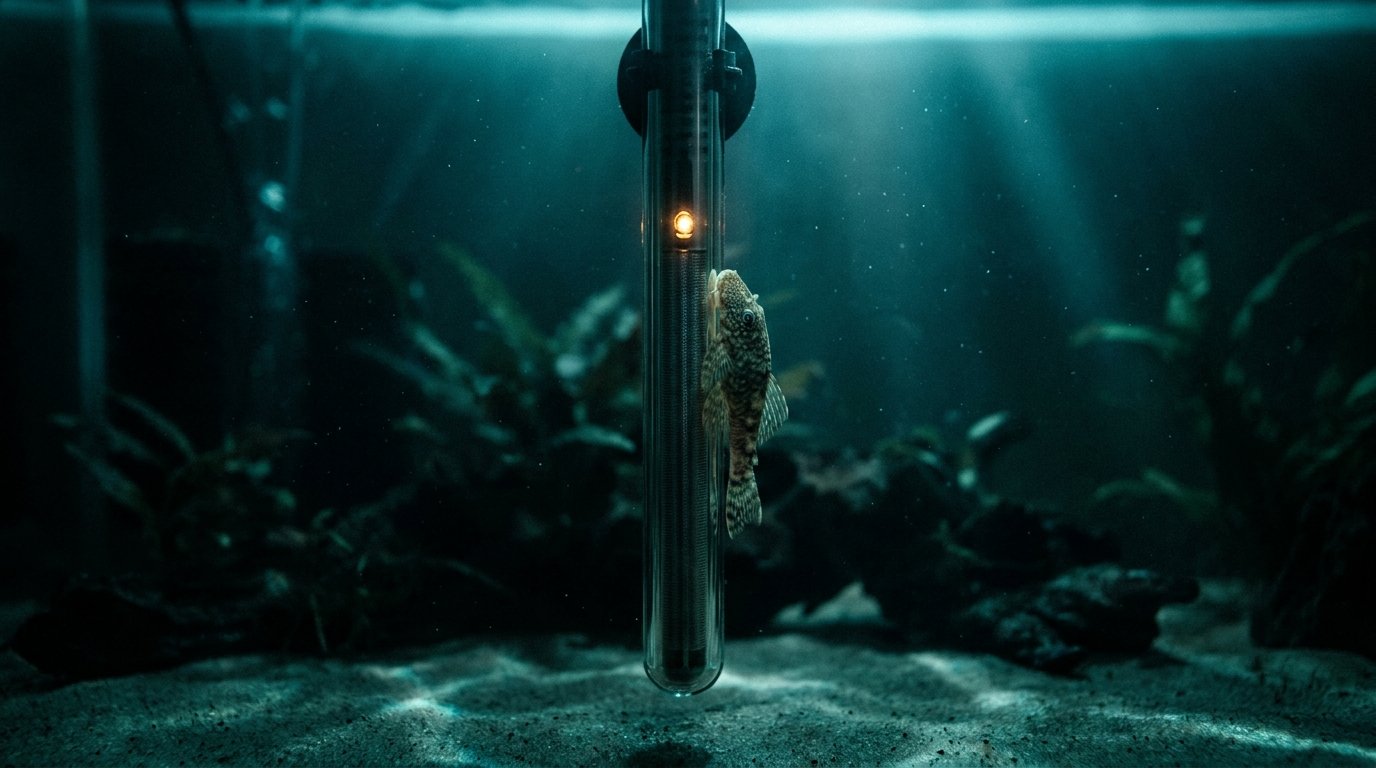
Quick answer: A fish hugging the heater usually means the tank is too cold — an undersized, failed, or unplugged heater. Check the temperature with a separate thermometer (never trust the dial) and warm the tank slowly, about 1–2°F per hour. If fish instead flee the heater and gasp, suspect a heater stuck ON and overheating.
Your fish has parked itself right against the heater — hugging the glass tube, hovering in that one warm pocket, barely moving from the spot. It looks like the fish has chosen a favourite corner, but in most cases it’s doing something far more deliberate: chasing the only warm water in the tank. Take a breath. This is a readable, fixable signal, not a death sentence.
Before you touch the heater dial, do one thing: read a separate, independent thermometer placed away from the heater. Never trust the number printed on the heater itself — a failed or miscalibrated heater will happily display “78°F” while the water sits at 68°F. The dial is the suspect, not the witness.
What this behavior actually looks like
There are two opposite versions of “fish near the heater,” and telling them apart is the whole diagnosis. Warm-seeking fish drift toward the heater and stay there — often near the bottom or mid-water beside the tube, fins held normally or slightly clamped, breathing slow, activity low. They’re behaving like a cold lizard on a sun-warmed rock: the rest of the tank feels too cold, so they camp where it’s least cold.
Heater-fleeing looks like the inverse and is far more urgent. The fish avoids the heater end entirely, crowds at the cool surface or the far corner, gasps at the top, and may dart erratically. That pattern points to a heater stuck ON — cooking the tank past safe limits. Same hardware, opposite emergency. If your fish is running from the heater and gulping at the surface, jump straight to confirming temperature and read our guide on fish gasping at the surface.
The hidden danger most owners miss
The trap with cold-driven heater-hugging isn’t the cold itself — it’s what cold does to the immune system. Fish are ectotherms; their immune response is temperature-dependent. Hold a tropical fish below its comfort band for days and antibody production and white-cell activity slow dramatically, leaving the door open for opportunistic pathogens. This is why Ichthyophthirius (ich) so often erupts after a cold snap or a heater failure.
Cold creates a double bind: at 75–80°F a fish’s immune defences run normally, but chronic exposure below ~70°F suppresses them within days — and the ich parasite’s life cycle accelerates as you warm the tank back up, completing in about 3–4 days at 80°F versus weeks in cold water. You can be fighting the cause and the symptom at the same time.
The flip side is just as dangerous and gets ignored because owners assume a heater can only fail by going cold. A heater whose thermostat sticks closed keeps pumping heat with nothing to shut it off. A 50-gallon tank can climb past 90°F in hours, oxygen-holding capacity drops as temperature rises, and the fish suffocates in hot water — which is exactly why a stuck-on heater shows up as fleeing and gasping, not hugging. Always cross-check with a second thermometer in both directions.
Fish Near the Heater: Symptom-to-Solution
| What you see | Most likely cause | What to test | Immediate action | Long-term fix |
|---|---|---|---|---|
| Hugging heater, separate thermometer reads low (below ~72°F) | Heater failed, undersized, or unplugged | Confirm heater indicator light; read independent thermometer near heater AND at far end | Reseat plug/check outlet; warm tank slowly ~1–2°F/hour | Replace with correctly sized heater (~3–5 W/gal) |
| Hugging heater, sluggish, fins clamped, slow breathing | Chronic cold stress | Temperature trend over 24h; check for white spots forming | Stabilise temp into 75–80°F band gradually; reduce stress | Reliable heater + thermometer; avoid cold-room drafts |
| FLEEING heater, gasping at surface, crowding cool end | Heater stuck ON / overheating | Independent thermometer immediately — is it above ~84°F? | Unplug heater now; add aeration; small cool water changes | Replace faulty heater; use a thermostat controller |
| Warm-seeking PLUS white salt-grain spots | Cold-triggered ich outbreak | Water parameters; inspect fins/body closely | Stabilise temp first; raise slowly toward 80°F under guidance | Treat after diagnosis; keep temp stable long-term |
| Cold room, only the heater area feels warm | Thermal stratification / undersized heater | Thermometer readings at top, middle, near heater, far corner | Improve circulation (filter/powerhead flow); right-size heater | Adequate wattage + flow to mix the water column |
| Active, eating, normal color — just rests near heater sometimes | Likely a comfortable resting spot | Confirm temp is in-range and stable | Nothing — observe over a few days | Routine monitoring; no action needed |
Why it happens: temperature, hardware, and disease
Most tropical community fish want a stable 75–80°F (24–27°C). The number matters less than the stability: a swing greater than about 2–3°F in a single day is physiologically stressful, and rapid drops are worse than slow ones. When the ambient room is cold and the heater can’t keep up, the water column stratifies — warm water pools around the element while the rest of the tank sits several degrees colder. The fish isn’t being fussy; it has found the only habitable zone. Weak circulation makes this worse, so a stronger filter return or a small powerhead can flatten the gradient. Browse options in our aquarium tools guide.
Heaters fail in three classic modes. They die silently (no light, water drifts to room temperature), they’re undersized (the element runs constantly but loses the race against a cold room), or the thermostat sticks on (the dangerous one — heat with no off switch). The sizing rule of thumb is 3–5 watts per gallon: a 20-gallon tank in a normal room wants roughly 75–100W, more if the room runs cold or the tank is tall and poorly circulated. An undersized heater is the single most common reason a fish ends up glued to the warm spot.
Now connect it to disease. A fish that is both warm-seeking and off-colour, clamped, or flashing is doing two things at once: thermoregulating because it’s cold, and possibly fighting an infection that the cold itself invited. Cold-suppressed immunity is a leading upstream trigger of ich, fungus, and bacterial flare-ups. If you also see spots, frayed fins, or rapid gilling, work the broader checklist with our fish symptoms checker and the why are my fish dying guide before reaching for any treatment.
One more cause hides in plain sight: water quality. Cold slows the biological filter and ammonia metabolism, so a chilled tank can quietly accumulate toxins even as you focus on temperature. If the fish is gasping and lethargic, rule out a parameter problem with our toxic water guide — temperature and chemistry failures often arrive together.
What to do in the first 10 minutes
Move calmly and in order. Stabilise first, diagnose second, treat last.
1. Read a separate thermometer at multiple spots. Place an independent thermometer near the heater and again at the far end and surface. Note both numbers — the gap tells you about stratification, and the absolute value tells you cold vs. hot.
2. Confirm heater function. Is it plugged in? Is the indicator light on? Is the dial set sensibly? Check the outlet and any timer or power strip. If the light is on but the water is cold, the heater is failing or undersized. If the water is hot and climbing, unplug it immediately.
3. Adjust temperature SLOWLY — about 1–2°F per hour. Never crank a cold tank straight to target; a fast warm-up shocks the fish and, if ich is present, kicks the parasite into its fastest reproductive gear. For a too-hot tank, unplug the heater and let it coast down gradually, adding aeration; do small, temperature-matched cool water changes rather than dumping cold water in.
4. Observe. Watch for 15–30 minutes. Does the fish leave the heater as the tank stabilises? Does breathing normalise? Look closely for spots, clamped fins, or flashing — those move you from a hardware problem to a possible disease problem.
What NOT to do
Don’t crank the heater to maximum and walk away. A rapid temperature spike is itself dangerous and accelerates any ich already present. Warm gently, ~1–2°F/hour, and let the tank settle.
Don’t trust the heater’s dial or built-in display. It is the most likely failed component in the whole scenario. A cheap independent thermometer is the single most valuable tool you can add today.
Don’t ignore a heater that might be stuck on. If fish are fleeing the heater and gasping, treat it as an active emergency — unplug first, ask questions after. Hot water holds less oxygen, so add surface agitation immediately.
Don’t dose medications before testing and observing. Throwing ich meds or “stress coat” at a cold tank treats a symptom while the real cause — temperature — keeps doing damage. Stabilise the environment, confirm the diagnosis, then treat if needed.
Fish & Heater FAQ
Is my fish hugging the heater because it’s cold?
Usually, yes. A fish that camps next to the heater and stays sluggish is almost always telling you the rest of the tank is too cold for it — typically a failed, undersized, or unplugged heater, or thermal stratification in a cold room. Confirm with a separate thermometer; most tropical fish want a stable 75–80°F.
How do I know if my heater is broken?
Never trust the dial. Put an independent thermometer in the tank, away from the heater. If the indicator light is on but the water reads cold, the heater is failing or undersized. If the water is hot and rising, the thermostat may be stuck on — unplug it immediately.
What temperature should a tropical tank be?
Most tropical community fish do best at a stable 75–80°F (24–27°C). Stability matters more than the exact number: avoid daily swings greater than about 2–3°F, and change temperature slowly when correcting a problem.
Can being cold give my fish ich?
Indirectly, yes. Cold suppresses a fish’s temperature-dependent immune system within days, which is a leading trigger for ich and other infections. The catch: warming back up speeds the parasite’s life cycle to about 3–4 days at 80°F, so warm slowly and watch closely for white spots.
What size heater do I need?
A rule of thumb is 3–5 watts per gallon, so a 20-gallon tank wants roughly 75–100W. Go higher if the room runs cold, the tank is tall, or circulation is weak. An undersized heater that runs constantly but can’t keep up is a very common cause of heater-hugging.
My fish is avoiding the heater and gasping — what does that mean?
That’s the opposite problem and an emergency: the heater may be stuck on and overheating the tank. Hot water holds less oxygen, so the fish flees the warm end and gasps at the surface. Check an independent thermometer immediately, unplug the heater, and add aeration.
Recommended gear
Digital Aquarium Thermometer
Never trust the heater dial. A separate digital thermometer shows the real tank temperature so you catch a cold tank, or a stuck heater, before it hurts your fish.
Check price Affiliate linkContinue Your Diagnosis
- Fish Symptoms Checker — find the cause fast
- Aquarium Rescue Hub
- Why Are My Fish Dying?
- Aquarium Rescue Blueprint — the exact rescue system
Educational guidance, not veterinary advice.
Author and editorial note
Written and maintained by Benjamin Thoden, founder of DBC Aquatics. This maintenance guide is reviewed around repeatable home checks: water tests, temperature, filter bacteria, oxygen, feeding, debris, and routines a beginner can actually keep. See our editorial standards for how guides are created, reviewed, and updated.
Related Rescue Guides
Fish Sitting in the Filter Output? Why It’s an Early Oxygen Warning
Fish parking in the filter outflow is usually oxygen-seeking — an early low-O2 warning. Learn to…
Clamped Fins in Fish: What It Means and How to Fix It
Clamped fins is an early distress signal, not a disease. Learn why water quality (not meds)…
Fish Flashing: Why Your Fish Is Scratching and What to Do First
Fish flashing is the earliest sign of gill or skin irritation. Learn why clear water still…

Leave a Reply