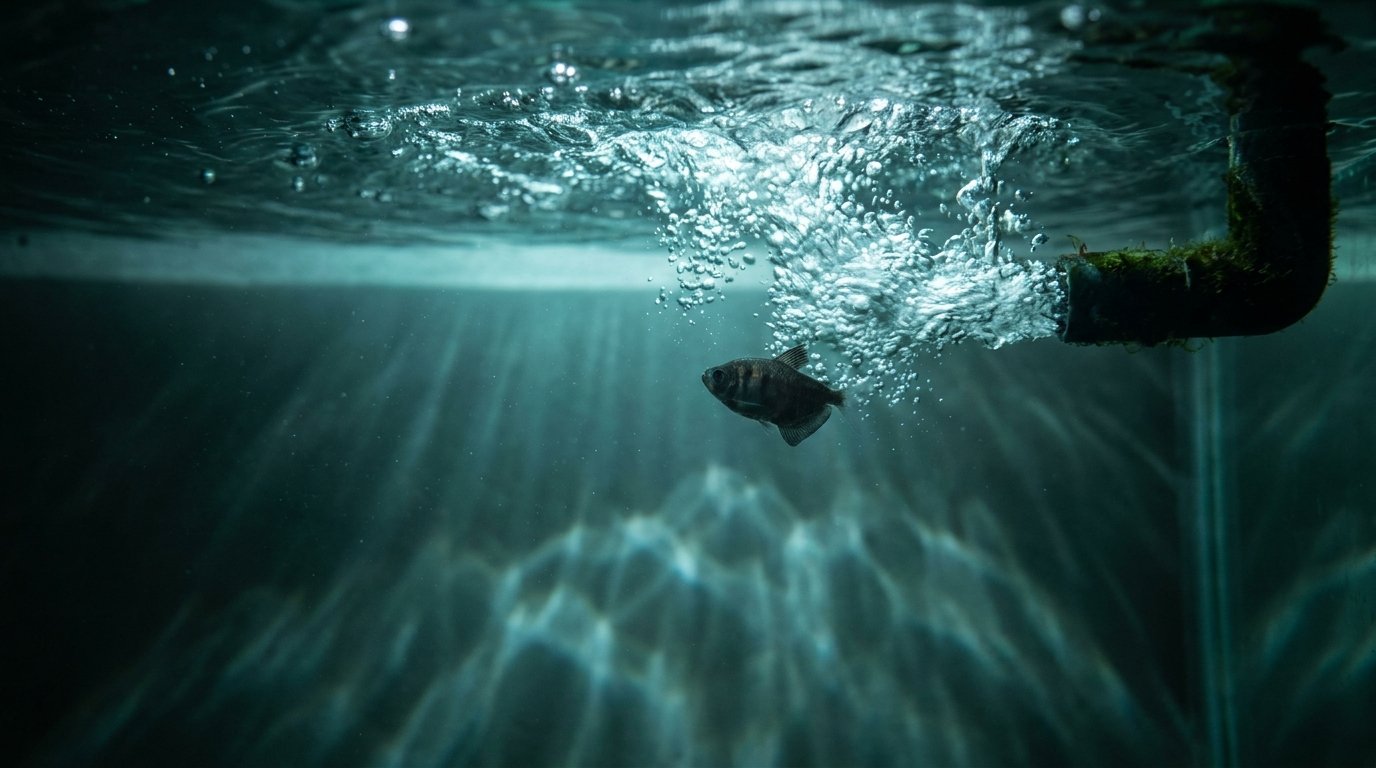
Quick answer: A fish suddenly parking in the filter outflow is usually oxygen-seeking — the outflow is the most oxygen-rich, agitated water in the tank — which is an early warning of low dissolved oxygen, often before any surface gasping. Increase surface agitation and test ammonia and nitrite, and rule out a current-loving species before assuming distress.
You walk past the tank and notice it: a fish that used to roam the whole aquarium is now parked directly in the filter’s outflow, holding itself in the current right where the water churns. People call this “sitting in the stream,” and the moment it starts suddenly, it’s easy to assume the worst. Take a breath. This is one of the most readable warning signs in the hobby, and you caught it early.
Here’s the one thing to check before anything else: is this an oxygen problem? The filter output is the single most oxygen-rich spot in your tank, because that’s where the water breaks the surface and exchanges gas with the air. A fish that suddenly chooses to live there is very often telling you the rest of the tank is running low on dissolved oxygen. Stabilise first, diagnose second, treat last — and in this case, stabilising means getting more oxygen into the water while you investigate.
What this behavior actually looks like
Not every fish near the filter is in trouble. The skill is reading context, not just position. Distress-driven “sitting in the stream” has a signature: it’s new and sudden, the fish often holds its body steady and faces into the flow with rapid gill movement, fins may be clamped, and frequently more than one fish drifts to the same high-flow zone at the same time. If you see fish stacking up near the outflow or hovering just below the surface there, treat it as a respiratory red flag.
Now the reassuring side. Plenty of species genuinely love current and have always parked in fast water — hillstream loaches are built for it, many danios and rainbowfish surf the outflow for fun, and some plecos and other rheophilic fish station themselves in flow by instinct. A single fish that has always done this, eats normally, shows relaxed fins, and breathes at a calm rate is almost certainly just being itself. The difference between “playing” and “panicking” is gill rate, fin posture, appetite, and whether the behavior is new. If it appeared overnight alongside fast breathing, that’s distress. If it’s a lifelong habit in a current-adapted species, that’s normal.
The hidden danger most owners miss
Dissolved oxygen is the threat you cannot see and probably cannot test. It’s not on the standard hobby kits that measure ammonia, nitrite, nitrate and pH, so most owners never measure it — and they don’t realise how quickly it changes. Two physics facts make this dangerous. First, warm water holds far less oxygen: water at 82°F/28°C holds roughly 30% less dissolved oxygen than water at 72°F/22°C. A summer heatwave or a heater stuck high can quietly starve a tank. Second, oxygen crashes overnight: in the dark, plants stop producing oxygen and instead consume it through respiration, while your bacteria and fish keep burning it all night. Levels are lowest just before dawn.
A fish sitting in the outflow at night or first thing in the morning is a textbook early oxygen warning — dissolved O2 typically bottoms out before dawn, and below about 4 mg/L most tropical fish begin actively seeking the most aerated water before they ever gasp at the surface.
Fish in the Filter Output: Symptom-to-Solution
| What you see | Most likely cause | What to test | Immediate action | Long-term fix |
|---|---|---|---|---|
| Several fish in the outflow, worse in early morning | Low oxygen / overnight O2 crash | Temperature; observe time-of-day pattern (DO not on most kits) | Increase surface agitation, add an air stone now | Permanent extra aeration; reduce overstocking/overfeeding |
| In the outflow AND gasping at the surface | Low O2 or ammonia/nitrite poisoning | Ammonia + nitrite immediately | Aerate hard; if toxins present, water change | Fix the cycle; treat the source, not the symptom |
| In the outflow during a warm spell / heatwave | Low oxygen (warm water holds ~30% less) | Temperature reading | Cool the tank gently, boost aeration | Stabilise temperature; add a fan or chiller in summer |
| One fish only, others normal, calm breathing | Possible early illness OR current-loving species | Observe gill rate, appetite, fins over 24h | Isolate-observe, do not medicate blindly | Identify species behavior; quarantine if truly sick |
| Started suddenly after adding fish or a big feeding | Bioload spike raising O2 demand | Ammonia + nitrite; recount stock | Aerate, small water change, stop overfeeding | Right-size stocking; feed less, more often |
| Current-loving species, has always done it, eats well | Normal rheophilic behavior | Nothing urgent — confirm calm breathing | No action needed | None; enjoy the natural behavior |
The core mechanism is simple once you see it. Oxygen enters water almost entirely at the surface, where agitation mixes air and water — not through the bulk of the tank. The outflow is your tank’s busiest gas-exchange zone, so it carries the highest dissolved-oxygen concentration. A fish that relocates there is doing the aquatic equivalent of opening a window: it has found the freshest air in the room. That’s why this behavior so reliably precedes open-mouthed gasping at the surface — it’s the earlier, quieter stage of the same emergency, and acting now buys you a comfortable margin.
The overnight crash deserves special attention because it ambushes people. During the day, planted tanks pump out oxygen via photosynthesis and everything looks fine. After lights-out, those same plants switch to consuming oxygen, the biofilter keeps respiring, and the fish keep breathing — so dissolved O2 falls all night and bottoms out near dawn. If your fish only park in the stream in the early morning and look normal by mid-afternoon, you’re watching a textbook overnight oxygen sag. The fix is more night-time aeration, not fewer plants. Run an air stone on the same timer as your lights, but inverted, or simply leave it running 24/7.
There’s one critical impostor: nitrite. Nitrite causes methemoglobinemia — it binds to the fish’s blood and blocks it from carrying oxygen, so the fish becomes “air-hungry” and crowds the outflow even when the water is genuinely well-oxygenated. You cannot tell oxygen-hunger from nitrite-hunger by behavior alone, which is exactly why testing comes before any treatment. If your nitrite reads above 0 ppm, you have a cycling or toxic-water problem, not just an aeration problem, and the response is water changes plus fixing the cycle. When several fish look distressed at once and the situation is escalating fast, work through the Fish Symptoms Checker and the broader Aquarium Rescue Hub so you don’t miss a parallel cause like overstocking or a failing filter.
What to do in the first 10 minutes
Move in order. The goal of the first ten minutes is to get oxygen up safely while you gather information — stabilise before you diagnose.
1. Increase surface agitation immediately. Drop in an air stone if you have one, or angle the filter outflow so it ripples the surface harder. Lowering the water level slightly so the return splashes also helps. More broken surface equals more gas exchange within minutes.
2. Test ammonia and nitrite. These are your fastest way to rule the impostors in or out. Any nitrite above 0 ppm, or ammonia above 0 ppm, changes your plan toward water changes — see toxic water.
3. Check the temperature. If it’s above 80°F/27°C, warm water is part of the problem. Cool gradually — a fan across the surface, a partial cooler water change, lights off — never an ice dump.
4. Note the time of day and the pattern. Is this worse at dawn? Did it start after feeding or adding stock? The timing tells you whether you’re chasing an overnight crash, a bioload spike, or a heat event. If fish are also gasping or dropping, escalate using the fish-dying emergency steps.
What NOT to do
Do not turn the filter down or off. This is the instinctive mistake — the fish is “stuck in the current,” so people reduce the flow to give it a break. You’d be cutting off the exact surface agitation keeping it alive. If anything, you want more circulation and surface movement, not less. The right tools for boosting aeration are covered in aquarium tools.
Do not assume disease and dose medication. Most medications consume oxygen as they break down and some directly reduce the water’s oxygen-carrying capacity — dosing a low-O2 tank can be the thing that tips fish over the edge. Never medicate before you’ve tested water and watched behavior. Treat last, and only when a tested cause justifies it.
Do not ignore it because “only one fish” is doing it. One fish in the stream is your most sensitive individual flagging a tank-wide trend before the others notice. And do not crank the heater up in a panic — warmer water holds less oxygen, so raising temperature to “help a sick fish” can deepen the exact shortage causing the behavior.
Fish & Filter Output FAQ
Why is my fish suddenly sitting in the filter current?
The filter outflow is the most oxygen-rich water in the tank because that’s where the surface is agitated and gas exchange is highest. A fish that suddenly parks there is usually oxygen-seeking — an early warning that dissolved oxygen elsewhere in the tank is dropping, often before any surface gasping starts.
Is sitting in the filter output always a sign of low oxygen?
No. Current-loving species like hillstream loaches, many danios, rainbowfish and some plecos naturally station themselves in fast flow. If one fish has always done it, eats well, and breathes calmly, it’s normal. Treat it as distress only when it’s new and sudden, breathing is rapid, fins are clamped, or several fish gather there at once.
Why is it worse in the morning?
Dissolved oxygen crashes overnight. In the dark, plants stop photosynthesising and instead consume oxygen, while fish and biofilter bacteria keep burning it all night, so levels bottom out just before dawn. A fish in the stream at night or early morning that looks fine by afternoon is showing a classic overnight oxygen sag.
Should I turn the filter down so the fish can rest?
No — that’s the most common mistake. Reducing flow cuts the surface agitation that drives oxygen into the water, which is exactly what the fish is seeking. Increase surface movement instead: add an air stone, angle the outflow to ripple the surface harder, and keep circulation strong.
Can warm water cause this behavior?
Yes. Warm water holds far less oxygen — water at 82°F/28°C holds roughly 30% less dissolved oxygen than water at 72°F/22°C. During a heatwave or with an overheating heater, oxygen can drop enough to push fish into the outflow. Cool the tank gradually and boost aeration rather than raising the temperature.
My water test looks clean but fish still crowd the outflow — what now?
Dissolved oxygen isn’t on standard hobby kits, so a “clean” ammonia/nitrite/nitrate result doesn’t rule out low O2. Also confirm nitrite is truly 0 ppm, because nitrite causes methemoglobinemia and makes fish air-hungry even when oxygen is fine. If tests are clean, assume an oxygen shortfall and add permanent aeration.
Recommended gear
Air Pump and Air Stone
If your fish is chasing the filter outflow for oxygen, an air pump and air stone raise dissolved oxygen fast — cheap insurance against overnight crashes.
Check price Affiliate linkContinue Your Diagnosis
- Fish Symptoms Checker — find the cause fast
- Aquarium Rescue Hub
- Fish Gasping & Low Oxygen
- Aquarium Rescue Blueprint — the exact rescue system
Educational guidance, not veterinary advice.
Author and editorial note
Written and maintained by Benjamin Thoden, founder of DBC Aquatics. This plant guide is reviewed for low-tech practicality: correct placement, light level, substrate or rhizome needs, melt risk, algae pressure, and what a beginner can maintain consistently. See our editorial standards for how guides are created, reviewed, and updated.
Related Rescue Guides
Clamped Fins in Fish: What It Means and How to Fix It
Clamped fins is an early distress signal, not a disease. Learn why water quality (not meds)…
Fish Flashing: Why Your Fish Is Scratching and What to Do First
Fish flashing is the earliest sign of gill or skin irritation. Learn why clear water still…
How Overfeeding Quietly Kills Aquarium Fish
Overfeeding rarely kills fish at the dinner table. It kills days later through ammonia spikes, overnight…

Leave a Reply