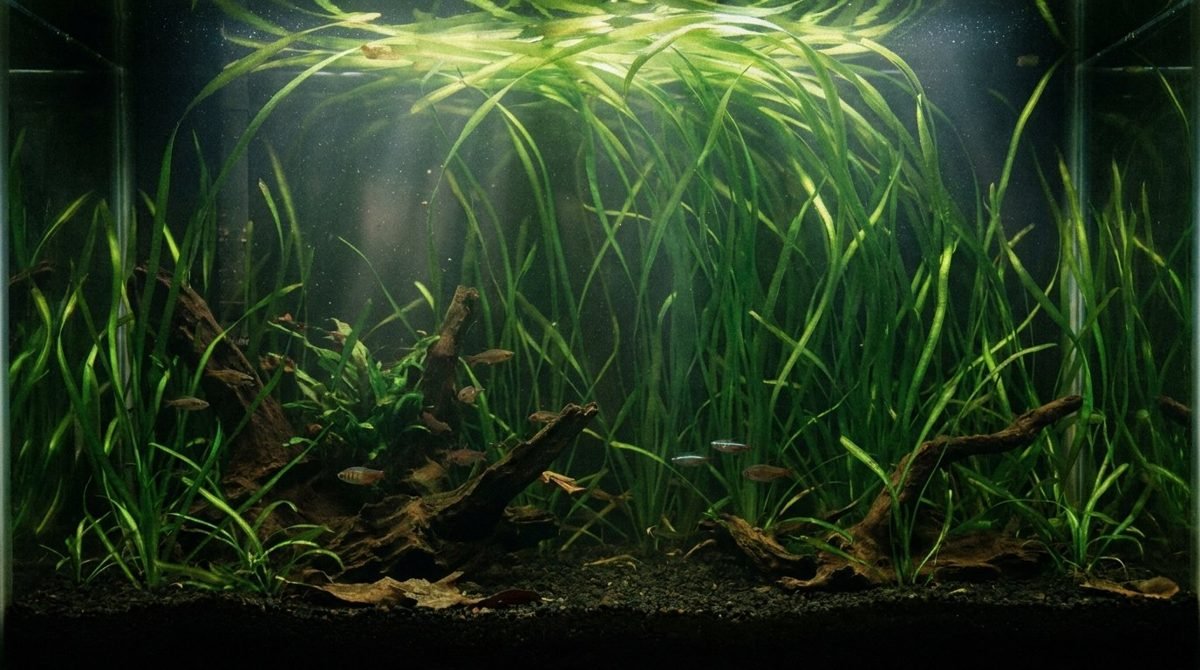
Quick answer: Vallisneria (jungle val) is a tall background plant that grows a curtain of ribbon leaves up the back glass. It’s a root feeder, so plant it in substrate and push root tabs down near the roots — that’s where most of its food comes from. It needs no CO2 and only low to moderate light. It spreads fast by runners to form a jungle, so plan to thin it. One hard rule: vallisneria hates liquid carbon (Excel-type products) and will melt if you dose it.
Vallisneria was the first background plant I ever got to actually take off, and that’s not a small thing. I’d killed a lot of stem plants before that — they’d arrive green, sit there sulking, drop leaves, and rot from the bottom up. Then I planted a dozen scraggly vallisneria runners along the back of a 40-gallon, did basically nothing special, and three months later I had a wall of green I had to keep trimming back. That’s the plant in a sentence: hard to kill, easy to grow into a jungle, and forgiving of nearly everything except one specific mistake I’ll keep hammering on.
Watch: Vallisneria Magic for Beginners
So this is the guide I wish I’d had — what vallisneria actually needs, how to plant it so it doesn’t rot, how to keep the runners from swallowing your whole tank, and the handful of ways people accidentally melt it. I grow it in low-tech tanks with no pressurized CO2, and that’s the setup I’m writing for.
What vallisneria is (and the types)
Vallisneria is a genus of grass-like, fully aquatic plants that root in the substrate and send up long, flat, ribbon-shaped leaves. People call it jungle val, Italian val, or just “vals,” and you’ll see it sold as Vallisneria spiralis and a few close relatives. The leaves grow toward the surface and then lay along the top under bright light, which is where the curtain look comes from. It’s a classic background plant — you put it along the back glass and let it screen everything behind it.
The names get muddy at the store, so here’s the practical breakdown. Jungle val (often Vallisneria americana) is the big one — wide leaves that can run several feet long in a deep tank, best for large setups where you want a tall screen. Italian val and standard spiralis types are a bit narrower and more manageable, a good middle-ground for most community tanks. Dwarf val stays shorter, often under a foot, and works in smaller or mid-size tanks where full jungle val would just flop across the surface and block all your light. If you’re not sure which you have, watch how it grows for a month — the leaf width and the length tell you more than the label did.
All of them grow the same way and want the same care, so don’t overthink the species. Match the height to your tank depth and you’re most of the way there. If you want to compare it against other beginner backgrounds, I keep notes on each plant over in the plant library.
Vallisneria care at a glance
| Requirement | What vallisneria needs |
|---|---|
| Light | Low to moderate. It grows under almost any planted-tank light; too much just makes it grow faster and reach the surface sooner. |
| CO2 | None. It’s a true low-tech plant. Do NOT dose liquid carbon (Excel/glutaraldehyde) — it melts vals. |
| Substrate | Any — sand, gravel, or aquasoil. It’s a root feeder, so add root tabs near the roots whatever you use. |
| Fertilizer | Root tabs are the big one. A light water-column dose helps but the roots do the heavy lifting. |
| Temperature | Roughly 64–82°F. Comfortable in standard tropical tanks and most unheated room-temp tanks. |
| Water hardness / KH | Tolerates and often prefers harder water with some carbonate hardness (KH). Soft, low-KH tanks can grow it but it does best with minerals. |
| pH | Wide range, roughly 6.5–8.5. Not fussy. |
| Placement | Background, along the back glass. Leaves form a curtain to the surface. |
The headline here is how short that list of demands really is. No CO2, no special light, no narrow temperature window. The two things it genuinely cares about are food at the roots and the absence of liquid carbon. Get those right and the rest is slack.
How to plant vallisneria
This is where most new keepers lose their vals in the first two weeks, and it’s a one-line fix: bury the roots, but keep the white crown above the substrate. The crown is the pale base where the green leaves meet the roots. If you plant it too deep and bury that white part, it rots, and the whole plant comes loose and dies. Too shallow and it just floats off. You want the roots tucked down into the substrate and the crown sitting right at the surface of it, with the green starting where the substrate ends.
My method: trim the roots back to about an inch with scissors so they’re easier to push in (don’t worry, it regrows them fast), make a little trench in the substrate with my fingers, lay the roots in, and pull the gravel or sand back around them — not over the crown. Then I give the leaves a gentle tug; if the plant pops up, it’s too loose, so I re-seat it. New vals often float for the first few days no matter what, because they haven’t gripped yet. A planting weight or a few extra days of patience fixes that. Once the roots catch, nothing moves it.
Because it’s a root feeder, this is the moment to add root tabs. Push one into the substrate every few inches along the row where you’re planting, down near where the roots will sit. This matters more in inert sand or gravel than in nutrient soil, but I add tabs even in soil after the first few months once the soil starts to run low. If your vals grow for a while and then stall out and pale, a fresh round of root tabs is almost always the answer. I go deeper on substrate choices in my guide to the best substrate for aquarium plants.
How it spreads, and how to control the runners
Vallisneria spreads by runners — horizontal shoots that travel sideways under the substrate and pop up new plantlets a few inches away. One healthy plant becomes three, then a dozen, then a row, then a thicket along your whole back wall. This is the best and the most annoying thing about it. It’s why a handful of cheap plants becomes a full background, and it’s why people complain it took over the tank.
Controlling it is simple manual work, not chemistry. When a runner sends up a plantlet somewhere you don’t want it, reach in, follow the runner back, and pinch or snip it free, then pull the unwanted plantlet out by its roots. Do this every few weeks and the patch stays where you put it. If it’s creeping forward into your midground, I’ll run a finger down through the substrate along the front edge of the patch like a little underground fence to sever any runners crossing the line. The pulled plantlets are perfectly good plants — trade them, move them to another tank, or toss them.
One thing I’d warn against: don’t try to “thin” a val jungle by hacking it all back hard at once. It bounces back fast, but a big sudden trim can trigger some melt while it recovers. Steady, small removals beat one big cleanout. This kind of low-effort, no-CO2 maintenance is exactly the rhythm I describe in my low-tech planted aquarium setup guide.
Common vallisneria problems and fixes
Melting (leaves going clear, thin, and disintegrating). The number-one cause I see is liquid carbon — Excel, Flourish Excel, and any glutaraldehyde-based “liquid CO2” product. Vallisneria is unusually sensitive to it and will melt, sometimes dramatically, even at the bottle’s recommended dose. If you’re dosing it, stop, do a water change, and let the plant recover. The other melt cause is transplant shock: vals often melt back a bit after you first plant them or after a move, then push new growth from the crown. As long as the crown is firm and white, be patient — new leaves will come.
Browning leaf tips. Almost always one of two things. Either the plant has hit the surface and the tips are sitting in the open air or under intense light and burning, or you trimmed it wrong. Cutting a val leaf flat across the middle leaves a raw edge that browns and dies back from the cut. Which leads to the trimming rule below.
How to trim without browning: remove whole outer leaves at the base instead of cutting tips flat. Reach down to where the leaf meets the crown and pull or snip that single oldest leaf off at the bottom. The plant keeps its clean, tapered leaf shape and there’s no cut edge to brown. If the whole patch is too tall and flopping across the surface, take the longest outer leaves off at the base, a few at a time, rather than giving everything a flat-top haircut.
Not growing / pale and stunted. This is a feeding problem nine times out of ten. It’s a root feeder and it’s run out of food at the roots. Add fresh root tabs near the base of the patch and give it two or three weeks. Slow growth can also mean very soft, mineral-poor water — vals like some hardness and KH, so if your tank is very soft, that may be the limiter. And double-check you’re not dosing any liquid carbon, because chronic low-level melt can look like “won’t grow.”
Is vallisneria right for your tank?
Vallisneria is a yes for most people, with a couple of honest caveats. It’s ideal if you want a tall green background without buying CO2 gear, if you have at least a moderately deep tank, if your water is on the harder side, and if you don’t mind pulling runners now and then. It’s the plant I hand beginners who’ve struggled with finicky stems, because it grows on autopilot once it’s rooted. New to planted tanks generally? Start with my aquarium plants beginner’s guide and add vals as your background.
It’s a no, or at least a “think twice,” in a few cases. If your tank is short — say under 12 inches tall — full jungle val will just lie across the surface and shade everything; pick dwarf val or another plant. If you run liquid carbon as part of your routine and don’t want to give it up, vals aren’t compatible, full stop. And if you specifically want a tidy, low-maintenance scape that never changes, a plant that spreads by runners and needs thinning may frustrate you. For everyone else — and that’s most tanks — it’s one of the easiest, most rewarding background plants you can grow.
FAQ
Does vallisneria need CO2 or root tabs?
No CO2 — vallisneria is a true low-tech plant that grows fine with no added carbon, and you should never dose liquid carbon (Excel-type products) because it melts vals. Root tabs are the part that matters. It’s a root feeder, so push tabs into the substrate near the roots and refresh them when growth slows.
Why is my vallisneria melting or dying?
The most common cause is liquid carbon (Excel/glutaraldehyde), which vals are very sensitive to — stop dosing it, do a water change, and let the plant recover. The other common cause is transplant shock right after planting or moving it; if the white crown is still firm, new leaves will push from it within a couple of weeks.
How deep do I plant vallisneria?
Bury the roots in the substrate but keep the white crown above it. The crown is the pale base where the leaves meet the roots, and if you bury it the plant rots and dies. Tuck the roots down, pull substrate back around them, and leave the green starting right at the substrate line.
How do I stop vallisneria taking over?
Pull runners. Vallisneria spreads by horizontal runners that pop up new plantlets, so follow the runner back, snip it, and remove unwanted plantlets by the roots every few weeks. Running a finger through the substrate along the front edge of the patch severs runners trying to creep forward. The pulled plantlets are healthy plants you can replant or trade.
Does vallisneria need hard water?
It doesn’t strictly need it, but it tolerates and often prefers harder water with some carbonate hardness (KH). Vals do best with minerals in the water, so in very soft, low-KH tanks they may grow slowly or stall. If yours is struggling and your water is very soft, that can be the limiter.
How do I trim vallisneria without browning?
Remove whole outer leaves at the base instead of cutting tips flat. A flat cut across a leaf leaves a raw edge that browns and dies back, so reach down to where the oldest outer leaf meets the crown and pull or snip it off there. The plant keeps its clean tapered shape with no cut edge to brown.
Educational guidance, not veterinary advice.
Author and editorial note
Written and maintained by Benjamin Thoden, founder of DBC Aquatics. This plant guide is reviewed for low-tech practicality: correct placement, light level, substrate or rhizome needs, melt risk, algae pressure, and what a beginner can maintain consistently. See our editorial standards for how guides are created, reviewed, and updated.
Leave a Reply