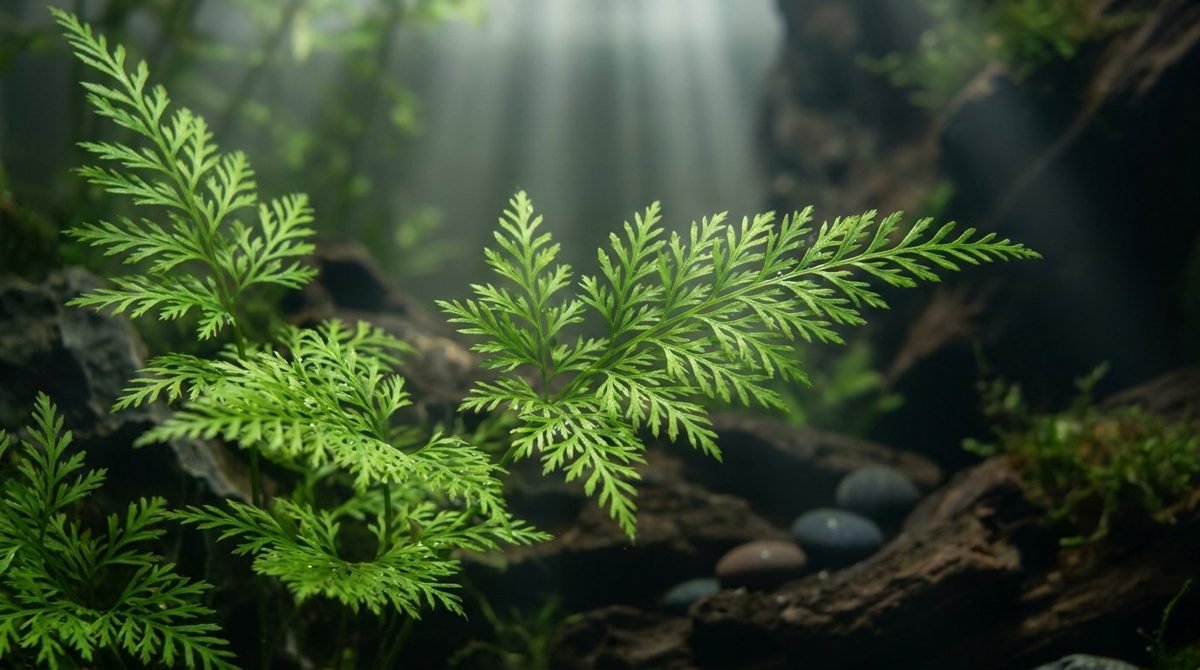
Quick answer: Water sprite is a fast-growing, very versatile aquatic fern you can either plant in the substrate or leave floating. It runs on low to moderate light, needs no CO2, and thrives between about 68 and 82°F. It propagates on its own from tiny plantlets that form on the leaf edges — you pinch those off and replant them. Floating it grows faster and makes excellent fry cover; planting it gives you a bushy midground or background. It’s one of the best beginner plants for shrimp and fry tanks, and a serious nutrient sponge that helps starve out algae.
Water sprite was the first leafy plant I ever kept that actually did what the label promised. A friend handed me a clump of this lacy green stuff in a sandwich bag and said “just toss it in, it grows on anything.” It doubled in two weeks and I’ve never been without it since. If you want one plant that forgives mistakes, feeds shrimp, hides fry, and fights algae without any special gear, this is the one I hand new keepers — including the one mistake almost everyone makes when they first plant it.
Watch: Water Sprite Secrets Revealed!
What water sprite is
Water sprite is the common name for Ceratopteris thalictroides, an aquatic fern. That fern part matters, because it explains how the plant behaves. It doesn’t grow like a stem plant with a clear top and bottom; it grows like a soft, branching frond, and it spreads by throwing off baby plants rather than by you cutting and replanting tops.
The look is the selling point. The leaves are finely divided and lacy — like a carrot top translated underwater — in a bright, fresh green. A healthy clump has a feathery, airy texture that softens the hard lines of a tank better than almost anything else I grow. The roots, when you plant it, are thin, white, and genuinely fragile, which is the source of the one big rookie mistake I’ll get to below.
It’s also one of the easiest aquarium plants there is. No CO2, no high-tech lighting, no special substrate. If you want more options in that same easy, low-tech lane, I keep a running list over on my easy aquarium plants with no CO2 guide.
Water sprite care at a glance
| Requirement | Water sprite needs |
|---|---|
| Difficulty | Easy — great beginner plant |
| Lighting | Low to moderate (no high-output needed) |
| CO2 | Not required |
| Temperature | About 68–82°F |
| pH | About 6.0–7.5 |
| Placement | Planted (midground/background) or floating |
| Growth rate | Fast |
| Propagation | Adventitious plantlets on leaf edges |
| Best for | Fry/shrimp tanks, nutrient control, algae fighting |
That low-to-moderate light line matters. You do not need a planted-tank light to grow this — a basic LED that came with your kit is usually plenty. If anything, too much light just speeds up the algae race, and water sprite is more useful as the thing winning that race. For more plants with the same forgiving lighting, see my low-light aquarium plants roundup.
Planting vs floating water sprite
Water sprite genuinely works both ways, and the two looks are completely different. I run it both ways depending on what I need from a tank.
Floating is the lazy, fast option, and it’s how I’d start if you’re new. Lay the clump on the surface and walk away. It sits closer to the light, pulls CO2 from the air, and grows noticeably faster than the same plant rooted down. The trailing roots underneath become a dense jungle, and that jungle is gold for baby fish and shrimp — fry dart up into it and disappear. The trade-off is that it shades the tank below and you’ll have to thin it fairly often, or it carpets the whole surface.
Planted is the aquascaper’s option. Tuck the base into the substrate and it grows upward into a tall, bushy column — a fantastic midground filler or a soft, leafy background that hides equipment. It grows a bit slower than floating but looks far more intentional. The catch is those fragile roots: planted water sprite is prone to melting right after you bury it, which I’ll cover below. Once it’s anchored and growing new roots, it’s rock solid.
My honest take: float it for speed, fry cover, and zero fuss; plant it if you care about the layout. There’s no rule against doing both — I’ll often float a piece in a fry tank and plant a piece in the display next door, all from the same parent.
How to propagate water sprite from plantlets
You barely have to “propagate” water sprite — it does it for you. As it grows, it produces little baby plants, called adventitious plantlets, right on the edges and tips of its leaves. You’ll spot them as tiny green nubs along the leaf margins that slowly grow their own leaves and a wisp of root while still attached to the parent.
The process I use: let a plantlet develop until it has a few of its own leaves and at least a hair of visible root — bigger is more forgiving. Then gently pinch or twist it off where it attaches; it comes away easily and won’t hurt the mother plant. From there you’ve got two choices: drop it on the surface to float and grow out, or carefully tuck it into the substrate. Floating the babies first and only planting them once they’re sturdier is the higher-success route, and it’s what I do.
One nice side effect: even leaves that break off and drift around will often sprout plantlets on their own. This plant wants to multiply — within a couple of months one starter clump can seed every tank you own, which is part of why it shows up so often in my plant library as a starter recommendation.
Common problems and fixes
Water sprite is easy, but it has three failure modes I see over and over. None are hard to fix once you know what you’re looking at.
Melting after planting. This is the big one, and it scares people into thinking they killed it. You plant a gorgeous clump and within days the leaves go translucent, brown, and mushy. That’s not death — it’s the plant shedding old growth and converting to your tank’s conditions, made worse by the shock of burying those fragile roots. The fix is patience: don’t rip it out. Watch the base, and as long as new green growth is pushing up from the center, it’s winning. Trim away the mushy leaves so they don’t foul the water, and in two to three weeks you’ll have a fully adjusted plant. To skip the drama, float it for a couple of weeks first, then plant it once it’s established.
Yellowing leaves. Pale or yellowing foliage usually means a nutrient gap, most often nitrogen or iron, because this plant is a heavy, fast feeder and can outrun a lean tank. In a lightly stocked or brand-new tank, a basic liquid all-in-one fertilizer fixes it quickly. If it’s planted in inert gravel or sand, slipping a root tab near the base helps too, since some of its feeding happens through the roots.
Leggy, stretched, thin growth. When the leaves go sparse and spindly instead of full and lacy, that’s a light complaint — it’s reaching for more. Either nudge the light up a step or move the plant nearer the surface (or just float it, which solves this instantly). Don’t go overboard; moderate light is the target, not blinding light.
Is water sprite right for your tank?
For most beginners and most community tanks, yes — easily. Where it really earns its place, though, is in two specific situations.
Fry and shrimp tanks. This is where water sprite is close to a cheat code. Floated, its trailing roots and dense leaves make instant cover, so live-bearer fry and baby shrimp have somewhere to hide the moment they’re born. The plant’s surface also collects the film of microorganisms that newborn fry and shrimplets graze on, so it feeds them as well as hides them. If you’re breeding anything, I’d put a handful of this in before almost any other plant.
Nutrient control and algae. Because it grows so fast, water sprite pulls a lot of nitrate and ammonia out of the water — nutrients algae would otherwise use. In a new tank fighting algae, or an over-fed one, a fast-growing plant like this is one of the most effective tools you have, because it simply out-competes the algae for food.
The only tanks where I’d hesitate are ones with big, destructive plant-shredders — large cichlids or goldfish will tear it apart faster than it can grow. Everywhere else, it’s hard to go wrong. If you’re still building out your first planted setup, my aquarium plants for beginners guide walks through pairing plants like this with the rest of a low-tech tank.
FAQ
Does water sprite need CO2 or root tabs?
No CO2 — water sprite grows fine without it, which is a big part of its appeal. Root tabs aren’t required either, but they help if you’ve planted it in inert gravel or sand and the leaves start yellowing, since it does some feeding through its roots. A basic liquid all-in-one fertilizer is usually enough for a healthy clump in an average community tank.
Should I plant or float water sprite?
Both work. Floating is faster, easier, and creates excellent cover for fry and shrimp, but it shades the tank and needs regular thinning. Planting gives you a tall, bushy midground or background for a more intentional look, though it grows a little slower and can melt at first. Float it if you want speed and fry cover; plant it if you care about the aquascape.
How do I propagate water sprite?
It propagates itself from adventitious plantlets — tiny baby plants that form along the edges and tips of the leaves. Let a plantlet grow a few of its own leaves and a wisp of root, then pinch it off the parent leaf and either float it or plant it. Floating the babies first and planting them once they’re sturdier gives the best survival rate.
Why is my water sprite melting after I planted it?
That’s normal transition shock, not death. After planting, water sprite often sheds its old leaves — they go translucent, brown, and mushy — while it grows new growth adapted to your tank, and the fragile roots being buried adds to the stress. Leave it alone, trim off the mushy leaves so they don’t foul the water, and watch for new green growth from the center. It usually recovers in two to three weeks.
Is water sprite good for fry and shrimp?
It’s one of the best plants for both. Floated, its dense leaves and trailing roots give newborn fry and baby shrimp instant cover from bigger tankmates, and the plant’s surface collects the microorganisms that shrimplets and fry graze on. It’s a top pick for any breeding or shrimp tank.
How fast does water sprite grow?
Fast — it’s one of the quicker plants you can grow without CO2. Floating it grows fastest of all because it sits at the light and pulls CO2 from the air. That speed is exactly why it works so well as a nutrient sponge against algae, but it also means you’ll be thinning and replanting it regularly to keep it in check.
Educational guidance, not veterinary advice.
Author and editorial note
Written and maintained by Benjamin Thoden, founder of DBC Aquatics. This shrimp guide is reviewed through DBC Aquatics’ stability-first lens: cycle maturity, mineral consistency, molt safety, copper risk, grazing surfaces, and slow acclimation matter more than quick fixes. See our editorial standards for how guides are created, reviewed, and updated.
Leave a Reply