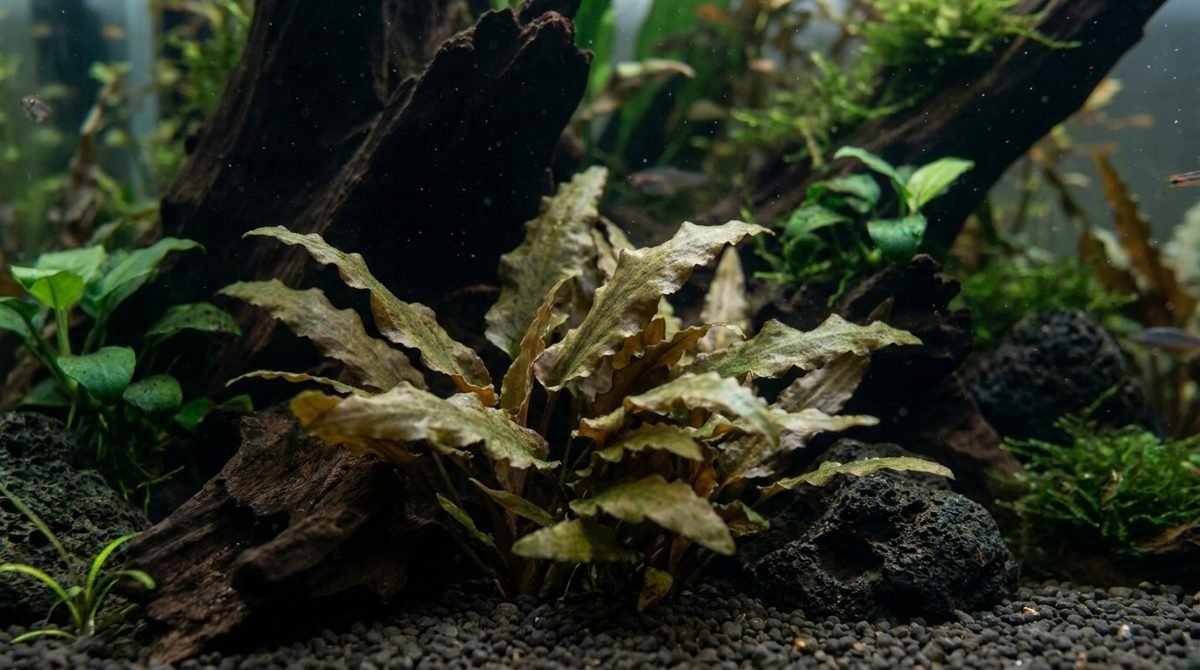
Quick answer: Cryptocoryne (crypts) are low-tech rosette plants that root in the substrate. They want low light and no CO2, and they’re root feeders, so a nutrient substrate with root tabs underneath them does most of the work. They’re famous for “crypt melt” — when you first plant them, or after any change in water or lighting, the leaves can dissolve away completely. Don’t pull the plant out. The roots survive, and it regrows stronger and adapted to your tank. Patience is the whole game.
Crypts were the first plant that taught me to stop panicking. I planted a pot of Cryptocoryne wendtii in my first soil tank, came back two weeks later, and the whole thing had turned to brown slime. I figured I’d killed it and almost scooped the roots out. I left them in out of laziness, and a month later there was a fresh rosette of leaves pushing up that were better colored than the ones that melted. That’s crypts in a nutshell. They test your patience, then reward it.
This is the guide I give people who just bought their first crypt and are about to make the mistake I almost made. It covers what crypts actually are, the care numbers, how to plant them so the crown sits right, why they melt and what to do about it, how they spread on their own, and the handful of problems that come up.
What cryptocoryne is
Cryptocoryne — almost always shortened to “crypts” — is a big genus of rosette plants from the streams and rivers of South and Southeast Asia. Unlike anubias or bucephalandra, crypts are true rooted plants. They grow as a rosette of leaves coming up out of a crown, with a network of roots below pulling nutrients straight from the substrate. They’re root feeders first, which is the single most important thing to understand about keeping them well.
There are a lot of varieties, and they cover a wide range of sizes and colors:
- Cryptocoryne wendtii. The workhorse of the genus and the one most people start with. It comes in green, brown, and red forms, grows a few inches to a hand-span tall, and sits perfectly in the midground. Tough and forgiving.
- Cryptocoryne lutea. A compact, sturdy green crypt that stays small and tidy. Great as a foreground-to-midground plant and very hard to kill once it settles.
- Cryptocoryne parva. The smallest crypt in the hobby, only an inch or two tall. It’s the one true foreground crypt, though it’s also the slowest, so it asks for real patience.
- Cryptocoryne balansae. A tall crypt with long, ruffled, almost bullwhip leaves that reach for the surface. A background plant that gives you the look of a fast stem plant without the trimming.
- Cryptocoryne spiralis. Another tall background variety with narrow, twisting leaves. Like balansae, it fills the back of a tank and sways in the flow.
Between the small foreground types, the midground wendtii and lutea, and the tall balansae and spiralis, you can plant most of a low-tech tank with nothing but crypts and have it look layered and natural.
Cryptocoryne care at a glance
Crypts are forgiving once they’ve settled in. The numbers below are where they do well — they tolerate a wider range, but stay near here and you mostly won’t have to think about them.
| Requirement | Cryptocoryne needs |
|---|---|
| Light | Low to moderate. Crypts are genuine low-light plants and do fine under modest lighting. Strong light isn’t needed and mostly just feeds algae. |
| CO2 | None required. Crypts are one of the best low-tech plants there is. CO2 speeds them up but is completely optional. |
| Substrate | A nutrient-rich substrate, or plain gravel/sand with root tabs added. They’re root feeders, so what’s under them matters more than what’s in the water. |
| Root tabs | Yes — this is the big one. Push a root tab into the substrate near the roots and refresh it every few months. It’s the difference between a crypt limping along and one that fills in. |
| Temperature | 72–82°F. Comfortable across the normal tropical range, so they suit most community tanks. |
| pH | Roughly 6.0–8.0. Soft or hard, acidic or alkaline — most varieties adapt to typical tap water. |
| Placement | Rooted in substrate with the crown above it. Foreground (parva, lutea), midground (wendtii), or background (balansae, spiralis) depending on variety. |
| Difficulty | Easy once established. The only real hurdle is melt and the slow start while the roots take hold. |
If there’s one line to take from that table, it’s the root tabs. Crypts feed through their roots, and a nutrient substrate plus a tab underneath each plant does ninety percent of the work of keeping them happy.
How to plant cryptocoryne
Planting a crypt is simple, but there’s one detail people get wrong — they bury the crown. The crown is the point where the leaves meet the roots, and if you push it down under the substrate it tends to rot. The roots go down, the crown stays at the surface, the leaves stay up. That’s the whole rule.
- Separate the plants. Crypts often come several to a pot in rock wool. Pull the wool off the roots gently and tease the plants apart so you can space them out.
- Bury the roots, not the crown. Make a hole, spread the roots into it, and cover them with substrate up to — but not over — the crown. The leaves and the crown they grow from should sit above the substrate.
- Add a root tab. Push a root tab into the substrate an inch or two from the roots. This is the most important step for crypts, and the one most people skip. Refresh tabs every couple of months.
- Space for spread. Crypts send out runners and fill in over time, so leave gaps between plants. A patch that looks sparse on day one knits together into a carpet or clump over the following months.
- Then leave them alone. Once they’re in, don’t keep moving them. Crypts hate being disturbed, and every replant resets the clock and often triggers a melt.
If your tank runs on plain gravel or sand, root tabs aren’t optional — they’re how you turn an inert substrate into something a root feeder can live in. My substrate guide goes deeper on the options here.
Crypt melt explained
This is the thing that scares everyone off crypts, so I’ll be blunt: crypt melt is normal, and it almost never kills the plant. When you first plant a crypt, or after any change in water parameters, lighting, or fertilization, the leaves can go soft, translucent, and dissolve away — sometimes the entire rosette turns to mush within days. It looks like total death. It usually isn’t.
What’s happening is the plant shedding leaves it grew under different conditions. A lot of crypts are grown emersed (out of water) at the farm, and the leaves built for that air-grown life can’t handle being submerged in your tank. So the plant drops them and regrows leaves adapted to your water. The roots, meanwhile, are fine the whole time.
- Do not dig it up. This is the one rule that matters. The roots survive the melt and hold all the plant’s energy. Pull it out and you throw away the part that was about to regrow. Leave it in the substrate.
- Trim the mush. Snip off any leaf that’s gone fully to slime so it doesn’t foul the water. Leave anything still partly intact — it may hold on.
- Keep conditions steady. Melt is triggered by change, so the cure is stability. Hold your parameters, lighting, and dosing steady and let the plant settle. Don’t react to the melt by changing things, which just causes more melt.
- Wait. New leaves push up from the crown over the following weeks, adapted to your tank and usually better colored than the ones that melted. The regrown plant is stronger than the one you bought.
The only time melt is genuinely bad news is if the crown and roots go soft and brown too — that’s rot, not melt, and it usually traces back to a buried crown. As long as the roots are intact, a melted crypt is a recovering crypt.
How to propagate cryptocoryne
Crypts propagate themselves, which is one of the nicest things about them. A settled plant sends out runners — horizontal shoots that travel under the substrate and pop up a daughter plant a few inches away. Do nothing and a single crypt becomes a patch over a year.
- Let it run. The main “method” is patience. Keep the plant fed with root tabs and stable, and it’ll throw runners and new rosettes on its own schedule.
- Separate daughters once they’re rooted. When a daughter plant has its own decent set of leaves and roots, you can gently lift it and the runner connecting it, snip the runner, and replant the daughter elsewhere. Wait until it’s well rooted — pulling a young one too early can stall both plants.
- Expect a melt after moving them. Replanting a division disturbs it, so don’t be surprised if a moved daughter melts and regrows. Same rules apply: leave the roots in and wait.
Because crypts spread underground, a patch you planted sparse will gradually close the gaps on its own. The trick is just to give it the months it needs and not keep digging around in it.
Common cryptocoryne problems and fixes
Nearly every crypt complaint is one of four things. Here’s what’s actually going on with each.
- Melt after planting. Covered above, but worth repeating because it’s the number one panic: melting leaves are normal adjustment, not death. Don’t dig it up. Trim the mush, hold conditions steady, and wait for new growth from the crown.
- Painfully slow to establish. Crypts spend their first weeks to months building roots before they put energy into leaves, so the top can look like it’s doing nothing while the bottom is working. This is normal. Root tabs and patience are the whole fix — don’t rip it out assuming it’s failed.
- No growth at all. A crypt that’s been settled for months and still isn’t growing is usually starved. It’s a root feeder in an inert substrate with no tabs. Push a root tab in near the roots and give it a few weeks. Lighting that’s far too low can also stall it, though that’s rarer.
- Holes or yellowing leaves. Pinholes and yellowing in otherwise established crypts usually point to a nutrient shortfall — often potassium or general fertilization. Refresh root tabs and add a modest liquid fertilizer, and new leaves should come in clean.
The thread through all of these: feed the roots, keep things stable, and resist the urge to dig. Crypts punish fussing and reward neglect, which is the opposite of most hobby plants.
Is cryptocoryne right for your tank
For most low-tech and planted community tanks, crypts are one of the best plants you can own once you get past the slow start. They ask for patience rather than effort. Here’s where they shine and where I’d think twice.
- Low-tech tanks — yes. No CO2, low light, forgiving on parameters. Crypts are close to the definition of a good low-tech plant, especially wendtii and lutea.
- Community tanks — yes. They sit in the foreground or midground, don’t need constant trimming, and handle the temperature and pH range of most community setups.
- Tall background planting — yes. Balansae and spiralis give you height and movement at the back of the tank without the weekly trimming a stem plant demands.
- Carpets, slowly — yes for parva and lutea. They’ll fill in a foreground over time. Just know “over time” means months, not weeks.
- Anyone in a hurry — maybe not. If you want a tank that fills in fast, crypts will frustrate you. They’re slow to establish by nature, and the melt scares people who don’t know it’s coming.
If you’re building a low-tech tank around them, my low-light plants guide covers the companions that pair well, and the Amazon sword is another root-feeding centerpiece that likes the same substrate and tabs.
Cryptocoryne FAQ
Does cryptocoryne need CO2 or high light?
No to both. Crypts are low-tech plants that grow fine in low to moderate light with no CO2, which is exactly why they’re a beginner and low-tech favorite. CO2 and stronger light speed them up, but neither is required, and strong light over a slow plant mostly just feeds algae. What crypts actually want is a nutrient substrate and root tabs, because they feed through their roots, not the water column.
What is crypt melt and what do I do about it?
Crypt melt is when the leaves go soft, translucent, and dissolve away after you first plant a crypt or after any change in water, lighting, or fertilization. It’s the plant shedding leaves grown under different conditions, often emersed at the farm, and regrowing ones adapted to your tank. The critical thing is not to dig it up — the roots survive and hold the plant’s energy. Trim off fully mushy leaves, keep your conditions steady, and wait. New leaves push up from the crown over the next few weeks, usually stronger and better colored than the ones that melted.
Do crypts need root tabs?
Effectively yes, especially in plain gravel or sand. Crypts are root feeders, so they pull most of their nutrients from the substrate rather than the water. In an inert substrate they’ll struggle without help, so push a root tab into the substrate near the roots when you plant and refresh it every couple of months. In a rich aquasoil they need less, but a tab still helps. Root tabs are the single biggest thing you can do to keep crypts growing well.
How do I plant cryptocoryne and how deep should the crown be?
Bury the roots and keep the crown above the substrate. The crown is where the leaves meet the roots, and if you bury it under the substrate it tends to rot. Make a hole, spread the roots into it, and cover them up to but not over the crown, so the leaves stand above the surface. Add a root tab nearby, space plants out to allow for runners, and then leave them alone — crypts hate being moved and replanting often triggers a melt.
How do I propagate cryptocoryne?
Crypts propagate themselves by runners — horizontal shoots that travel under the substrate and send up daughter plants nearby. The main method is patience: keep the parent fed with root tabs and stable, and it’ll spread on its own. Once a daughter has its own decent leaves and roots, you can gently lift it, snip the runner connecting it to the parent, and replant it elsewhere. Expect a moved daughter to melt and regrow, which is normal.
How fast do crypts grow and how long do they take to establish?
Slowly, and that’s their nature. Crypts spend their first few weeks to a couple of months building roots before they put much energy into new leaves, so the plant can look like it’s doing nothing while it’s actually working underground. A melt early on is common and not a setback. Once they’re established — usually a month or two in — they grow steadily and spread by runners. Root tabs and stable conditions are what get them there. Patience is the whole game with crypts.
Keep reading
Author and editorial note
Written and maintained by Benjamin Thoden, founder of DBC Aquatics. This plant guide is reviewed for low-tech practicality: correct placement, light level, substrate or rhizome needs, melt risk, algae pressure, and what a beginner can maintain consistently. See our editorial standards for how guides are created, reviewed, and updated.
Leave a Reply