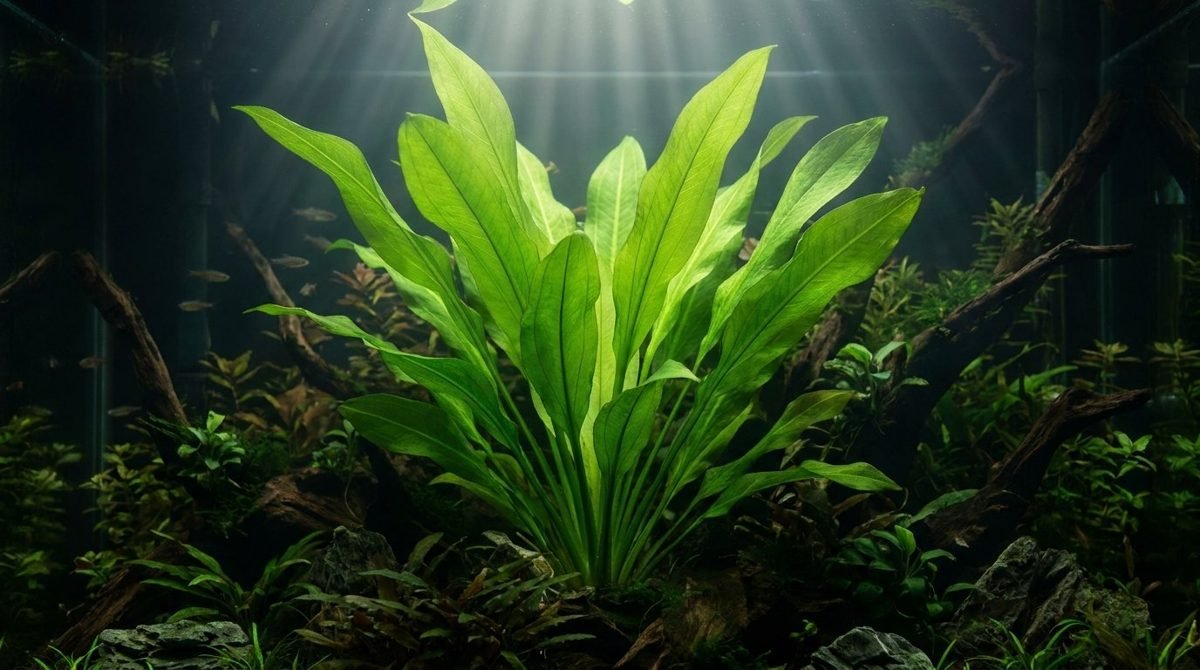
Quick answer: The amazon sword is a big rosette plant for the background of a larger tank, and it’s a heavy root feeder above everything else — give it a nutrient-rich substrate or push root tabs down near the roots, or it yellows and develops holes. It needs no CO2 and only low to moderate light. Plant it with the roots buried but the crown sitting above the substrate, because a buried crown rots. And know going in that it grows large, with leaves running 12 to 20 inches, so it will outgrow a nano tank.
The amazon sword is the first “big” plant a lot of people buy, usually as the green centerpiece for a community tank, and it’s also the plant I get the most worried emails about. The story is almost always the same: it looked gorgeous for a few weeks, then the leaves started going pale and getting little holes, and now the owner is sure they did something wrong. Most of the time they didn’t, so much as they didn’t do the one thing this plant actually demands. I’ve grown swords in everything from a soil tank to plain gravel, and the difference between a sad sword and a two-foot monster comes down to feeding the roots.
So this is the guide I’d hand someone standing in the fish store about to drop a sword into a 10-gallon. What it needs, how to plant it so the crown doesn’t rot, why a brand-new one drops half its leaves, and how to deal with the yellowing-and-holes problem that scares everybody. I grow mine low-tech with no pressurized CO2, and that’s the setup I’m writing for.
What an amazon sword is
The amazon sword is a large rosette plant from the genus Echinodorus — you’ll see it sold as Echinodorus grisebachii, E. bleheri, or just “amazon sword,” and the labels are often interchangeable at the store. Rosette means all the leaves grow out from a single central base called the crown, fanning up and outward instead of climbing a stem. The leaves are broad, sword-shaped, and bright green, and on a healthy plant in a deep tank they can reach 12 to 20 inches long. That’s not a typo. A single mature sword can fill a third of a standard tank by itself.
That size is the whole point and the whole problem. Used as a centerpiece or a background plant, one sword anchors an entire scape — you put it center or back, let it fan out, and build everything else around it. But in a small tank that same growth habit just means a wall of leaves blocking all your light and crowding the fish. It’s a plant that rewards a tall, larger tank and punishes a nano. I keep notes on it and its tankmates over in the plant library if you want to compare it against smaller options.
Amazon sword care at a glance
| Requirement | What an amazon sword needs |
|---|---|
| Light | Low to moderate. It grows under almost any planted-tank light; strong light just speeds it up and invites algae if the plant isn’t well fed. |
| CO2 | Not required. It’s a solid low-tech plant. CO2 makes it grow bigger and faster, but you do not need it. |
| Substrate | The big one. It’s a heavy root feeder, so use a nutrient-rich substrate and/or push root tabs down near the roots. Plain gravel without tabs will starve it. |
| Temperature | Roughly 72–82°F. Comfortable in standard tropical community tanks. |
| pH | About 6.5–7.5. Not fussy within the normal community range. |
| Tank size | Larger tanks. Leaves reach 12–20 inches, so it needs depth and width. It will outgrow nano and most small tanks. |
| Placement | Centerpiece or background. Bury the roots, keep the crown above the substrate. |
If you read nothing else in that table, read the substrate row. Light, CO2, temperature, and pH on a sword are all forgiving. The thing it genuinely cares about — the thing that decides whether you get a lush green centerpiece or a yellowing wreck full of holes — is food at the roots. Everything else is slack.
How to plant an amazon sword
This is where new keepers lose swords in the first couple of weeks, and the fix is one line: bury the roots, but keep the crown above the substrate. The crown is the firm central base where all the leaves meet the roots. If you plant the sword too deep and bury that crown, it rots, the leaves come loose, and the plant collapses from the middle out. Too shallow and it just floats off. You want the roots tucked down into the substrate and the crown sitting right at the surface of it, with the green starting where the substrate ends.
My method: trim any long or mushy roots back with scissors so they’re easier to handle, make a hole in the substrate with my fingers, spread the roots down into it, and pull the gravel or sand back around them — up to the crown, not over it. Then I give the plant a gentle tug; if it lifts, it’s too loose, so I re-seat it. Swords have a big, hungry root system, and once it grips, nothing moves the plant.
Because it’s a heavy root feeder, planting is the moment to add root tabs. Push a tab or two into the substrate right under where the roots will sit, and add more in a ring around the plant as it grows. In plain gravel or sand this is non-negotiable. Even in a nutrient soil I start adding tabs after the first few months once the soil runs low. If your sword grows well for a while and then stalls and pales, fresh root tabs are almost always the answer. I go deeper on this in my guide to the best substrate for aquarium plants.
Feeding a heavy root feeder
Feeding is the number-one care factor for this plant, full stop. An amazon sword pulls most of its nutrition up through its roots, not out of the water column. So liquid fertilizer alone — the kind that’s plenty for a tank of stem plants — often isn’t enough for a sword. The plant can sit in well-dosed water and still slowly starve, because the food it wants isn’t where its roots are.
So the foundation is the substrate. Either start with a nutrient-rich planted substrate, or commit to root tabs in inert gravel or sand, refreshed every couple of months. Tabs are cheap and they’re the single best thing you can do for a sword. Push them down near the root mass, not scattered on the surface where they do nothing for this plant.
The two nutrients swords most often run short on are iron and potassium, and the symptoms are specific. Iron shortage tends to show as new leaves coming in pale or yellow with the veins staying greener — yellowing that starts at the top of the plant. Potassium shortage classically shows as pinholes in the leaves, little holes that can spread into larger transparent patches with a yellow halo. If you’re seeing either, a comprehensive root tab plus a liquid fert with iron usually turns it around over a few weeks of new growth. The old damaged leaves won’t heal — watch the new ones to know it’s working.
Why new amazon swords melt
Here’s the thing that makes people throw out a perfectly good plant. Most amazon swords are grown by nurseries emersed — that is, with their leaves up in the air above the waterline, where they grow faster and cheaper. The plant you buy is wearing a set of leaves built for life in the air. When you submerge it in your tank, those emersed leaves often can’t cope, and the plant drops them — they go soft, yellow, and ragged, sometimes within the first week or two. This is the famous “transition melt,” and it looks like the plant is dying.
It almost never is. As long as the crown stays firm, the sword is just swapping wardrobes. It pulls energy out of the old emersed leaves and pushes new submersed leaves from the center — leaves actually built for being underwater, often a slightly different shape and a richer green. Don’t toss a melting sword. Trim off the fully mushy leaves so they don’t foul the water, keep the crown buried but not covered, keep feeding the roots, and give it a few weeks. The new growth coming from the middle is the plant telling you it’s fine.
How to propagate amazon sword
This is the fun part, and it’s free plants. A happy amazon sword propagates by sending out long stalks — they look like flower or runner stalks — that arch out from the crown, and along those stalks it grows little baby plants called adventitious plantlets. Each plantlet sprouts its own tiny rosette of leaves and, given time, its own roots, right there on the stalk while still attached to the mother plant.
You let those plantlets develop until each one has a few leaves and a small set of roots of its own — that’s when they’re ready. Then snip the plantlet off the stalk and plant it in the substrate exactly like the parent: roots buried, crown above the surface, a root tab underneath. It grows into a full sword over the following months. One mature plant can throw several plantlets on a single stalk, so a single sword turns into a row of them surprisingly fast. If a stalk reaches the surface and tries to flower, you can let it, but most low-tech keepers just harvest the submersed plantlets.
Common amazon sword problems and fixes
Yellowing leaves. Almost always a feeding problem, because this is a heavy root feeder running short on food at the roots. If the yellowing is on new top growth with greener veins, suspect iron. Add comprehensive root tabs near the base and a liquid fert with iron, and judge it by the new leaves over the next few weeks. Don’t expect already-yellow leaves to turn green again — they won’t.
Holes and transparent patches. The classic potassium shortage. It starts as pinholes and can grow into larger see-through patches, often with a yellow edge. The fix is the same family — root tabs and a balanced fertilizer that includes potassium. Again, the damaged leaves stay damaged; you’re feeding the next generation of leaves, not repairing the old ones.
Melting right after you bought it. That’s the emersed-to-submersed transition from the section above, and it’s normal. Trim the mush, keep the crown firm and above the substrate, keep feeding the roots, and wait for new submersed leaves. Don’t throw it out.
Whole plant going soft and collapsing from the center. This one is usually a buried crown that’s rotting. Gently lift the plant, check whether the crown is mushy, replant with the crown above the substrate, and it often recovers if the rot hasn’t gone too far. New to all of this? My aquarium plants beginner’s guide walks through the basics that head off most of these problems.
Is amazon sword right for your tank?
An amazon sword is a yes if you have the room and you’re willing to feed the roots. It’s ideal for a larger, deeper tank — a 29-gallon and up is where it really shines — as a centerpiece or background plant, in a low-tech setup with no CO2, run by someone who’ll drop in root tabs every couple of months. Do that and you get one of the most impressive plants you can grow without gear, a green sword fountain that anchors the whole scape.
It’s a no, or at least a “think hard,” if your tank is small. This bears repeating because it’s the most common mismatch I see: an amazon sword will outgrow a nano tank and most 10-gallons, lying its leaves across the surface and shading everything underneath within months. In that case you want a smaller plant — something like a cryptocoryne gives you a similar rooted, root-feeding plant in a much more manageable size. And if you’re not prepared to feed the roots at all, skip the sword; it’s the one thing it can’t forgive. For everyone with the space and a bag of root tabs, though, it’s hard to beat.
Keep reading
FAQ
Does amazon sword need root tabs or CO2?
Root tabs yes, CO2 no. The amazon sword is a heavy root feeder, so unless you’re using a nutrient-rich substrate you need to push root tabs into the substrate near its roots, or it yellows and develops holes. CO2 isn’t required at all — it’s a good low-tech plant. CO2 will make it grow bigger and faster, but plenty of beautiful swords grow with none.
How big does an amazon sword get, and what tank size does it need?
Big. Leaves on a mature plant can reach 12 to 20 inches long, and the whole rosette fans out wide, so it needs a larger, deeper tank — roughly a 29-gallon and up is where it’s comfortable. It will outgrow a nano tank and most 10-gallons, where it just lies across the surface and shades everything below it. Match it to a tall tank and give it room.
Why is my amazon sword getting holes or turning yellow?
Those are nutrient-deficiency symptoms, because it’s a heavy root feeder that’s run short of food at the roots. Pinholes and transparent patches usually mean potassium; yellowing on new top growth with greener veins usually means iron. The fix is comprehensive root tabs near the base plus a liquid fertilizer with iron and potassium. The old damaged leaves won’t recover, so judge progress by the new leaves over the next few weeks.
Why is my new amazon sword melting?
Because it was grown emersed — out of the water — at the nursery, and the leaves it arrived with aren’t built for being submerged. When you put it in your tank it drops those old leaves, going soft and yellow, and regrows new submersed leaves from the crown. This transition melt is normal and almost never kills the plant. Trim the mushy leaves, keep the crown firm and above the substrate, keep feeding the roots, and wait for new growth. Don’t throw it out.
How do I plant an amazon sword?
Bury the roots in the substrate but keep the crown above it. The crown is the firm central base where all the leaves meet the roots, and if you bury it, it rots and the plant collapses from the middle. Spread the roots down into the substrate, pull it back around them up to but not over the crown, and push a root tab underneath. Give the plant a gentle tug; if it lifts, re-seat it deeper at the roots.
How do I propagate amazon sword?
Let it grow plantlets. A healthy sword sends out long stalks from the crown, and baby plants — adventitious plantlets — form along those stalks. Wait until each plantlet has a few leaves and some small roots of its own, then snip it off the stalk and plant it in the substrate like the parent: roots buried, crown above the surface, a root tab underneath. Each one grows into a full sword over the following months.
Educational guidance, not veterinary advice.
Author and editorial note
Written and maintained by Benjamin Thoden, founder of DBC Aquatics. This plant guide is reviewed for low-tech practicality: correct placement, light level, substrate or rhizome needs, melt risk, algae pressure, and what a beginner can maintain consistently. See our editorial standards for how guides are created, reviewed, and updated.
Leave a Reply