Aquarium Heater Failed Overnight? Do Not Warm The Tank Too Fast
Quick Answer
If your aquarium heater failed overnight and the tank is colder than normal, do not dump in hot water or try to force the temperature back all at once.
First, confirm the temperature with a separate thermometer. Increase oxygen and surface movement. Check whether the heater, outlet, power strip, GFCI, or thermometer is the real problem. Then restore stable heat gradually with safe equipment while watching fish behavior.
The goal is not to hit the old number instantly. The goal is to protect fish from sudden temperature swings and a second shock while you bring the tank back under control.
First 10 Minutes
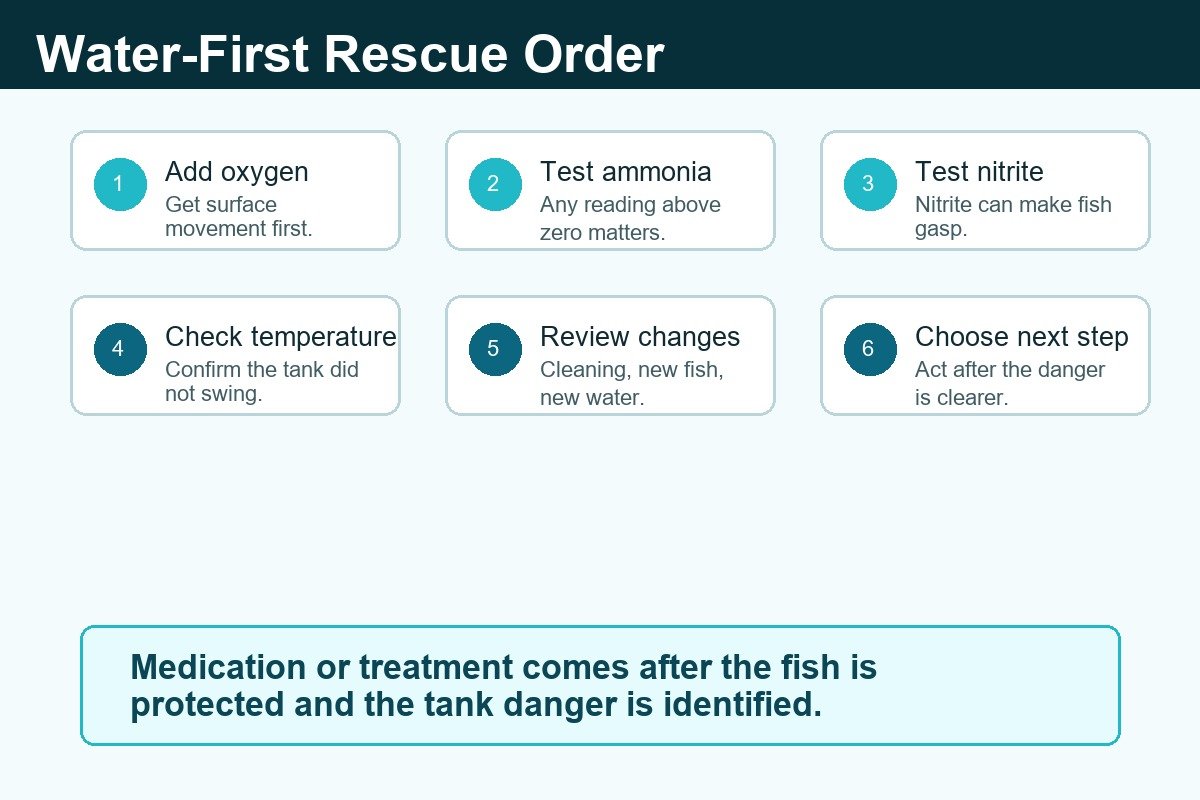
Do these in order:
- Confirm the reading. Use a separate thermometer if you have one. A failed thermometer can look like a failed heater.
- Increase oxygen. Add an air stone, raise surface movement, or aim the filter return at the surface.
- Check power and equipment. Look at the heater indicator, outlet, GFCI, power strip, and cord position without putting yourself at electrical risk.
- Observe the fish. Look for sluggish swimming, clamped fins, hiding, gasping, rolling, or sudden darting.
- Restore heat gradually. Use a working heater sized for the tank and avoid sudden hot-water corrections.
- Keep monitoring. Recheck temperature and fish behavior often until the tank is stable.
Why Fast Warming Can Make Things Worse
Cold stress is frightening, but rapid temperature swings can be another stressor.
Fish are not helped by panic changes. A sudden jump can be harder on them than a controlled recovery, especially if they were already cold for hours.
The safe move is to confirm what happened, restore reliable heat, keep oxygen strong, and avoid changing five things at once.
Why This Safety Order Fits Fish Physiology
This is not just a “go slow” preference. Fish depend on the water around them for body temperature and oxygen. The Merck Veterinary Manual notes that fish have species-specific temperature ranges, that sudden temperature changes can stress fish, and that dissolved oxygen problems can make fish pipe or gasp at the surface.
Oxygen is part of the heater-failure check because temperature changes and oxygen stress can overlap. The U.S. EPA dissolved oxygen guide explains that warmer water holds less dissolved oxygen, and UF/IFAS Extension describes fish gasping at the surface as a sign that low dissolved oxygen may be involved.
That is why this DBC rescue order verifies the temperature, protects surface movement, checks equipment safely, and warms gradually instead of guessing, medicating first, or chasing a number fast. Species tolerance still matters, so a cold-tolerant fish and a warm-water tropical fish may not respond the same way.
The Recent-Change Clue
This problem usually starts after one of these clues:
- The tank is colder than normal in the morning.
- Fish are sluggish, hiding, clamped, or breathing harder than usual.
- The heater light is off, stuck on, or acting differently.
- The room was colder overnight.
- A power strip, outlet, GFCI, or breaker may have tripped.
- A thermometer reading does not match how the tank usually feels or behaves.
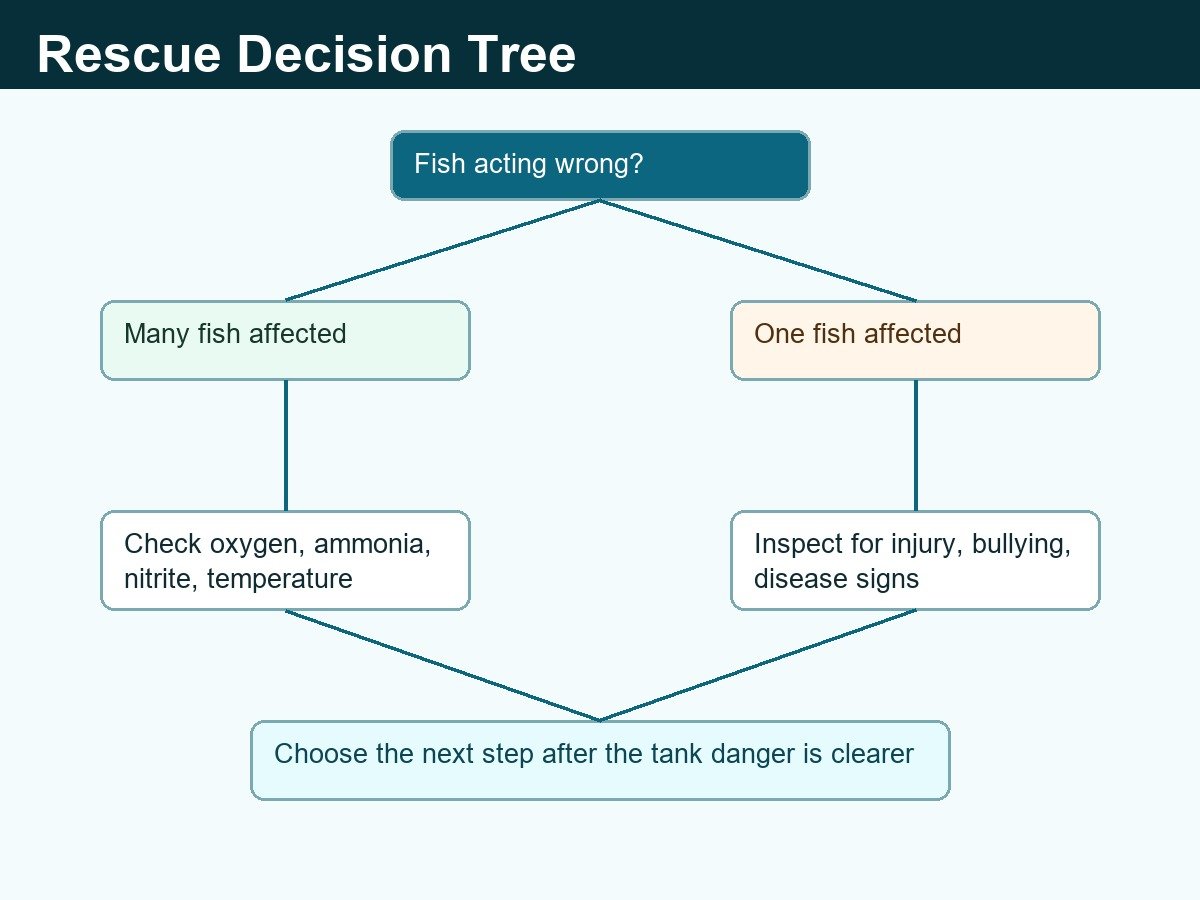
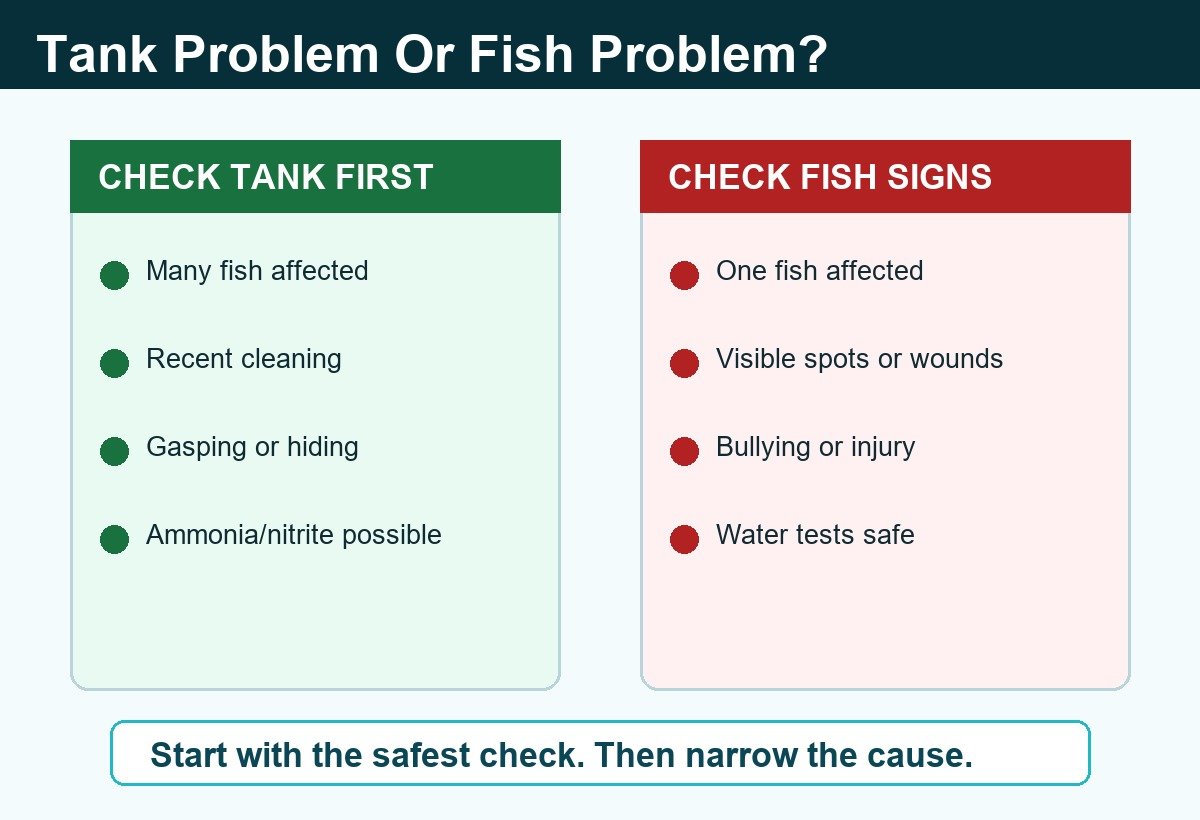
If multiple fish are acting wrong at the same time, start with the shared environment before treating one fish as sick.
What To Check Before You Change Anything
| What You Check | What It Can Mean | First Safe Move |
|---|---|---|
| Separate thermometer confirms low temperature | The tank may truly be cold. | Restore heat gradually and keep oxygen strong. |
| Heater light is off | Heater, outlet, GFCI, or power strip may have failed. | Check power safely and use reliable replacement equipment if needed. |
| Fish are gasping near the surface | Oxygen stress may be part of the emergency. | Increase surface movement and use the fish gasping rescue path if needed. |
| One thermometer reads differently than another | The thermometer may be wrong. | Do not chase a number until the reading is verified. |
| Heater appears damaged or unsafe | Electrical risk or equipment failure is possible. | Unplug safely if needed and replace equipment; do not put hands near suspect electrical gear. |
One Measured Action
Pick the next action based on what you confirmed:
- If the tank is truly cold, restore heat gradually with working equipment.
- If the outlet or GFCI failed, correct the power issue safely before trusting the heater again.
- If fish are gasping, increase oxygen immediately and check the fish gasping guide.
- If the thermometer is suspect, verify the reading before changing the tank.
- If equipment looks damaged, stop using it and replace it safely.
Do not medicate just because fish look stressed after a temperature problem. Medication does not fix a cold tank, failed heater, low oxygen, or electrical fault.
Protect The Shared Environment
A heater failure is not a reason to deep-clean the tank.
Do not replace filter media, scrub the tank, or perform a full reset while fish are already stressed. Keep the filter running if it is safe and functional, keep oxygen high, and avoid adding new variables unless testing or observation justifies them.
If you also find ammonia, nitrite, chlorine/chloramine, or another water-quality problem, follow the matching DBC rescue path instead of guessing.
What Not To Do
Avoid these moves during a heater failure:
- Do not pour hot water directly into the aquarium as a blanket fix.
- Do not raise temperature as fast as possible.
- Do not medicate before checking temperature, oxygen, ammonia, nitrite, and recent changes.
- Do not replace all filter media because fish look stressed.
- Do not assume one heater setting or one thermometer reading is automatically correct.
- Do not buy a random replacement and trust it without monitoring.
When To Get More Help
Get experienced fish-health or equipment help if:
- Fish are collapsing, rolling, or unable to swim normally.
- The heater is cracked, sparking, smoking, or electrically suspect.
- The tank temperature is far outside the normal range for the species.
- You cannot confirm whether the heater or thermometer is wrong.
- Fish keep getting worse after oxygen and gradual stabilization.
Internal Rescue Path
Use the next DBC guide that matches what you find:
- If fish are gasping, use the fish gasping rescue guide.
- If water tests show ammonia or nitrite, start with Water Quality Rescue and the matching ammonia or nitrite guide.
- If a controlled water change is justified by testing, use the emergency water change guide.
- If you need the broader emergency path, use the Aquarium Rescue Hub.
Save The Rescue Order
If you are trying to stabilize the tank right now, use the Aquarium Survival Checklist so you do not skip oxygen, temperature, conditioner, filter flow, ammonia, nitrite, or recent changes under stress.
Use the Checklist first. The Blueprint is for building repeatable rescue judgment after the immediate heater problem is under control.
Frequently Asked Questions
What should I check first?
Start with the actual tank temperature, oxygen/surface movement, heater power, outlet or GFCI status, fish behavior, ammonia, nitrite, conditioner, and the most recent change you made to the tank.
Should I warm the tank as fast as possible?
No. Confirm the temperature first, then restore heat gradually with reliable equipment. A sudden temperature jump can create a second stress event.
Can I add hot water to fix it?
Do not use hot water as a blanket fix. It can create uneven hot spots, sudden swings, and conditioner or contamination problems. Use safe equipment and monitor the actual tank temperature.
Should I medicate fish after a heater failure?
Not as the first response. Check temperature, oxygen, ammonia, nitrite, and recent equipment changes first. Medication does not fix a failed heater or low oxygen.
Should I replace the filter too?
No. A heater failure is not a reason to replace biological filter media. Protect the filter unless it is directly unsafe or not running.
Do I need a backup heater?
A backup plan can help, but only if the equipment is correctly sized, tested, and monitored. Redundancy does not replace observation and safe response.
THE DBC RULE
Confirm the reading.
Protect oxygen.
Warm the tank gradually.
Bottom Line
If your aquarium heater failed overnight, slow down before you chase the number.
Confirm the temperature, increase oxygen, check the equipment safely, restore heat gradually, protect the filter, and monitor fish behavior until the tank is stable.
After the immediate problem is under control, use the Aquarium Rescue Blueprint only if you want a repeatable system for preventing and responding to equipment failures.
Leave a Reply