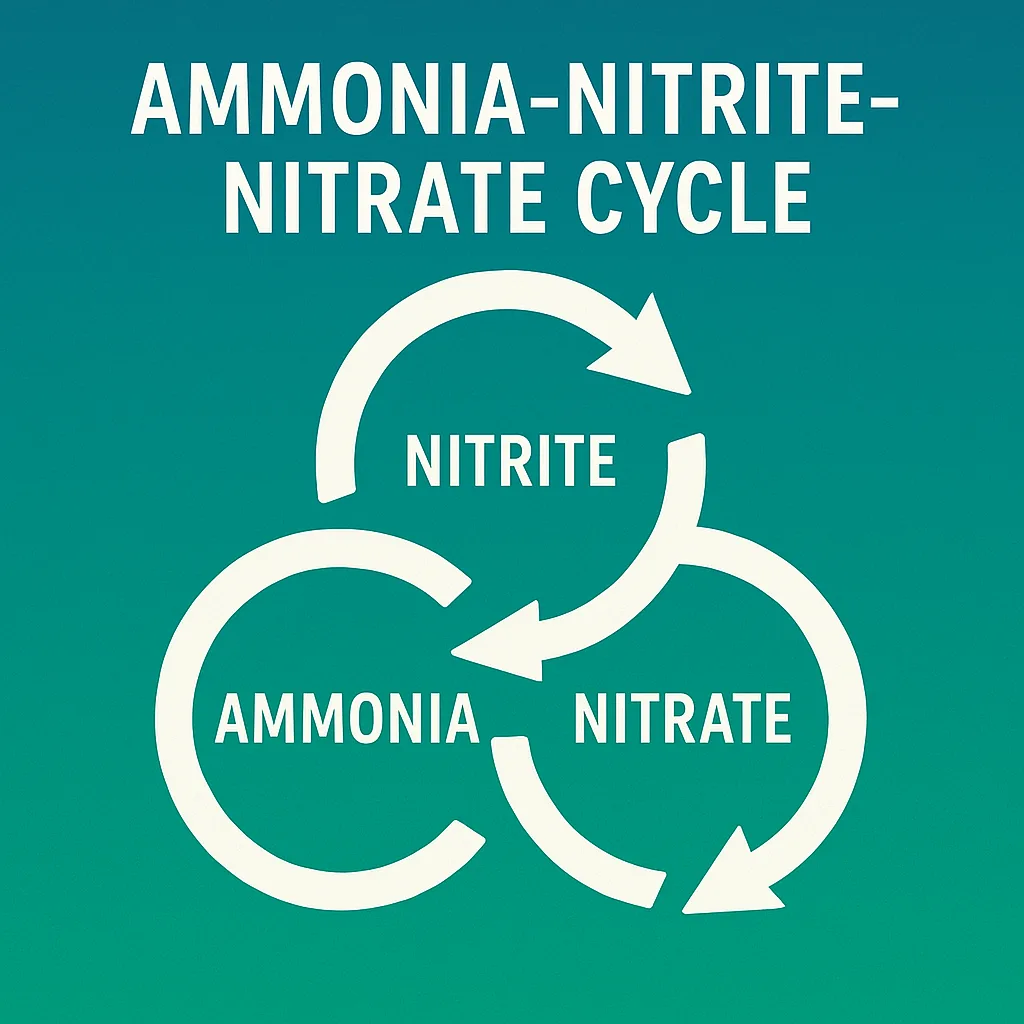
Quick answer: A tank is only truly cycled when it processes ammonia all the way to nitrate — ammonia and nitrite both read 0 ppm while nitrate slowly climbs. A “false cycle” from bottled bacteria, too short a wait, or no ammonia source looks finished but isn’t. Confirm with test readings over several days, not by how long you waited or how the water looks.
Aquarium Nitrogen Cycle Guide: Master the Ammonia-Nitrite-Nitrate Process
If your aquarium is cloudy, your fish are acting stressed, or your new setup just isn’t stable — there’s a good chance the nitrogen cycle is incomplete or mismanaged. The nitrogen cycle, also known as the ammonia–nitrite-nitrate cycle, is the biological foundation of every successful aquarium. Understanding it isn’t just important — it’s essential.
In this detailed guide, we’ll walk through what the nitrogen cycle is, how to set it up properly, and how to troubleshoot it when things go wrong. Whether you’re new to fishkeeping or need a deeper understanding of water chemistry, this guide will give you the clarity and tools to keep your fish happy and healthy.
What Is the Aquarium Nitrogen Cycle?
The nitrogen cycle refers to the biological process that converts toxic fish waste (ammonia) into less harmful substances (nitrate) through the activity of beneficial bacteria. This cycle is critical because ammonia and nitrite are highly toxic, while nitrate is much less harmful in small amounts.
- Step 1: Ammonia (NH3) – Produced by fish waste, leftover food, and decaying matter
- Step 2: Nitrite (NO2) – Created when ammonia is broken down by Nitrosomonas bacteria
- Step 3: Nitrate (NO3) – Final product after Nitrobacter bacteria convert nitrite
This ongoing cycle keeps toxins in check and provides a stable environment for your aquatic life. Without a properly cycled tank, fish can suffer or die from toxic buildup.
How to Cycle a New Aquarium
There are two common methods for cycling a tank: fish-in and fishless. Fishless cycling is recommended for humane and controlled conditions.
Fishless Cycling
- Add a source of ammonia (pure ammonia, shrimp, or fish food)
- Test water daily for ammonia, nitrite, and nitrate
- Add bottled bacteria (like FritzZyme or Seachem Stability) to speed up colonization
- Wait for ammonia to drop to 0, nitrite to spike and drop to 0, and nitrate to rise
Fish-In Cycling
More risky for fish but sometimes necessary. Use only hardy species like zebra danios or platies and do daily water changes. Use ammonia binders like Prime or AmGuard to reduce toxicity.
What You’ll Need
- Filter with biological media (sponge, ceramic rings)
- Water conditioner to remove chlorine/chloramine
- Liquid test kit (API Master Kit is a popular choice)
- Ammonia source (pure ammonia or organic matter)
- Bottled bacteria to seed the tank
Tracking Your Progress
- Days 1–7: Ammonia rises
- Days 7–14: Nitrite spikes as ammonia is converted
- Days 14–30: Nitrate appears and nitrite declines
- After cycling: Ammonia = 0, Nitrite = 0, Nitrate = 10–40 ppm
Once you reach this point, you can add fish slowly, continuing to monitor parameters regularly.
Maintaining the Cycle
Once the cycle is established, your job is to maintain it by feeding fish responsibly, doing regular water changes, and never fully cleaning your filter media in tap water.
- 💧 25–50% water changes weekly
- 🧽 Rinse filter media in tank water only
- 🧪 Test weekly for ammonia, nitrite, nitrate
- 🐟 Avoid overfeeding or overstocking
Common Cycle Problems and Fixes
- ❌ Ammonia never drops: Add more bacteria or increase oxygen
- ❌ Nitrite stalls: Ensure filter is running 24/7 and seeded correctly
- ❌ Cycle crashes: Avoid replacing filter media all at once
- ❌ Fish gasping: Indicates ammonia spike — do a water change and add Prime
Bonus: Use Live Plants to Support the Cycle
Plants can absorb ammonia and nitrate, providing biological support and stability. Great low-light options include hornwort, water sprite, and java fern. Floating plants like frogbit or duckweed are nitrate sponges.
What to Read Next
🎥 Subscribe to DBC Aquatics on YouTube to watch real cycling progress, filter hacks, and water chemistry tips in action — all designed to help you avoid the most common beginner pitfalls.
The False Cycle: Why a Tank Can Read “Done” and Still Kill Fish
Here is the trap almost no beginner sees coming. You dose ammonia (or add a few fish), check the next morning, and ammonia reads 0 ppm. You celebrate and stock the tank. Three days later your fish are gasping at the surface and the nitrite test is bright purple. What happened? You never had a real cycle — you had a false cycle.
When you set up a new tank, the first microbes to explode in population are heterotrophic bacteria — the fast-breeding ones that feed on leftover food, fish waste, and dissolved organics. They reproduce in hours, not days, and they can pull a slug of ammonia out of the water through a process called assimilation (they build it into their own cell mass). That is why ammonia can vanish overnight. But these are not the slow-growing nitrifying bacteria (Nitrosomonas and Nitrospira) that your tank actually depends on long-term. The moment your bioload outpaces those heterotrophs, ammonia and nitrite come roaring back — usually right after you add fish.
There is a second reason a “finished” tank misleads you: the two nitrifier groups grow at different speeds. Nitrosomonas (ammonia → nitrite) colonizes in about 1–2 weeks. Nitrospira/Nitrobacter (nitrite → nitrate) lags far behind — often 3–6 weeks. So ammonia frequently hits zero a full two weeks before the cycle is genuinely complete. Seeing 0 ppm ammonia is the single most common reason beginners stock too early. If your fish are dying while ammonia and nitrite read fine, the cause is almost always elsewhere — see why fish die when water tests fine.
Bottled Bacteria: What It Actually Does (and What It Doesn’t)
“Add this bottle and stock fish the same day” is the most expensive sentence in the hobby. Some refrigerated, properly stored products (the live nitrifier brands) can shorten a cycle meaningfully. Many shelf-stable products do little to nothing — the actual nitrifying strains are fragile and often do not survive months of warehouse heat, freezing trucks, and store shelves. Independent hobbyist testing repeatedly finds little measurable difference between some products and adding nothing at all.
What bottled bacteria realistically does at its best: it seeds the tank so the colony reaches full strength faster. What it does not do: make a tank instantly safe, replace testing, or override your bioload. Even with the best bottle on the market, you must still confirm the cycle with a test (below) before trusting it with livestock. Treat the bottle as a head start, never as a finish line.
Stocking Errors: How “Just a Few More Fish” Overloads the Biofilter
A cycled tank is only cycled for the bioload that built it. Your bacteria colony sizes itself to the amount of ammonia it has been fed. If you cycled on two small fish (or a low ammonia dose) and then add eight fish at once, you have increased the waste faster than the biofilter can process it. Hobbyists often call this a mini-cycle, but it is shorthand for temporary ammonia or nitrite accumulation while the bacteria colony catches up — not a literal restart of the nitrogen cycle. The fix is patience: add livestock in small batches (roughly 1–3 fish per week for a typical community tank), and test for 3–4 days after each addition.
Two stocking mistakes that quietly stall or wreck a cycle:
- Over-dosing the cycle. Pushing ammonia above ~5 ppm during fishless cycling is self-defeating — high nitrite that accumulates above roughly 5 ppm becomes toxic to the nitrite-eating bacteria themselves and stalls the cycle for weeks. Keep ammonia dosing around 2 ppm.
- Killing the colony you can’t see. Ammonia-detoxifying conditioners are fine, but heavy reliance on ammonia removers, plus a pH that drifts to 6.0 or below, can starve or shut down nitrifiers (they nearly stop working at pH ≤6). A pH crash is one of the most common hidden cycle stalls.
The Only Test That Proves Your Cycle Is Done
Forget calendars and forget the bottle’s promises. There is one definitive check: the 24-hour double-zero test.
Dose the tank with pure ammonia to about 2 ppm. Wait 24 hours and test again. A genuinely cycled tank will read 0 ppm ammonia AND 0 ppm nitrite, with a measurable nitrate reading (often 10–40 ppm) to prove the full chain is working. If ammonia is gone but nitrite is anything above zero, you are not cycled — your Nitrospira colony hasn’t caught up. Pass the double-zero test on two consecutive days before you trust the tank with fish, then do a large water change to knock nitrate down before stocking.
Cycling Mistakes Table: Symptom → Cause → Test → Action → Fix
| What you see | Likely cause | What to test | Immediate action | Long-term fix |
|---|---|---|---|---|
| Ammonia hits 0 in a day, fish crash later | False cycle (heterotrophs, not nitrifiers) | 24-hour double-zero test (ammonia + nitrite) | Do not stock; keep testing daily | Wait for both ammonia and nitrite to zero out in 24h before adding livestock |
| Ammonia clears but nitrite stays high | Nitrite-eating bacteria lag behind ammonia eaters | Nitrite + nitrate | Water change to get nitrite under 5 ppm; stop adding ammonia for a day | Patience — give Nitrospira 3–6 weeks; seed media from an established filter |
| Cycle “completed” then nitrite spikes after stocking | Increased bioload temporarily exceeds biofilter processing capacity | Ammonia + nitrite for 3–4 days | Reduce feeding; partial water change; dose dechlorinator that detoxifies ammonia | Add fish in small batches; let colony grow with bioload |
| Bottled bacteria added, tank still not safe | Dead/ineffective product or unverified cycle | Full ammonia/nitrite/nitrate panel | Treat as uncycled; confirm with double-zero test | Use refrigerated live nitrifiers as a head start, not a substitute for testing |
| Cycle stalls for weeks, readings frozen | pH crash (≤6), over-dosed ammonia, or chlorine in top-off water | pH + KH + ammonia | Partial water change with dechlorinated water; check KH buffer | Keep ammonia near 2 ppm, KH above ~4 dKH; always dechlorinate |
| Fish gasping at surface during cycling | Ammonia or nitrite toxicity | Ammonia + nitrite immediately | 25–50% water change now; add ammonia-detoxifying conditioner | Switch to fishless cycling or finish fish-in cycle with daily testing — see the rescue steps below |
When The Nitrogen Cycle Becomes A Fish Emergency
If fish are gasping, clamped, hiding, darting, or dying right after you added livestock or cleaned the tank, do not treat it like a normal cycling lesson. Treat it like a water-quality rescue. Test ammonia and nitrite, add aeration, stop feeding for the moment, and protect the filter bacteria you still have.
- Added several fish at once? Use Added Too Many Fish At Once? so you can slow the temporary ammonia or nitrite buildup without making another swing.
- Cleaned the filter or substrate hard? Use the Filter Bacteria Crash Rescue Guide before replacing more media or scrubbing again.
- Fish are dying after maintenance? Use Fish Dying After Cleaning The Tank Or Filter? and work from symptoms plus test numbers.
- Ammonia or nitrite is above zero? Start at the Water Quality Rescue Hub and follow the measured rescue order.
Emergency Checklist: “I Think I Stocked an Uncycled Tank”
- Test now — ammonia, nitrite, nitrate, and pH. Don’t guess; testing before treating is the whole game.
- Water change 25–50% with temperature-matched, dechlorinated water if ammonia or nitrite is above 0.25 ppm.
- Dose an ammonia-detoxifying conditioner to buy your fish time without killing your bacteria.
- Cut feeding to every other day — less food means less ammonia for the unfinished colony to handle.
- Do not change all filter media, scrub the substrate, or add more fish — you’ll destroy the colony you’re trying to grow.
- Test daily until you hit the double-zero, then resume normal care. If fish show disease signs, run them through the fish symptoms checker before medicating.
This is stabilise → test → diagnose → treat, not the other way around. For a full triage walkthrough, start at the aquarium rescue hub or follow the aquarium rescue blueprint. None of this is veterinary advice — when in doubt, stabilise water first and consult an aquatic vet.
Which ammonia, nitrite, or cycling page should you read next?
The hidden problem is that ammonia, nitrite, nitrate, stocking, filter cleaning, and the nitrogen cycle all overlap. Use the page that matches what is happening in your tank right now.
- Water Quality Rescue Hub – use this when ammonia, nitrite, oxygen, or recent maintenance could be hurting fish now.
- Nitrite poisoning in fish – use this when nitrite is above zero or oxygen symptoms do not match the test numbers.
- Filter bacteria crash rescue – use this when the problem started after cleaning or replacing filter media.
- Added too many fish at once – use this when new livestock pushed waste beyond the current biofilter capacity.
- Emergency water change guide – use this when ammonia or nitrite is unsafe and you need to change water without shocking the tank.
Nitrogen Cycle Mistakes FAQ
My ammonia is zero but my tank still isn’t safe — why?
Ammonia reaching zero only proves your ammonia-eating bacteria are working. The nitrite-eating bacteria grow much slower and often lag two to four weeks behind. Until nitrite also reads zero within 24 hours of dosing ammonia, the tank is not cycled and fish are at risk.
Does bottled bacteria really cycle a tank instantly?
No. At best, properly stored live-nitrifier products give your colony a head start and shorten the cycle. They do not make a tank instantly safe and cannot replace testing. Many shelf-stable products lose viability before you ever open them. Always confirm with the 24-hour double-zero test before stocking.
How do I know for sure my aquarium is fully cycled?
Dose ammonia to about 2 ppm, wait 24 hours, and test. A cycled tank reads 0 ppm ammonia AND 0 ppm nitrite, with measurable nitrate present. Repeat on two consecutive days, then do a water change to lower nitrate before adding fish.
Why did nitrite spike again after I added more fish?
You triggered what hobbyists call a mini-cycle: the added bioload exceeded the biofilter’s current processing capacity. Adding several fish at once produces more waste than the colony can process, so ammonia and nitrite can accumulate until it catches up. Add livestock in small batches and test for a few days after each addition.
My cycle has been stuck for weeks with no change — what’s wrong?
The usual culprits are a pH crash (nitrifiers nearly stop working at pH 6 or below), ammonia dosed above 5 ppm (high nitrite becomes toxic to the bacteria), or chlorine sneaking in through un-dechlorinated top-off water. Check pH and KH, keep ammonia near 2 ppm, and always dechlorinate.
Can I speed up cycling safely?
Yes — seed the new filter with media, sponge, or gravel from an established, disease-free tank. That transfers living nitrifiers directly. Keep the water warm (around 26–29°C / 78–84°F), well-oxygenated, and at a stable pH. Avoid the temptation to over-dose ammonia, which stalls rather than speeds the cycle.
Recommended gear
Liquid Water Test Kit
The only way to confirm a real cycle is watching ammonia and nitrite hit zero while nitrate climbs. A liquid kit is non-negotiable for cycling.
Check price Affiliate linkAs an Amazon Associate I earn from qualifying purchases.
Continue Your Diagnosis
Fish Symptoms Checker Aquarium Rescue Hub Ammonia Spike Symptoms Most Miss Aquarium Rescue Blueprint →Author and editorial note
Written and maintained by Benjamin Thoden, founder of DBC Aquatics. This nitrogen-cycle guide is reviewed through DBC Aquatics’ stability-first lens: ammonia and nitrite testing, biofilter maturity, stocking pace, filter-bacteria protection, oxygen support, and measured corrections before medication or panic changes. See our editorial standards for how guides are created, reviewed, and updated.
Leave a Reply