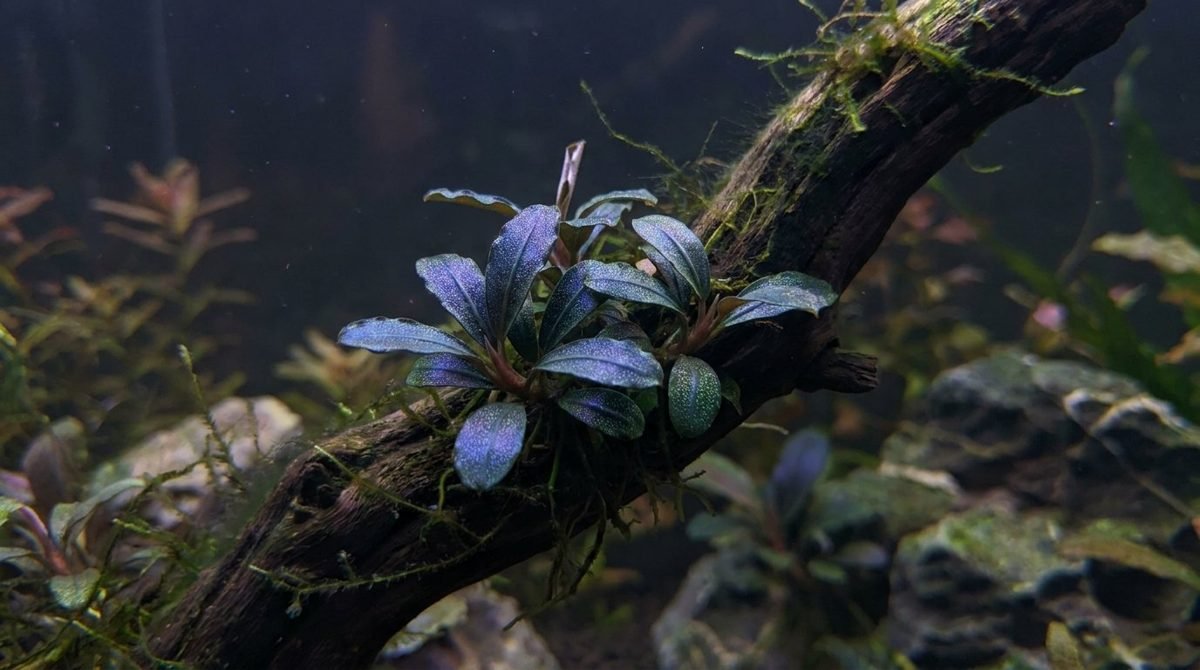
Quick answer: Bucephalandra is a hardy, slow-growing rhizome epiphyte — care it like anubias. You attach it to driftwood or rock with thread or glue; you never bury the rhizome or it rots. Low light and no CO2 are fine, though good light and CO2 pull out the blue and purple iridescence. Newly bought buce often melts its leaves while it adjusts — don’t toss it, the rhizome regrows. It’s a great pick for nano, shrimp, and low-tech tanks.
Bucephalandra was a plant I was nervous to recommend for years, because every batch I got melted within a week of going in the tank. People would panic, and then six weeks later the rhizome would push out fresh leaves like nothing happened. Once I understood the melt is just buce adjusting to new water, it became one of my favorite plants to hand people. It’s tough, it’s slow, and the colors on a settled-in clump are unlike anything else in a freshwater tank.
This is the guide I give people who just bought their first “buce” and aren’t sure what they’re doing with it. It covers what the plant actually is, the care numbers, how to attach it without killing it, why it melts on arrival, how to coax out the blue and purple, and how to split one plant into several.
What bucephalandra is
Bucephalandra (usually sold as Bucephalandra sp. and shortened to “buce”) is a slow-growing rhizome plant from the rivers of Borneo. In the wild it grows attached to rocks along streams, going underwater in the wet season and emersed in the dry — which is exactly why it works as an aquarium epiphyte. Like anubias, it grows from a horizontal rhizome with leaves and roots coming off it, and it pulls nutrients from the water column rather than needing to root in substrate.
There are dozens of named varieties — Brownie, Kedagang, Wavy Green, Mini Coin, and a long list of others — and the leaf shape, size, and color vary a lot between them. The draw is the color. Under the right light the dark green leaves throw a metallic blue or purple iridescent sheen, and many varieties are speckled with tiny pale dots. Settled clumps also send up little white flowers on a stalk that bloom underwater, which almost no other aquarium plant bothers to do.
Bucephalandra care at a glance
Buce is forgiving once it’s established. The numbers below are where it does well — it tolerates a wider range than this, but stay near here and you won’t have to think about it much.
| Requirement | Bucephalandra needs |
|---|---|
| Light | Low to moderate. Low light is enough and is actually safer — strong light over a slow plant invites algae on the leaves. More light deepens the color. |
| CO2 | None required. It grows fine in a low-tech tank. CO2 speeds growth, tightens it up, and brings out the iridescent color, but it’s optional. |
| Temperature | 71–82°F. Comfortable across the normal tropical range, so it suits most community tanks. |
| pH | Roughly 6.0–8.0. Soft or hard, acidic or alkaline — it adapts to most tap water. |
| Placement | Attached to driftwood or rock, rhizome above the substrate. Never buried. You can let the roots into substrate, but never the rhizome. |
| Fertilizer | Optional but helpful. A light all-in-one liquid fert feeds the leaves and supports color. In a stocked, fed tank it often finds enough on its own. |
| Difficulty | Easy once settled. The only real hurdle is the melt new plants go through on arrival. |
If you’ve kept anubias, you already know how to keep buce. The care is nearly identical — slow, epiphytic, and almost impossible to kill once it’s gripped its wood.
How to attach bucephalandra
This is the one thing people get wrong, so I’ll be blunt: do not bury the rhizome in your substrate. The rhizome is the thick horizontal stem the leaves and roots grow from, and if you push it down into gravel or soil it suffocates and rots, and you lose the plant. The roots can go into substrate if you want — it’s only the rhizome that has to stay above it and exposed to water. Buce grows attached to a surface, the same as anubias.
- Pick your hardscape. Driftwood and rough rock are ideal. The roots grip texture over time and the rhizome sits up in the flow where it’s happy.
- Keep the rhizome on top. Lay the plant so the rhizome rests against the surface and the roots face down. The rhizome must stay exposed — never sandwiched under glue or pressed into substrate.
- Tie it with thread. Cotton thread or fishing line wrapped over the rhizome and around the wood or rock holds it while the roots take hold. Cotton dissolves in a few weeks, by which point it’s anchored itself. This is my default.
- Or use gel super glue. Cyanoacrylate gel (the coral-fragging stuff) bonds buce to hardscape in seconds and is aquarium-safe once cured. Dab a small spot on the underside of the rhizome — not over the top — press it down, and hold for a moment.
- Give it time. New roots and the occasional new leaf show over the following weeks. Buce is slow, so don’t expect a flush of growth — expect it to quietly grip and settle.
You can also just wedge it into a crevice between rocks and let the roots do the work with no thread or glue at all. As long as the rhizome stays above the substrate and in the water, it’ll attach on its own.
Why new bucephalandra melts (and what to do)
This is the part that scares everyone, so I’ll be clear: buce melt is normal and almost never fatal. Most buce is grown emersed (out of water) or shipped between very different water for days. When it hits your tank, the established leaves often can’t handle the swing and go soft, translucent, and slough off. It looks like the plant is dying. It usually isn’t.
- Don’t throw it out. The melt is the leaves adjusting, not the plant dying. As long as the rhizome stays firm and green inside, the plant is alive and will regrow.
- Leave the rhizome alone. Attach it as normal and let it sit. The rhizome holds the plant’s energy, and it will push out new leaves that are adapted to your water — often a different, more intense color than the ones it arrived with.
- Trim only fully mush leaves. If a leaf has gone to slime, snip it off so it doesn’t foul the water. Anything still partly intact, leave it — it may hold on.
- Wait it out. New growth can take a few weeks to a couple of months. Patience is the entire treatment. I’ve had clumps look like a total loss and come back fuller than they started.
The only time melt is actually a problem is if the rhizome itself goes soft and brown — that’s rot, usually from being buried, and that’s a different issue covered below.
How to bring out the blue and purple colors
Buce in a dim, bare tank stays a plain dark green, and that’s fine — it’s still a healthy plant. But the iridescent blue and purple that buce is famous for shows up when you give it a bit more to work with. Three things drive the color.
- More light — within reason. Stronger light deepens and reveals the metallic sheen. The catch is that buce grows so slowly that strong light also feeds algae onto its leaves. Moderate light is the safe middle ground: enough to color up, not so much you grow a beard on every leaf.
- CO2. Injected CO2 is the single biggest upgrade for color and for tighter, more compact growth. It’s not required, but a buce in a CO2 tank looks like a different plant than the same variety in a low-tech one.
- Nutrients. A steady supply of liquid fertilizer, especially a little iron and trace, supports the pigments. Lean tanks tend to grow paler buce.
You don’t need all three. Plenty of people get gorgeous color from light and ferts alone in a low-tech tank. CO2 just turns it up to the maximum. And new leaves grown in your tank usually color better than the ones the plant arrived with, so some of this comes down to waiting for fresh growth.
How to propagate bucephalandra
Buce propagates by rhizome division, the same as anubias. It’s slow, like everything else about the plant, but it’s simple and free.
- Cut the rhizome into sections. Use clean, sharp scissors to slice the rhizome into pieces. Make sure each section has at least a few leaves and some roots of its own — a bare chunk of rhizome with nothing on it is much slower to take.
- Attach each division. Tie or glue each new piece to wood or rock exactly like the parent, rhizome on top, roots down. That’s the whole process.
- Be patient. Each division grows into its own plant over the following months. Because buce is slow, propagation is a long game — but one clump turns into several over a year with no real effort.
Dividing also keeps a clump healthy as it ages, and it’s a good way to spread a prized variety across several tanks once you have one established.
Common bucephalandra problems and fixes
Nearly every buce complaint comes down to three things: it melted, it’s growing algae, or the rhizome rotted. Here’s what’s actually happening with each.
- Melt after adding it. Covered above, but worth repeating: new buce melting its leaves is normal adjustment, not death. Leave the rhizome attached, trim only the mush, and wait for new growth. Don’t bin a plant with a firm rhizome.
- Algae on the leaves. Buce grows so slowly that an old leaf sits in the same spot for months, which gives algae plenty of time to settle on it — especially under strong light. Dial the light back to moderate, keep some flow over the plant, and let a few Amano shrimp or otocinclus graze the leaves. Moderate light is the real prevention.
- Rhizome rot. A soft, brown, mushy rhizome means the plant is actually dying, and the usual cause is burying the rhizome in substrate. Lift it out, cut away any rotted section back to firm tissue, and reattach the healthy part above the substrate where water can reach the rhizome.
The thread through all three: keep the rhizome exposed, keep the light moderate, and give new plants time. Do that and buce is close to unkillable.
Is bucephalandra right for your tank
For most nano, shrimp, and low-tech tanks, buce is a fantastic plant once you get past the initial melt. It asks for patience rather than effort. Here’s where it shines and where I’d think twice.
- Nano tanks — yes. Small leaves and slow, compact growth make it ideal for little tanks where a fast plant would take over. It stays put and stays in scale.
- Shrimp tanks — yes. It’s undemanding, the leaves and roots host biofilm for shrimp to graze, and it won’t need the constant trimming that disturbs a shrimp colony.
- Low-tech tanks — yes. No CO2 needed, low light is fine, forgiving on parameters. It’s one of the better-looking plants you can keep in a simple setup.
- Aquascapers chasing color — yes, with CO2. If you want the full blue-purple iridescence, a CO2 tank with moderate light and ferts is where buce earns its reputation.
- Anyone in a hurry — maybe not. If you want a tank to fill in fast, buce will frustrate you. It’s a slow plant by nature, and no amount of light fixes that entirely.
If you’re building a low-tech tank around it, my easy no-CO2 plants guide covers the companions that pair well with buce.
Bucephalandra FAQ
Does bucephalandra need CO2 or high light?
No to both. Buce grows fine in low light with no CO2, which is why it’s a low-tech and nano favorite. Good light and CO2 are what pull out the blue and purple iridescence and tighten up the growth, but neither is required to keep the plant healthy. Moderate light is actually safer than strong light, because buce grows slowly and bright light invites algae onto its leaves.
How do I attach bucephalandra, and can I plant it in substrate?
Attach it to driftwood or rock and never bury the rhizome. The rhizome — the thick horizontal stem the leaves grow from — has to stay above the substrate and exposed to water, or it rots. Tie the plant down with cotton thread or fishing line, or dab a little aquarium-safe gel super glue on the underside of the rhizome and press it onto hardscape. The roots can go into substrate, but the rhizome cannot.
Why is my bucephalandra melting after I added it?
That’s normal. Most buce is grown emersed or shipped through changing conditions, and the established leaves often melt while the plant adjusts to your tank. It looks alarming but it almost never kills the plant. Leave the rhizome attached, snip off only fully mushy leaves, and wait. As long as the rhizome stays firm, it will regrow new leaves over the next several weeks, often with better color than before.
How do I get the blue and purple colors?
Color comes from light, nutrients, and CO2. Moderate light reveals the metallic blue-purple sheen without growing algae on the slow leaves; a steady liquid fertilizer with iron and trace supports the pigments; and injected CO2 is the biggest single upgrade for color and compact growth. You don’t need all three — light and ferts alone color buce up nicely in a low-tech tank. New leaves grown in your tank usually color better than the ones it arrived with.
How fast does bucephalandra grow?
Slowly — that’s its defining trait. Expect a new leaf every few weeks rather than visible spread day to day. More light, CO2, and fertilizer speed it up somewhat, but it’s a slow plant by nature and always will be. The upside is that it rarely needs trimming and stays in scale in small tanks. Patience is the main thing buce asks of you.
How do I propagate bucephalandra?
Divide the rhizome. Use clean, sharp scissors to cut the rhizome into sections, making sure each piece has a few leaves and some roots of its own. Tie or glue each division to fresh wood or rock, rhizome on top and roots down, exactly like the parent plant. Each section grows into its own plant over the following months. It’s slow, like everything with buce, but it’s simple and free.
Keep reading
Author and editorial note
Written and maintained by Benjamin Thoden, founder of DBC Aquatics. This shrimp guide is reviewed through DBC Aquatics’ stability-first lens: cycle maturity, mineral consistency, molt safety, copper risk, grazing surfaces, and slow acclimation matter more than quick fixes. See our editorial standards for how guides are created, reviewed, and updated.
Leave a Reply