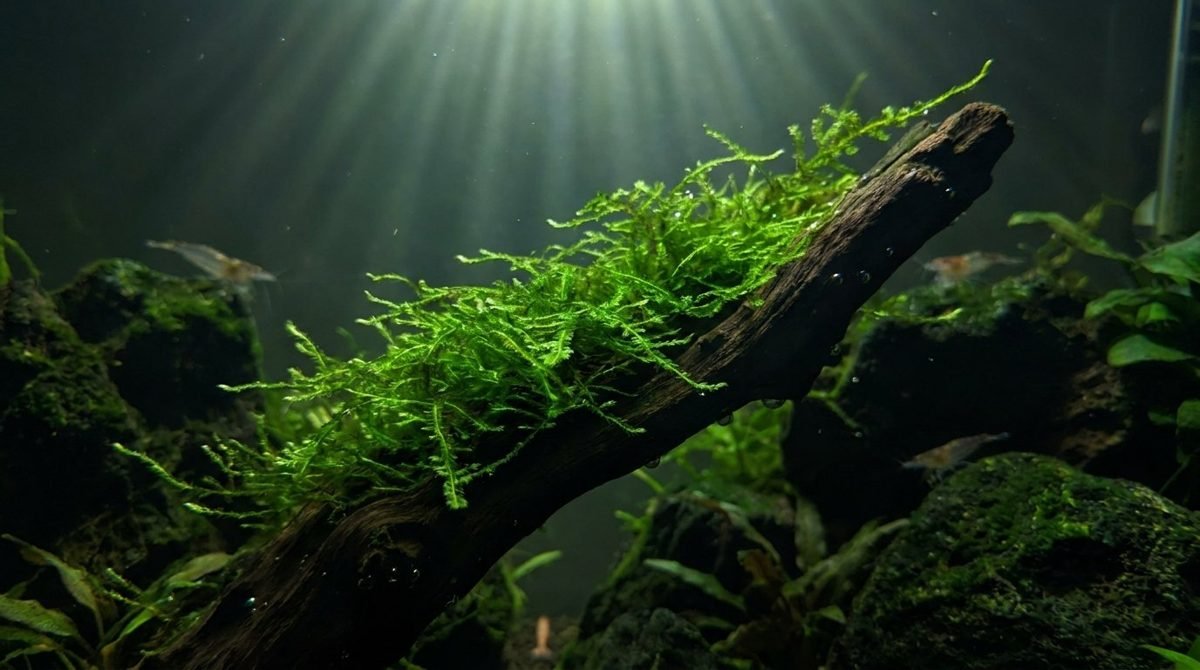
Quick answer: Java moss is the easiest moss to keep — low light, no CO2, and a wide temperature range. You don’t plant it in substrate; you tie or glue it to driftwood, rock, or mesh and let it grow. It’s close to beginner-proof, and it’s one of the best plants you can give a shrimp or fry tank.
Java moss is usually the first plant I hand someone who has killed everything else. I run a freshwater rescue, so I see a lot of tanks barely hanging on — no CO2, a weak stock light, a heater that drifts. Most “real” plants sulk in those conditions. Java moss doesn’t care. I’ve pulled clumps out of tanks that were otherwise a disaster and they were still green and growing.
Watch: Java Moss Magic: Transform Your Aquarium!
This is the guide I give people when they ask how to grow it and, more often, why theirs went brown and matted. It covers what the plant is, the care numbers, how to attach it, how to split it for free plants, and the three problems behind almost every complaint I hear.
What Java moss is and what it looks like
Java moss is Taxiphyllum barbieri, a small freshwater moss from Southeast Asia. It grows as a tangle of thin green stems covered in tiny overlapping leaves — no real roots, no flowers. Instead of roots it puts out rhizoids, little anchoring threads that grip surfaces but don’t feed the plant. Java moss takes everything it needs straight out of the water column through its leaves.
In a tank it reads as a soft green mat or a fuzzy beard. Low light and gentle flow grow it loose and feathery; brighter light grows it tighter and more compact. Left alone, it spreads outward and thickens into a dense pad. That spreading habit is the whole appeal — and, if you ignore it, the whole problem.
Java moss care at a glance
There isn’t much to memorize, which is the point. Java moss tolerates a wider range than almost anything else you’ll keep. The numbers below are where it does best, not hard limits — it survives well outside them.
| Requirement | Java Moss needs |
|---|---|
| Light | Low to moderate. Low light is fine and actually grows it slower and tidier. No special light needed. |
| CO2 | None. Grows perfectly in a low-tech tank. CO2 speeds it up but is completely optional. |
| Temperature | 70–75°F is ideal. Tolerant from about 59–86°F, so it works in unheated and tropical tanks alike. |
| pH | Roughly 5.0–8.0. Soft or hard, acidic or alkaline — it adapts to most tap water. |
| Substrate | None. It does not root in substrate. Attach it to hardscape instead — never bury it. |
| Flow | Gentle to moderate. Some flow keeps detritus out of the mat and feeds the leaves. |
| Difficulty | Beginner. About as forgiving as an aquarium plant gets. |
On fertilizer: it doesn’t need one, but a light dose of all-in-one liquid fert greens it up and speeds spread in a tank with little fish waste. In a stocked, fed tank it finds enough on its own.
How to attach and grow it
This is the one thing beginners get wrong, so I’ll be blunt: do not bury java moss in your substrate. It has no roots to anchor or feed. Buried, the bottom rots, the clump floats free, and you get green threads drifting through the tank and clogging your filter. Java moss grows attached to a surface. You pick the surface, fasten it down, and it grows over it.
- Pick your hardscape. Driftwood and rough rock are ideal — the moss grips texture better than smooth glass. Stainless steel or plastic mesh works if you want a flat moss wall or carpet.
- Spread it thin. Pull the clump apart and lay a thin, even layer over the surface. A thin layer grows out evenly; a thick wad rots in the middle because light and flow never reach the core.
- Tie it down with thread. Cotton thread or fishing line wrapped loosely around the wood or rock holds it while it grips. Cotton dissolves in a few weeks, by which point the moss has anchored itself. This is my default method.
- Or use gel super glue. Cyanoacrylate gel (the coral-fragging stuff) bonds moss to hardscape in seconds and is aquarium-safe once cured. Dab small spots, press the moss on, done. Faster than thread but harder to reposition.
- Give it light and time. Once attached it needs nothing special. New growth shows within a couple of weeks, and it thickens and spreads from there.
One practical note: keep gentle flow moving over a fresh attachment. Stagnant spots collect debris on new moss before it’s established, and that’s where the brown patches start.
How to propagate java moss
Propagation is almost too easy to call propagation. There’s no cutting technique, no rooting hormone, nothing to wait on. You divide it and you have more.
- Pinch off a piece. Any chunk of healthy moss — even a small one — will grow into a full clump on its own. There’s no parent stem it depends on.
- Attach the division somewhere new. Tie or glue it to a fresh piece of wood, rock, or mesh exactly like the original. That’s the entire process.
- Or just let it spread. Left attached and trimmed occasionally, one clump creeps across a piece of driftwood and fills it in over a few months on its own.
- Use your trimmings. Don’t throw clippings out. Net them up to start a new patch, or drop them in a fry or shrimp tank as instant cover.
This is why one small portion turns into enough moss to seed every tank you own within a year. I’ve never bought java moss twice.
Common java moss problems and fixes
Almost every java moss complaint comes down to three things: it’s browning, it’s matting and trapping gunk, or it’s full of algae. Here’s what’s actually happening and how to fix each one.
- Browning underneath. Brown moss is usually the bottom of a clump that’s too thick — light and flow never reach the core, so it dies and rots from the inside. Pull it apart thinner, trim out the dead material, and improve flow. A little browning on old growth is normal; a brown crust through the whole mat is a thickness problem.
- Matting and trapping debris. Not a defect — it’s the plant doing what it does. A dense mat traps fish waste, food, and detritus, and left long enough that gunk fouls the moss and the water around it. Trim it regularly before it gets thick, and once in a while pull the clump and swish it in old tank water to blow the debris out.
- Algae growing through the moss. The fine leaves give algae something to cling to, and stagnant, debris-trapping spots suit it. The cause is almost always too much light or nutrients. Cut the light back, improve flow, and keep trimming. A few Amano shrimp or otocinclus will graze a lot of it off for you.
The thread through all three: java moss problems are maintenance problems, not care problems. Keep it thin, keep flow on it, and trim before it gets out of hand.
Is java moss right for your tank
For most low-tech, shrimp, and fry tanks, it’s one of the best plants you can add. For a high-tech aquascape where you want sharp lines, it can be more fuss than it’s worth. Here’s where it shines and where I’d skip it.
- Shrimp tanks — yes, every time. The dense growth grows biofilm, the main food for shrimp and shrimplets, and gives babies cover from anything that might eat them. It goes into every Neocaridina tank I set up.
- Fry and breeding tanks — yes. A clump is instant shelter for fry and a place for egg-scatterers to spawn into. Standard kit for breeding livebearers and small egg layers.
- Low-tech and beginner tanks — yes. No CO2, low light, forgiving on parameters. It’s the plant most likely to survive a beginner’s first few months.
- Unheated or coldwater tanks — usually fine. Its tolerance down toward the high 50s suits room-temperature setups where tropical plants struggle.
- High-tech display aquascapes — maybe not. If you want crisp, controlled growth, its spreading, debris-catching habit can fight you. There are tidier mosses for that look.
If you’re building a beginner planted tank around it, my beginner plant guide covers the easy companions that pair well with moss.
Java moss FAQ
How do I attach java moss?
Tie or glue it to a hard surface — never bury it. Spread a thin layer over driftwood, rock, or mesh, then wrap it with cotton thread or fishing line, or dab it down with aquarium-safe gel super glue. Cotton thread dissolves after a few weeks once the moss has gripped on its own. A thin layer attaches far better than a thick wad, which rots in the middle.
Does java moss need CO2 or special light?
No to both. Java moss grows fine in low light with no CO2, which is exactly why it’s a beginner and low-tech favorite. Brighter light and added CO2 make it grow faster and tighter, but neither is required. A basic stock aquarium light is plenty.
How fast does java moss grow?
Slowly and steadily in a low-tech tank — expect noticeable spread over weeks, not days. It speeds up with more light, added CO2, and a dose of liquid fertilizer. Even at its slow pace it eventually thickens and spreads enough that you’ll need to trim it regularly.
How do I stop java moss trapping debris and getting dirty?
Trim it regularly and keep gentle flow moving over it. A dense, untrimmed mat traps fish waste and detritus, which is what makes it look dirty. Cut it back with scissors before it gets thick, and every so often pull the clump and swish it in old tank water to flush trapped gunk out. Keeping it thin stops the problem before it starts.
Is java moss good for shrimp?
It’s one of the best plants you can give shrimp. The dense growth grows biofilm, which shrimp and shrimplets graze on constantly, and it gives baby shrimp cover from being eaten. I add it to every shrimp tank I set up. It works the same way for fish fry in a breeding tank.
Can java moss grow floating or out of water?
Yes to both, within limits. It will grow as a floating clump, though it tends to trap more debris and grow less evenly when it’s not attached to anything. It can also grow emersed (out of water) in high humidity, like a paludarium or a covered shallow setup, as long as it stays damp. Fully dry air kills it.
Keep reading
Author and editorial note
Written and maintained by Benjamin Thoden, founder of DBC Aquatics. This shrimp guide is reviewed through DBC Aquatics’ stability-first lens: cycle maturity, mineral consistency, molt safety, copper risk, grazing surfaces, and slow acclimation matter more than quick fixes. See our editorial standards for how guides are created, reviewed, and updated.
Leave a Reply