Emergency Water Change? How Much To Change And What To Check First
When fish are gasping, hiding, clamping their fins, or acting like the tank suddenly turned dangerous, a water change can feel like the obvious move.
And sometimes it is.
But in an emergency, the wrong water change can make things worse. Too much temperature difference, forgotten dechlorinator, or a filter cleaning at the same time can turn a fix into another problem.
Before you drain half the tank, slow down for a minute. The goal is not to change the most water. The goal is to protect the fish, reduce the danger, and avoid damaging the bacteria that help the tank recover.
Quick Answer
If you think your aquarium needs an emergency water change:
- Increase oxygen immediately.
- Test ammonia and nitrite.
- Match the new water temperature as closely as possible.
- Use dechlorinator before the new water reaches the fish.
- Change only the amount the test result and fish behavior justify.
- Leave the filter media alone unless flow is blocked.
- Retest after the water change.
If fish are gasping at the surface, add oxygen first, then use the Fish Gasping At The Top rescue guide to check oxygen, ammonia, nitrite, temperature, and filter flow.
Emergency: If multiple fish are gasping, rolling, losing balance, or rapidly getting worse, increase aeration now. Then test ammonia and nitrite before adding medication or deep-cleaning the tank.
Prefer to watch the rescue order? Ben walks through the same oxygen, testing, water-change, and filter-protection sequence in the video below.
For the full written route through related water-quality emergencies, start at the Water Quality Rescue Hub.
How Much Water Should I Change?
Use this as a starting point, not a blind rule.
| What You Find | Risk | First Water Change | What To Do Next |
|---|---|---|---|
| Fish acting normal, ammonia 0 ppm, nitrite 0 ppm | Low | Usually none | Observe and test again later. |
| Mild stress, ammonia or nitrite near 0.25 ppm | Concern | 20-30% | Increase oxygen, stop feeding, retest. |
| Clear stress, ammonia or nitrite around 0.5 ppm | Moderate | 30-50% | Retest, repeat smaller changes if needed. |
| Fish gasping or ammonia/nitrite near 1.0 ppm or higher | Emergency | 50% may be justified | Increase oxygen, match temperature carefully, retest. |
| Chemical exposure, forgotten dechlorinator, or severe contamination | Emergency | Large changes may be needed | Use conditioned, temperature-matched water and watch fish closely. |
The more urgent the situation, the more careful the setup needs to be. Big water changes are not automatically bad, but rushed water changes are where many problems happen.
Most emergency water changes do not fail because too little water was changed. They fail because too many things changed at once.
Emergency Water Change Decision Flow
Use this flow before you drain more water.
Fish in trouble
-> Test ammonia and nitrite
-> Both are 0 ppm
-> No emergency water change yet
-> Observe, increase oxygen if fish are breathing hard, and look for another cause
If ammonia or nitrite is above 0 ppm:
-> Increase oxygen
-> Do a controlled water change
-> Protect the filter
-> Retest
If The Aquarium Is New
A new aquarium can look clear while the biological filter is still learning to process the current waste load.
If ammonia or nitrite appears in a new tank, do not treat the water change as the entire fix. Increase oxygen, reduce feeding temporarily, protect the filter media, and retest every day. Ammonia may fall before nitrite rises, so test both until they remain at 0 ppm.
Use the Nitrogen Cycle Rescue Hub to follow the ammonia, nitrite, and filter-bacteria path. Before adding more fish, work through the Aquarium Startup Checklist.
When Not To Change More Water Yet
A water change is not always the first move.
Another large water change may not be the safest next step if:
- Ammonia is 0 ppm.
- Nitrite is 0 ppm.
- Fish are behaving normally.
- You only noticed cloudy water for a few minutes.
- The tank was already changed heavily today.
In that situation, slow down. Keep oxygen steady, watch the fish, retest later, and look for what actually changed before you make the tank go through another major swing.
THE DBC RULE
Test the water.
Protect the fish.
Protect the filter bacteria.
Then decide the size of the water change.
An emergency water change is not a random reset button. It is a controlled rescue step. You are trying to dilute the danger while keeping the tank stable enough to recover.
Why A Water Change Helps
A water change can dilute ammonia, nitrite, chlorine mistakes, decaying waste, and other dissolved problems.
It does not fix the cause by itself.
If ammonia is high because the filter bacteria are damaged, the water change helps the fish right now. But the tank still needs time and protected bacteria to stabilize again.
If nitrite is high, the water change helps reduce the level. But you still need oxygen support, daily testing, and filter protection until nitrite stays at 0 ppm.
This is why the DBC rescue order does not stop at “change water.” It always asks what caused the emergency.
When A Water Change Can Make Things Worse
One of the most common patterns I see is a fishkeeper doing everything at once.
They change a lot of water.
They gravel vacuum heavily.
They rinse the filter.
They replace the cartridge.
Each step seems reasonable by itself. Together, they can shock the fish, stir up waste, and remove the bacteria the tank needs most.
An emergency water change should be controlled. Do the water change. Protect oxygen. Protect the filter. Then test again.
Do not turn one emergency into five changes at the same time.
Here is the pattern I want you to watch for: a fishkeeper changes a large amount of water, scrubs the filter, gravel vacuums heavily, and then the fish look worse the next morning. The water may even look cleaner, but the tank lost part of the bacteria it needed. In that situation, another rushed cleaning usually is not the answer. Oxygen, testing, controlled water changes, and filter protection are the safer path.
Real Rescue Example
In my experience, one of the easiest emergency traps is thinking the tank needs to look cleaner before the fish can recover.
I have seen tanks where the fish looked worse after a big water change because the owner also rinsed the filter under tap water and replaced the cartridge. The water looked clear, but ammonia or nitrite showed up because the biological filter had been knocked backward. The rescue was not another big cleaning. It was oxygen, conditioned water, daily testing, and leaving the filter bacteria alone long enough to recover.
Before you decide what to do next, ask what changed in the last 48 hours:
- Did you clean or replace filter media?
- Did you do a large water change?
- Did you add new fish?
- Did anyone feed extra?
- Did the filter slow down or stop?
- Did the temperature swing?
- Did you forget or under-dose dechlorinator?
Those answers often tell you more than the cloudiness or the fish behavior alone.
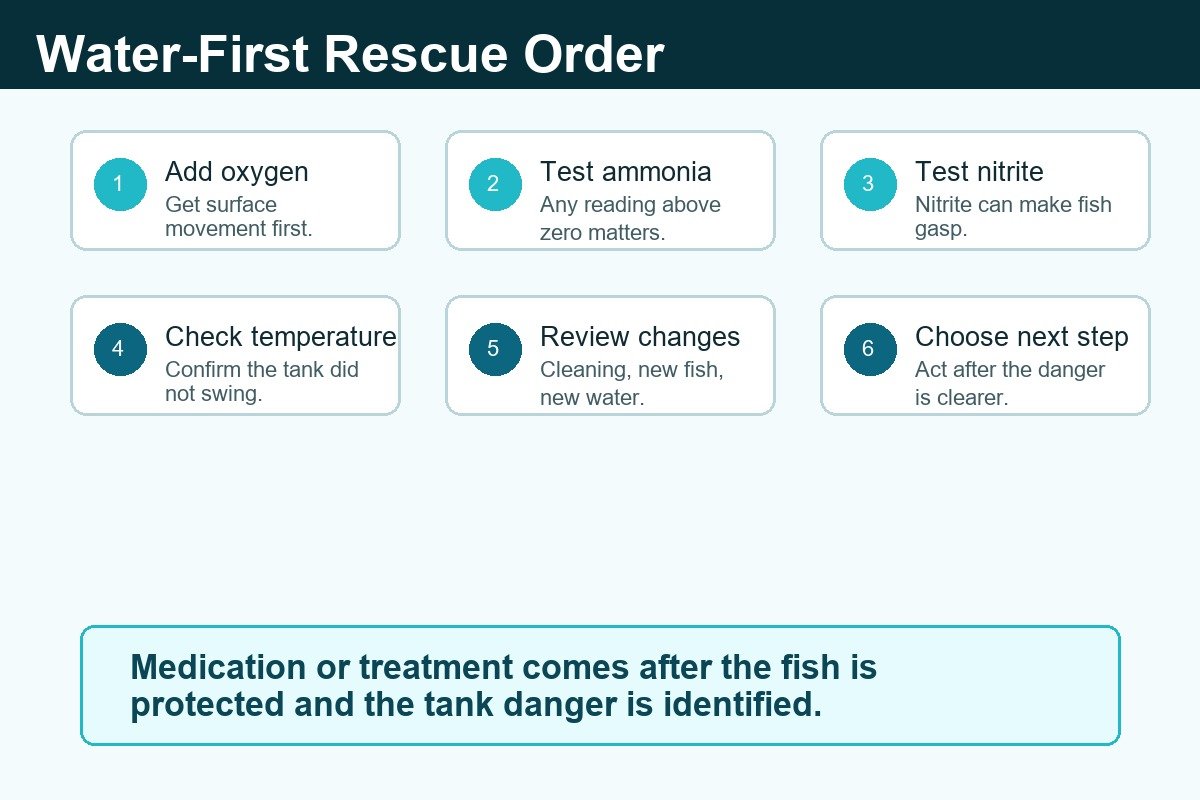
Step-By-Step Emergency Water Change Order
Follow this order when fish are already stressed.
- Add oxygen first.
- Turn off equipment only if needed for safety.
- Test ammonia and nitrite.
- Prepare replacement water.
- Match temperature as closely as possible.
- Add dechlorinator at the correct dose.
- Remove water slowly enough that fish are not thrown around.
- Refill gently.
- Confirm filter flow is normal.
- Retest ammonia and nitrite.
- Watch breathing, balance, and swimming for the next hour.
If you need the whole rescue order in one place, download the free Aquarium Survival Checklist and keep it near your tank.
Temperature And Dechlorinator Matter
The two easiest mistakes are also two of the most dangerous.
New water should be close to the tank temperature. It does not need to be perfect to the decimal, but it should not feel dramatically colder or warmer.
Dechlorinator matters because untreated tap water can hurt fish and filter bacteria. If you forgot conditioner during a water change, correct that first before guessing at disease or medication.
If fish got worse right after maintenance, use Fish Dying After Cleaning The Tank Or Filter? What To Do Now to check whether chlorine, filter bacteria damage, oxygen, ammonia, or nitrite is the real issue.
If Ammonia Is Above 0 ppm
Ammonia is an emergency because it can damage gills and stress fish even when the water looks clear.
Start with:
- Increase oxygen.
- Stop feeding temporarily.
- Do a controlled water change based on the level and fish behavior.
- Protect the filter media.
- Retest after the water change.
If ammonia is present, go to the Ammonia Spike Emergency guide.
If Nitrite Is Above 0 ppm
Nitrite is dangerous because fish can struggle to use oxygen properly even when the tank has oxygen in the water.
Start with:
- Increase oxygen.
- Stop feeding temporarily.
- Do a controlled water change.
- Protect the filter.
- Retest daily until nitrite is 0 ppm.
If nitrite is present, use the Nitrite Poisoning rescue guide.
If Fish Are Gasping
Do not assume the water change alone fixed the problem.
Fish gasping can point to low oxygen, ammonia, nitrite, warm water, poor surface movement, or filter flow problems.
After the water change, watch:
- Are fish leaving the surface?
- Is breathing slowing down?
- Is the filter moving water normally?
- Did ammonia or nitrite drop?
- Is temperature stable?
If gasping continues, use the Fish Gasping At The Top rescue guide.
If The Water Is Cloudy Or Smells Bad
Cloudy water plus bad smell can mean extra waste, decaying food, dead plant matter, dead livestock, or damaged filter bacteria.
Do not just change water and walk away.
Check for:
- Hidden food.
- Dead leaves.
- Dead fish, shrimp, or snails.
- Blocked filter intake.
- Heavy debris in one area.
- Ammonia or nitrite.
Use the Cloudy Water, Bad Smell, Or Gasping Fish rescue guide if cloudiness, smell, and fish stress are happening together.
What Recovery Usually Looks Like
| Timeframe | What You Want To See |
|---|---|
| First 10 minutes | More oxygen, calmer surface behavior, filter running normally. |
| First hour | Breathing may improve if oxygen, ammonia, nitrite, or chlorine exposure was reduced. |
| First 24 hours | Ammonia and nitrite should trend down with correct water changes and reduced feeding. |
| Two to seven days | Filter bacteria should begin stabilizing if the media and flow are protected. |
| One to three weeks | The tank should become more predictable if the cause is fixed. |
Most tanks do not become stable because of one perfect water change. They recover because the fish are protected while the biological filter catches up.
If The Rescue Is Not Working
If ammonia or nitrite keeps returning after water changes:
- Check that the tank is not being overfed.
- Confirm the filter is flowing.
- Make sure filter media was not replaced or scrubbed.
- Look for hidden decaying material.
- Test your tap water.
- Verify your test kit is not expired.
- Review whether the aquarium is overstocked.
If the same emergency keeps repeating, the problem is probably not the water change. It is tank stability.
That is where the Aquarium Rescue Blueprint becomes the next logical step, because it helps you stop bouncing from one emergency to the next.
The Biggest Mistakes I See
| Mistake | Why It Backfires |
|---|---|
| Changing water before adding oxygen | Fish may keep struggling while you prepare the fix. |
| Forgetting dechlorinator | Untreated tap water can hurt fish and bacteria. |
| Deep-cleaning the filter during the emergency | Removes bacteria the tank needs to recover. |
| Feeding because fish look weak | More food creates more waste. |
| Changing five things at once | You cannot tell what helped or hurt. |
| Assuming medication is the next step | Medication does not fix ammonia, nitrite, chlorine, or oxygen. |
Internal Rescue Path
If you discovered:
- Ammonia above 0 ppm: go to the Ammonia Spike Emergency guide.
- Nitrite above 0 ppm: go to the Nitrite Poisoning rescue guide.
- Fish gasping: go to the Fish Gasping At The Top guide.
- Cloudy water or bad smell: go to the Cloudy Water rescue guide.
- Trouble after cleaning: go to Fish Dying After Cleaning The Tank Or Filter.
- Confusing symptoms after water tests look safe: use the DBC Symptoms Checker.
- Multiple water problems at once: start at the Water Quality Rescue Hub.
FAQs
Can a new tank need repeated emergency water changes?
Yes. A new or disrupted biofilter may need a series of controlled, conditioned water changes while ammonia or nitrite is detectable. Keep oxygen high, protect the filter media, and retest after each change. Do not add more fish until ammonia and nitrite remain at 0 ppm under the current load.
Is a 50% water change too much in an emergency?
Not always. A 50% change can be reasonable when ammonia or nitrite is high and fish are clearly stressed. The risk comes from rushing, forgetting dechlorinator, swinging temperature, or disturbing the filter at the same time.
Should I do a 100% water change if fish are dying?
Usually no, unless there is severe contamination or a true poisoning event. A full water change can shock fish and disrupt the tank. In most aquarium water-quality emergencies, controlled partial changes plus oxygen and retesting are safer.
Should I clean the filter during an emergency water change?
Only fix flow problems. Do not deep-clean or replace filter media during a water-quality emergency unless the media is physically unsafe. The filter bacteria may be what saves the tank.
How soon should I retest after a water change?
Retest ammonia and nitrite after the water has mixed through the tank. Then test again later the same day or the next day if fish were stressed or either reading was above 0 ppm.
Can I add medication after an emergency water change?
Only if water tests and symptoms point to disease after the water-quality checks. Medication is not the first move when ammonia, nitrite, oxygen, chlorine, temperature, or filter bacteria may be involved.
Bottom Line
An emergency water change can save fish.
But it has to be controlled.
Add oxygen. Test the water. Match temperature. Use dechlorinator. Protect the filter. Retest.
The safest rescue is not the biggest water change. It is the water change that solves the real problem without creating a new one.
The bucket is not what saves fish.
Understanding the problem does.
That is why every DBC rescue starts the same way.
Test the water.
Protect the fish.
Protect the filter.
Then choose the next step.
Leave a Reply