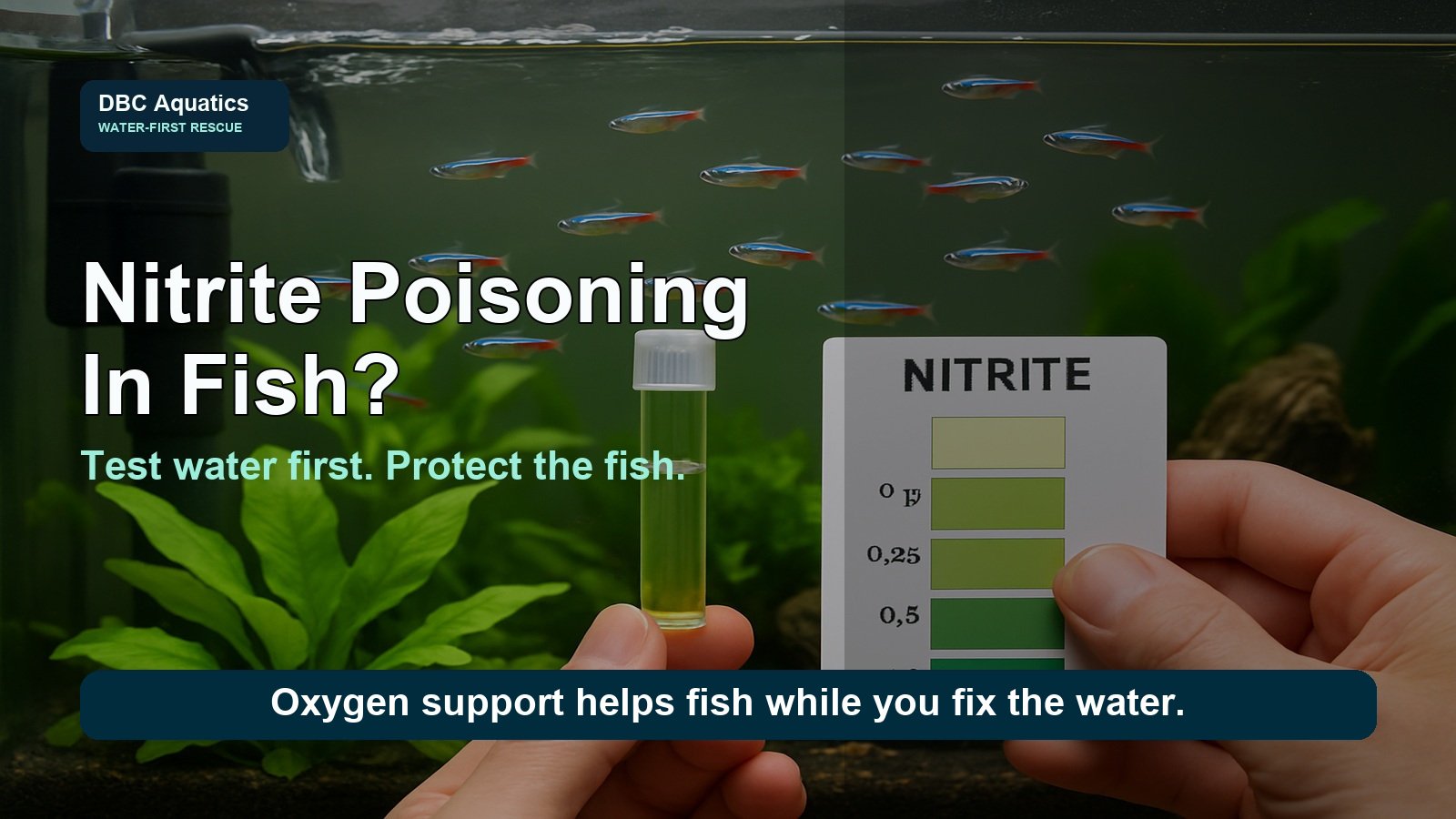
Nitrite Poisoning In Fish? What To Do First
Seeing nitrite on a test kit can make your stomach drop.
The tank may look clear. The filter may be running. The fish may have looked fine yesterday.
Then suddenly they are breathing hard, hanging near the surface, clamping their fins, or acting weak.
Do not panic and do not start dumping in random medication. Nitrite is a water-quality emergency, but it is also something you can work through if you follow the right order.
Protect the fish while the aquarium catches back up.
Quick Answer
If nitrite is above 0 ppm, treat the tank as unstable.
Fish still look oxygen-starved and you are not sure what to check next? Open the Aquarium Command Center to follow the first safe rescue path before you guess or medicate.
Start with this order:
- Increase oxygen and surface movement.
- Stop feeding temporarily.
- Confirm nitrite with a liquid test kit or a fresh test strip.
- Do a controlled partial water change with dechlorinated, temperature-matched water.
- Protect the filter bacteria.
- Test ammonia and nitrite every day until both stay at 0 ppm.
- Look for what changed: new fish, overfeeding, filter cleaning, dead fish, power outage, or an unfinished cycle.
Video support: If you are about to change more water, watch Ben walk through the controlled rescue order: Fish Dying? Do This Before You Change More Water.
Nitrite is not a reason to deep-clean the whole tank.
It is a reason to stabilize the water and protect the bacteria that remove nitrite.
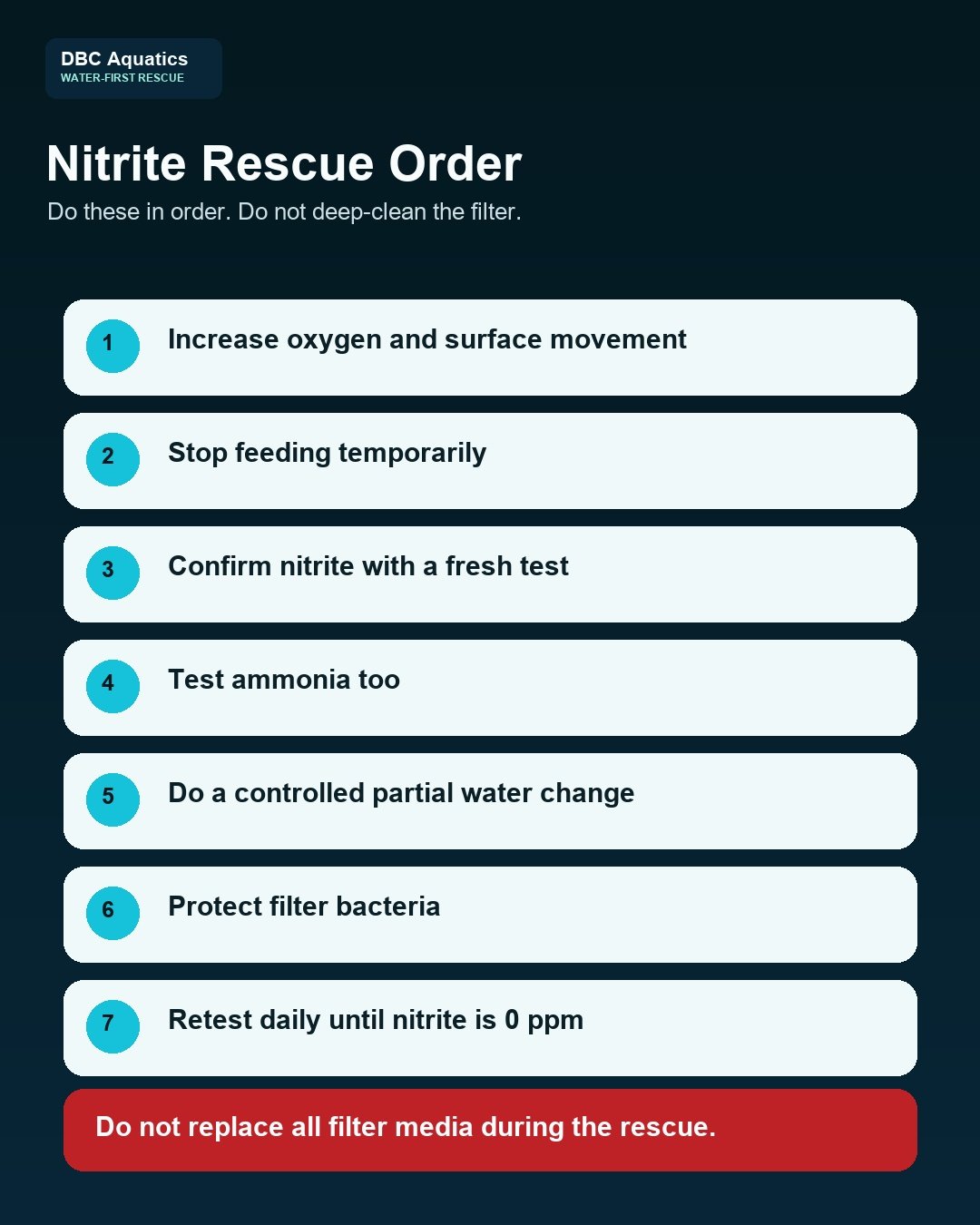
How Dangerous Is My Nitrite?
Use this as a practical decision guide, not a reason to panic.
| Nitrite Reading | Risk | What I Would Do |
|---|---|---|
| 0 ppm | Safe target | Continue normal maintenance and keep testing if fish recently looked stressed |
| 0.25 ppm | Mild concern | Increase aeration, reduce feeding, retest, and consider a partial water change |
| 0.5 ppm | Moderate | Water change, stop feeding temporarily, increase oxygen, and test daily |
| 1.0 ppm+ | Emergency | Follow the rescue order immediately, monitor closely, and keep oxygen high |
Most nitrite spikes do not kill fish immediately.
The greatest risk is when the problem goes unnoticed or continues for several days without correction.
THE DBC RULE
Test the water.
Protect the fish.
Then choose the next step.
Nitrite problems are exactly why this rule matters. Your fish do not care whether the water looks clean. They care whether the water lets them breathe.
First 10 Minutes
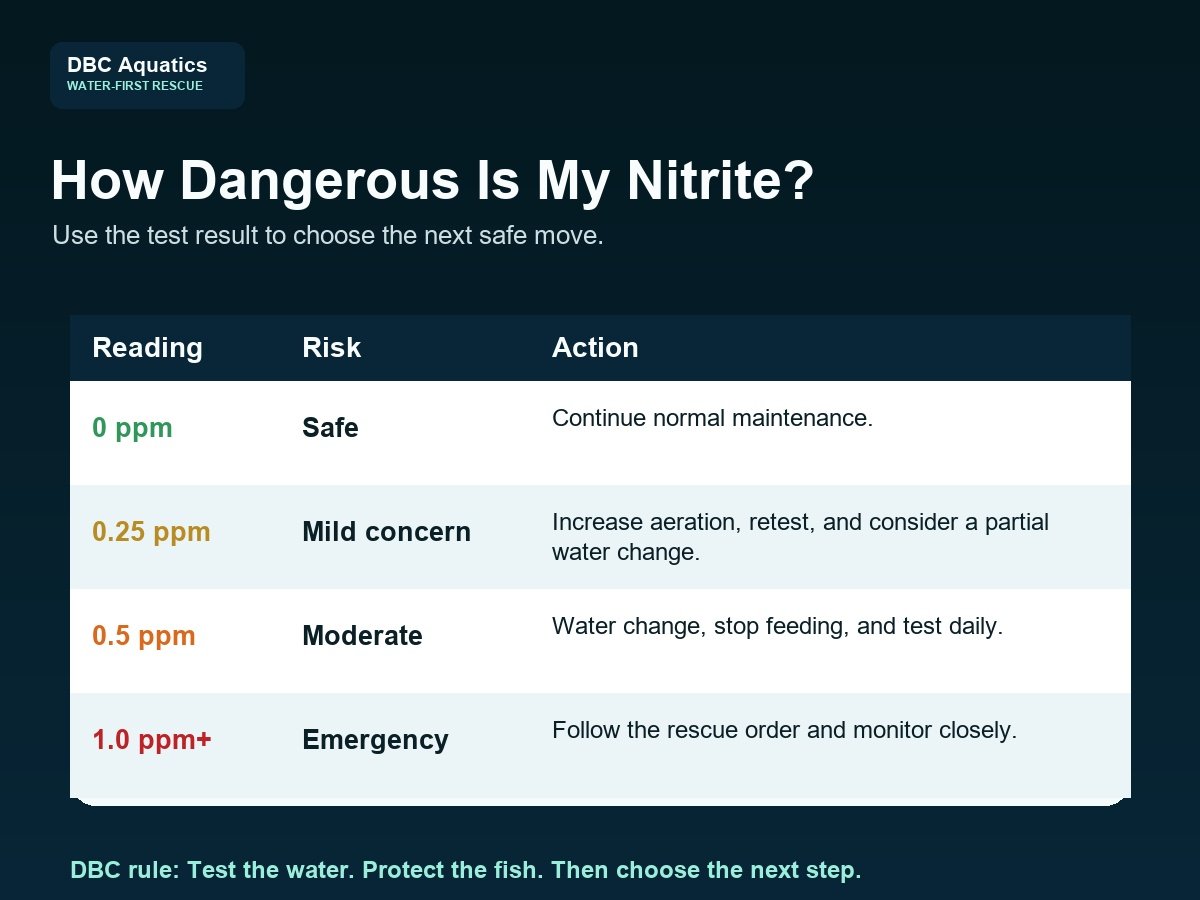
1. Add Oxygen Now
Aim the filter output at the surface. Add an air stone if you have one. Make sure the filter is actually moving water.
Increasing oxygen does not remove nitrite from the water.
It helps reduce stress while your aquarium recovers because fish under nitrite stress struggle to use oxygen efficiently.
Better surface movement gives them the best chance while you correct the underlying water-quality problem.
2. Stop Feeding Temporarily
Food becomes waste.
Waste feeds ammonia.
Ammonia eventually becomes nitrite in a cycling or unstable tank.
Skipping food for a short period is usually safer than adding more waste while the tank is struggling.
3. Retest Nitrite
Nitrite should be 0 ppm in a safe aquarium.
If your test shows nitrite above zero, do not ignore it.
If the result seems strange, retest with clean hands, clean test tubes, and the correct timing. Old strips or rushed liquid tests can mislead you.
But if the second test still shows nitrite, treat it as real.
4. Do A Controlled Water Change
Use dechlorinator. Match temperature as closely as you can. Keep oxygen high while you work.
For many beginner emergencies, a controlled partial water change is safer than a chaotic full reset.
The goal is to dilute nitrite without shocking the fish or damaging the filter bacteria.
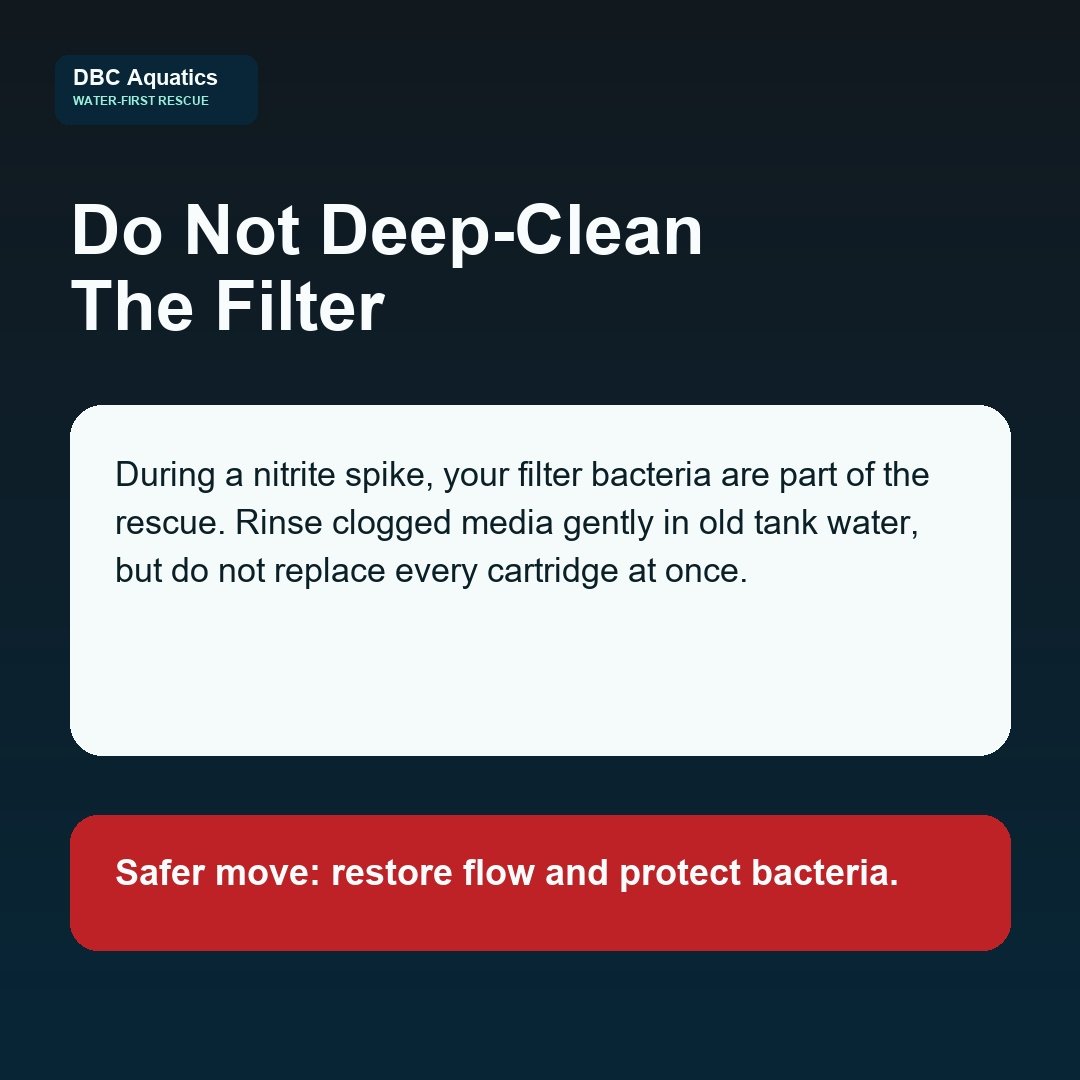
5. Protect The Filter
Your filter is part of the rescue.
Do not rinse biological media under untreated tap water. Do not replace every cartridge at once. Do not scrub the entire filter spotless because a test number scared you.
If flow is weak, gently swish sponge or biomedia in old tank water from the water change. Clear obvious clogs. Restart the filter and confirm strong flow.
A Real Rescue Example
One of the most common stories I hear starts with a new tank that looks clean.
The fishkeeper tests ammonia, sees it coming down, and thinks the worst part is over.
Then the fish start gasping.
That is where nitrite catches people off guard. The tank may be moving past the first ammonia spike, but the next bacteria colony is not strong enough yet. Nitrite rises, the fish struggle to use oxygen properly, and the tank looks better than it really is.
In that situation, medication is not the rescue.
Oxygen, water changes, careful feeding, and protecting the filter are.
Over the years, one of the most common mistakes I have seen is replacing every filter cartridge after seeing nitrite.
The intention is good. People think they are cleaning the problem out of the tank.
But many times, that removes the bacteria the aquarium needs most.
I have also seen tanks test around 0.5 ppm nitrite where fish recovered within a couple of days because the owner increased aeration, stopped feeding for a short time, changed water carefully, and left the filter bacteria alone.
Why Nitrite Makes Fish Look Like They Cannot Breathe
Here is the part many beginner guides do not explain clearly.
Ammonia and nitrite are not the same problem.
Ammonia irritates or damages the gills.
Nitrite interferes with the fish’s ability to use oxygen properly.
That is why fish with nitrite stress may gasp, breathe fast, hang near the surface, or crowd the filter return even when the tank has bubbles.
The fish are telling you oxygen delivery is not working normally.
That is also why the first move is not “add medicine.”
The first move is oxygen support and water correction.
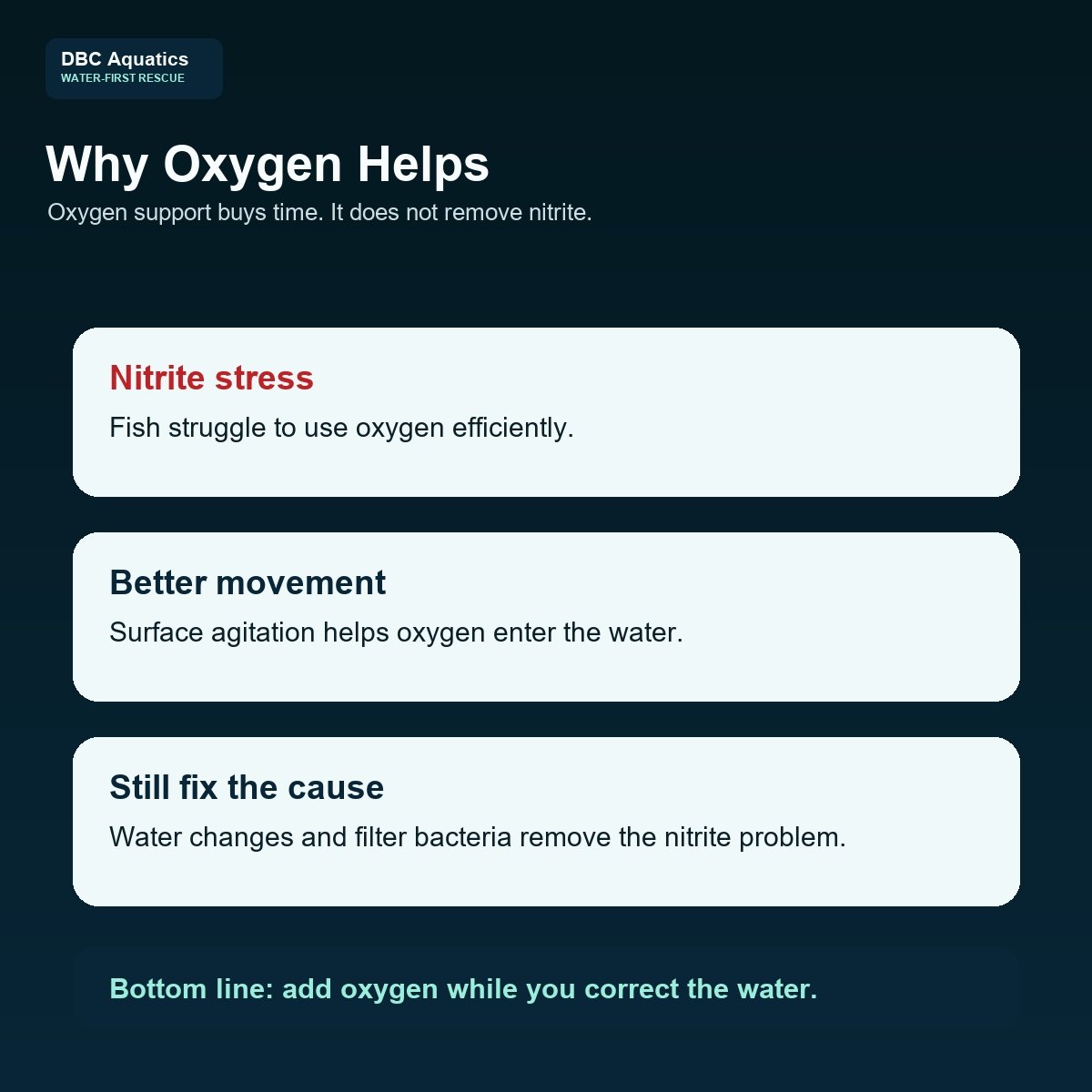
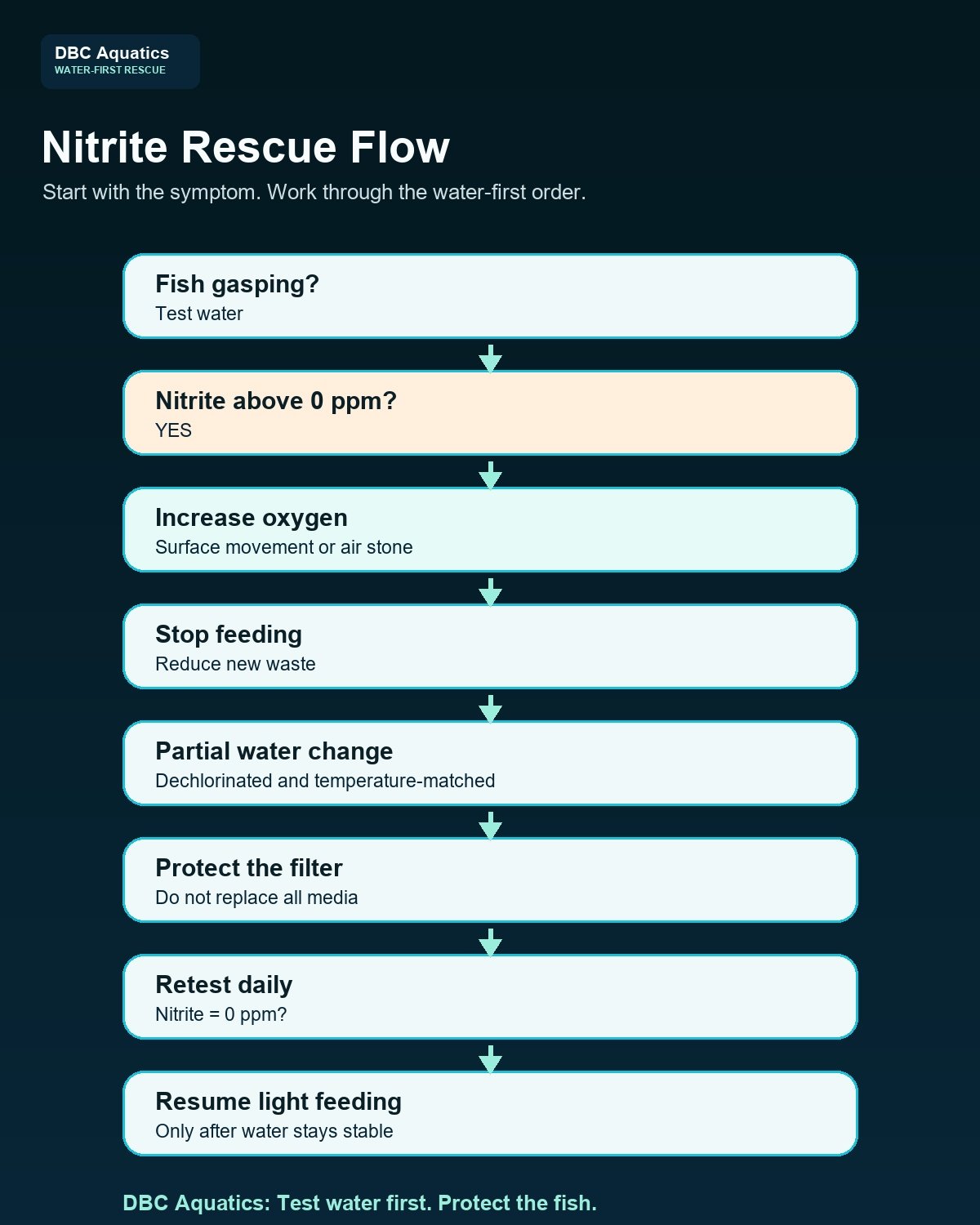
Nitrite Rescue Order
| Step | What To Do | Why It Helps |
|---|---|---|
| 1 | Add surface movement and air | Supports breathing while you fix the water |
| 2 | Stop feeding | Reduces new waste entering the system |
| 3 | Confirm nitrite | Prevents guessing and wrong treatment |
| 4 | Test ammonia too | Ammonia and nitrite often appear together in unstable tanks |
| 5 | Change water carefully | Dilutes nitrite without resetting the tank |
| 6 | Protect filter media | Keeps the bacteria that remove nitrite alive |
| 7 | Retest daily | Confirms whether the tank is recovering |
If ammonia is also present, use the same water-first rescue order and treat the tank as a broader cycling emergency.
Start with the Water Quality Rescue Hub if multiple water numbers are wrong.
What Recovery Usually Looks Like
Every tank is different, but this is the pattern I would hope to see.
| Timeframe | What You Want To See |
|---|---|
| First hour | Breathing should become easier if oxygen improves and the fish are still strong enough to respond |
| First day | Nitrite may begin decreasing with careful water changes and reduced feeding |
| Two to seven days | Filter bacteria begin catching up if they are protected and water flow stays strong |
| One to three weeks | Many tanks return to stability if the original cause is fixed |
Do not judge the whole rescue by one test tube.
Look for the trend: nitrite down, breathing easier, filter flow strong, and no new waste being added faster than the tank can process it.
What Usually Causes Nitrite In An Aquarium
Nitrite usually appears when the tank cannot process waste all the way to nitrate yet.
That can happen in a new tank, but it can also happen in an older tank after something damages the bacteria.
| Cause | Why Nitrite Rises | What To Check |
|---|---|---|
| New tank | The bacteria that remove nitrite are not fully established | Tank age, stocking, feeding |
| New fish added | More waste enters the system | Recent stocking changes |
| Overfeeding | Extra food breaks down into waste | Uneaten food, cloudy water |
| Filter media replaced | Bacteria colony was reduced | Cartridge/media changes |
| Filter cleaned too aggressively | Bacteria were damaged or removed | Recent cleaning method |
| Power outage | Filter bacteria lost oxygen/flow | Filter downtime |
| Dead fish hidden in tank | Decay adds waste fast | Missing fish, smell, ammonia |
| Medication or chemicals | Some products can stress bacteria | Recent treatments |
This is why “what changed in the last 48 hours?” matters so much.
Ammonia Vs Nitrite
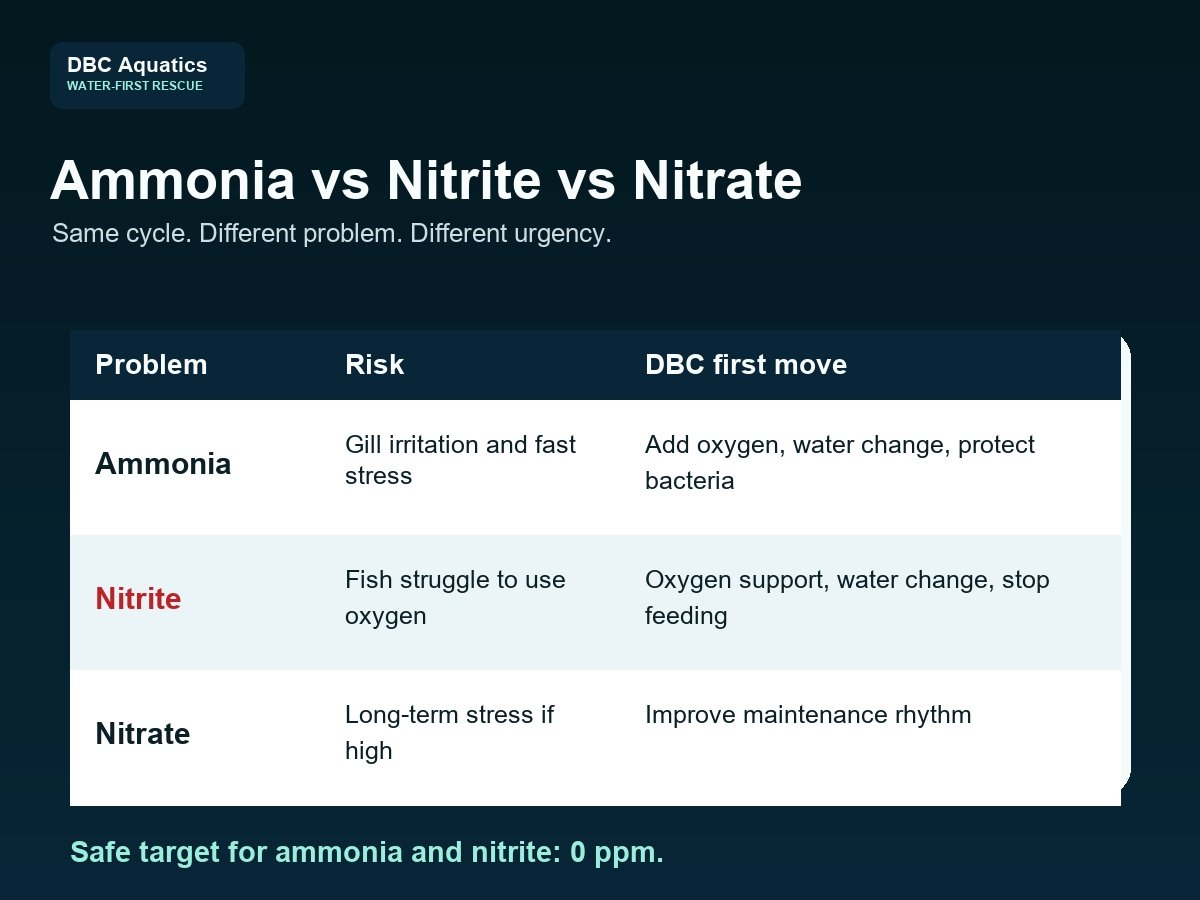
Both can hurt fish, but they do it differently.
| Problem | Safe Target | Common Signs | DBC First Move |
|---|---|---|---|
| Ammonia | 0 ppm | Red gills, gasping, lethargy, sudden stress | Add oxygen, water change, protect bacteria |
| Nitrite | 0 ppm | Gasping, fast breathing, weakness, brownish gill concern, new-tank stress | Add oxygen, water change, stop feeding, protect bacteria |
| Nitrate | Keep low for your setup | Long-term stress, algae pressure, weaker fish over time | Improve maintenance and water-change rhythm |
If fish are gasping, read this next: Fish Gasping At The Top? Low Oxygen, Ammonia, And What To Do First.
The Biggest Mistakes I See
| Mistake | Why It Backfires | Safer Move |
|---|---|---|
| Deep-cleaning the filter | Removes bacteria needed to process nitrite | Restore flow gently and keep biomedia wet |
| Feeding because fish look weak | Adds more waste to an unstable tank | Pause feeding temporarily |
| Medicating first | Treats symptoms while the water keeps hurting fish | Fix oxygen and water first |
| Replacing all filter media | Can restart the problem | Replace media gradually only when needed |
| Doing five fixes at once | Makes recovery hard to understand | Follow the rescue order and test daily |
| Assuming clear water is safe | Nitrite is invisible | Trust the test kit, not the water color |
What If Fish Are Still Gasping After A Water Change?
Keep oxygen high and test again.
If nitrite is still above zero, the tank is still unstable. You may need repeated controlled water changes while the filter bacteria recover.
Also check:
- Is the filter flowing strongly?
- Is the tank too warm?
- Is ammonia also present?
- Did you use enough dechlorinator?
- Did you add too many fish too fast?
- Is food sitting in the tank?
- Did a fish die where you cannot see it?
If gasping is the main symptom, use the fish gasping rescue guide alongside this nitrite guide.
If Nitrite Is Not Improving
If nitrite stays elevated despite water changes, do not just repeat the same steps blindly.
Check the rescue from the beginning.
- Make sure dechlorinator is being used correctly.
- Confirm the filter is actually flowing through the media.
- Look for hidden decaying food, plants, or a missing fish.
- Reduce feeding further until the tank stabilizes.
- Verify the test kit has not expired.
- Ask whether the aquarium is overloaded for the filter and tank size.
- Review whether filter media, gravel, or decorations were cleaned too aggressively.
When nitrite refuses to move, the tank is usually still producing more waste than the bacteria can process, or the bacteria were damaged before they could recover.
Should You Add Aquarium Salt For Nitrite?
Do not add salt blindly.
Some experienced fishkeepers use chloride support during nitrite problems, but this is not a beginner move to guess at. Scaleless fish, invertebrates, plants, and certain setups may not tolerate salt well.
For DBC’s beginner rescue order, start with the safer universal moves:
- Increase oxygen.
- Stop feeding temporarily.
- Change water carefully.
- Dechlorinate correctly.
- Protect filter bacteria.
- Retest daily.
If you are considering salt, confirm your fish species, plants, invertebrates, and exact setup first.
When Medication Makes Sense
Medication comes after water is checked, not before.
If ammonia and nitrite are both 0 ppm, oxygen is strong, temperature is stable, and one fish still has disease signs, then it may be time to use the fish medication guide.
But if nitrite is present, the tank is already telling you the first problem.
Fix the water before you medicate the fish.
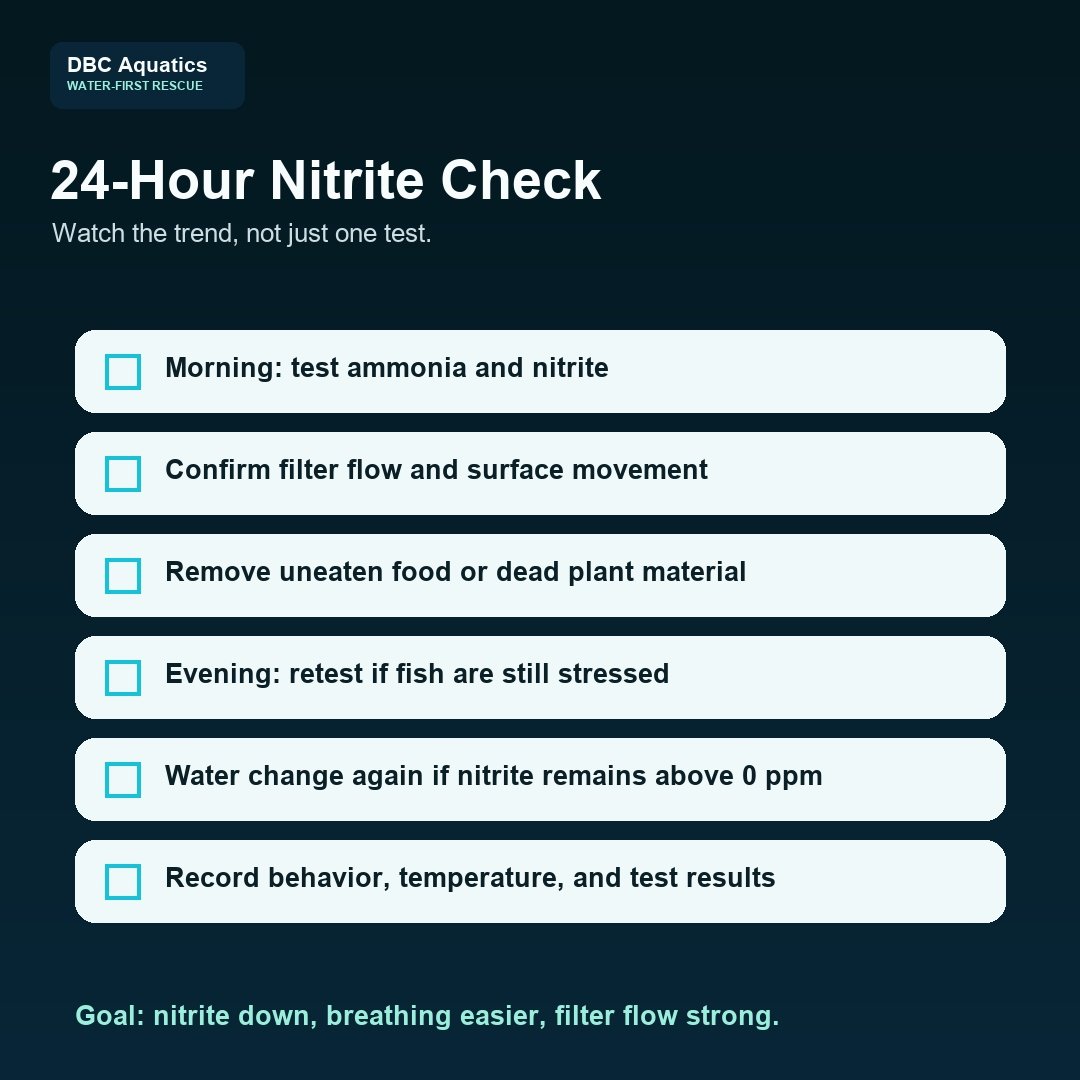
24-Hour Nitrite Monitoring Checklist
Use this for the next day:
- Morning: test nitrite and ammonia.
- Morning: confirm filter flow and surface movement.
- Morning: remove uneaten food or dead plant/fish material.
- Afternoon: check breathing and behavior.
- Evening: test nitrite again if fish are still stressed.
- Evening: perform another controlled water change if nitrite remains above zero.
- Daily: keep feeding very light or pause briefly until water is stable.
- Daily: write down nitrite, ammonia, temperature, water changes, and fish behavior.
You are looking for a pattern:
Nitrite going down.
Fish breathing easier.
Filter flow staying strong.
No new waste being added faster than the tank can handle.
Keep this rescue order handy.
Download the free Aquarium Survival Checklist so you always know what to do when your fish show signs of stress.
When To Use The Symptoms Checker
Use the DBC Fish Symptoms Checker if:
- Nitrite is 0 but fish still look sick.
- Only one fish is struggling while the others act normal.
- You see spots, fuzz, wounds, bloating, pineconing, or severe clamped fins.
- You are not sure whether this is water, disease, bullying, or injury.
The Symptoms Checker helps you separate water-quality emergencies from fish-specific problems.
Preventing The Next Nitrite Spike
Once the fish are stable, prevent the repeat.
Do this:
- Feed less than you think for a few days.
- Keep testing ammonia and nitrite.
- Avoid replacing all filter media.
- Clean filter media gently in old tank water.
- Add fish slowly.
- Do not overstock a new tank.
- Keep a regular water-change routine.
- Use the Water Quality Rescue Hub as your emergency map.
Nitrite spikes are not usually random.
They usually come from a tank that is new, overloaded, overcleaned, overfed, or recovering from a disruption.
Aquarium Survival Checklist
If you want the water-first rescue order in one place, use the Aquarium Survival Checklist.
It is built for moments like this: fish acting wrong, water numbers confusing, and you need a calm order instead of guesses.
Start with oxygen.
Test ammonia and nitrite.
Protect the filter.
Then choose the next step.
Aquarium Rescue Blueprint
If your tank keeps bouncing from one emergency to the next, the Aquarium Rescue Blueprint is the next logical step after the immediate rescue.
The goal is not just to fix today’s nitrite spike.
The goal is to build a tank that stops surprising you.
FAQ
Is any nitrite safe for fish?
The target is 0 ppm. If nitrite is above zero, treat the tank as unstable and start the rescue order.
Why are fish gasping if nitrite is the problem?
Nitrite can interfere with oxygen transport inside the fish. That is why fish may gasp, breathe fast, or hang near the surface even when the water has movement.
Should I feed fish during a nitrite spike?
Usually no, at least temporarily. Food adds waste, and waste can keep the problem going. Resume light feeding when ammonia and nitrite are stable at 0 ppm and fish are breathing normally.
Should I clean the filter to remove nitrite?
Do not deep-clean it. The filter holds the bacteria that help remove nitrite. If flow is blocked, gently clean media in old tank water and protect the bacteria.
How long does it take nitrite to go down?
It depends on the tank, stocking, filter bacteria, feeding, water changes, and what caused the spike. Test daily and watch whether nitrite trends down and fish breathing improves.
Is nitrite the same as nitrate?
No. Nitrite is an emergency water-quality problem and should be 0 ppm. Nitrate is the later end product of the nitrogen cycle and is usually managed with maintenance and water changes.
Can medication fix nitrite poisoning?
Medication does not remove nitrite. If nitrite is present, fix the water first. Medication may be useful later if water is safe and disease signs remain.
Bottom Line
Most fishkeepers see nitrite and think the tank is ruined.
Most of the time, it is not.
Nitrite means the aquarium is out of balance, and the fish need help while the filter bacteria catch up.
Every nitrite rescue starts the same way:
Add oxygen.
Stop adding waste.
Change water carefully.
Protect the filter.
Then keep testing until the tank proves it is safe again.
The safest rescue is not the one that changes the most things.
It is the one that finds the real water problem, protects the fish, and gives the filter a chance to recover.
Leave a Reply