New Tank Syndrome: Why Clear Water Can Still Be Dangerous
Your new aquarium can look perfect and still be dangerous.
The water may be crystal clear. The filter may be running. The fish may have looked fine yesterday.
Then one fish starts breathing hard. Another hides. Fins clamp. Food gets ignored. By morning, a fish may be dead.
That is the trap behind new tank syndrome. The aquarium looks finished before the biological filter is ready to handle the waste being produced inside it.
Do not treat the clear water as proof. Test the water.
Quick Answer
New tank syndrome happens when ammonia or nitrite builds before the biological filter can process the aquarium’s waste reliably.
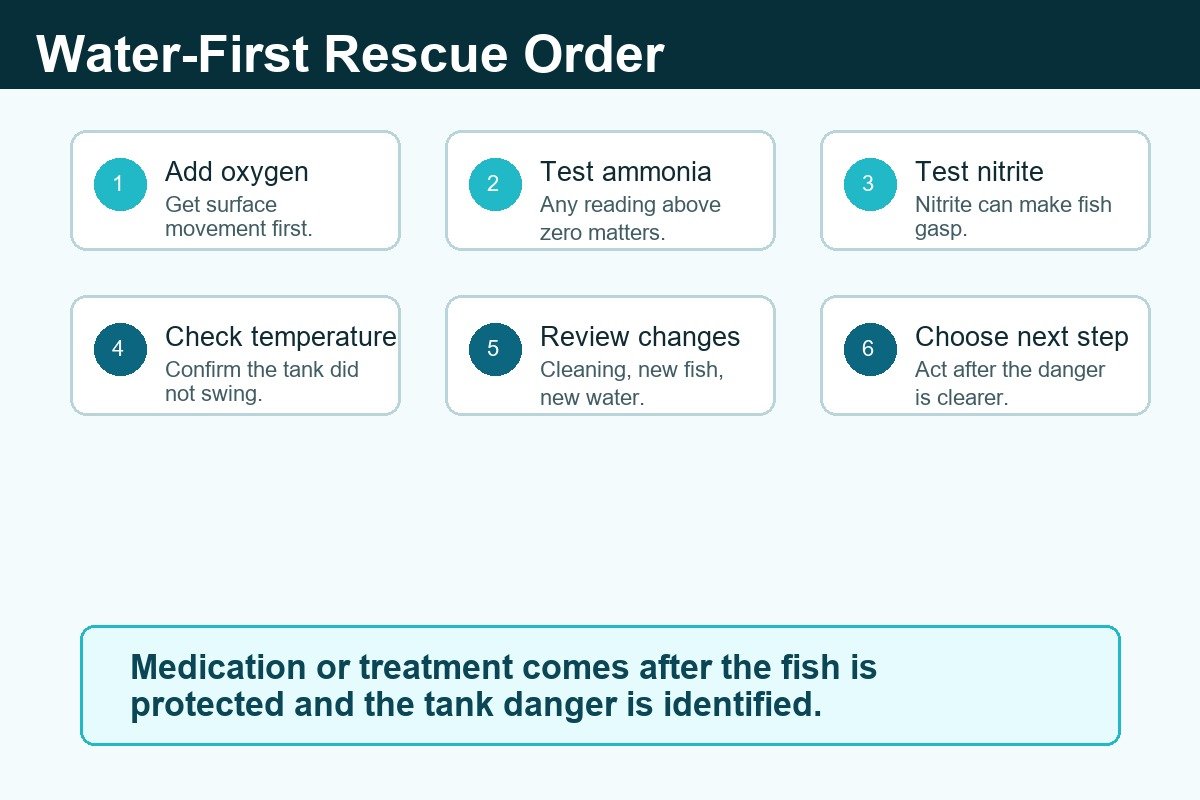
If fish in a new tank are gasping, hiding, clamping their fins, losing balance, or dying:
- Increase oxygen and surface movement.
- Test ammonia and nitrite now.
- Stop feeding temporarily if either is detected or fish are in distress.
- Use a controlled water change with conditioned, temperature-matched water when the tests or fish behavior justify it.
- Do not replace or disinfect the filter media.
- Retest ammonia and nitrite every day until both remain at 0 ppm.
- Do not add more fish while the tank is unstable.
The free Aquarium Survival Checklist can keep that rescue order in front of you while you work.
THE DBC RULE
Test the water.
Protect the fish.
Protect the filter bacteria.
Then choose the next step.
New tank syndrome is exactly why this order matters. Clear water tells you what the tank looks like. Ammonia and nitrite tests tell you whether the system is handling waste.
First 10 Minutes
1. Add Oxygen
Aim the filter return toward the surface. Add an air stone if you have one. Confirm that the filter is actually moving water.
More oxygen does not remove ammonia or nitrite. It supports stressed fish and the organisms in the biofilter while you correct the water problem.
2. Test Ammonia And Nitrite
Test both.
A new tank may show ammonia first. Later, ammonia may start falling while nitrite rises. If you only test one of them, you can miss the next part of the cycle.
If either ammonia or nitrite is detectable, treat the tank as unstable and monitor it daily.
3. Stop Adding Waste
Pause feeding temporarily when fish are distressed or either toxin is detected. Healthy adult fish can usually handle a short feeding pause better than they can handle more waste entering an unstable tank.
Do not add new fish. Do not add extra food to “help the bacteria” while fish are already exposed.
4. Change Water Carefully
Use dechlorinator and match the new water temperature as closely as you can.
The amount should be guided by the test result, the fish’s condition, and what has already been changed. The goal is to dilute the danger without creating another temperature or chlorine problem.
Use the Emergency Aquarium Water Change guide if you need help choosing a controlled first change.
5. Protect The Biofilter
Do not rinse filter media under untreated tap water. Do not replace every cartridge. Do not deep-clean the gravel and filter at the same time.
If flow is blocked, gently swish reusable media in removed aquarium water and clear the obstruction. Keep the media wet and return it to service.
The filter bacteria are not the enemy. They are part of the rescue.
What New Tank Syndrome Actually Means
Fish release ammonia through their gills and waste. Uneaten food and decaying material add more.
In a mature aquarium, microbes associated with the biofilter and other wet surfaces process that waste through nitrification:
Ammonia -> Nitrite -> Nitrate
A new filter can move water on the first day. That does not mean the biological community inside it is mature.
The first group of ammonia oxidizers must establish. Then the organisms that process nitrite must become capable of handling the load. That takes time, and the exact timing changes with temperature, oxygen, pH, alkalinity, media, stocking, feeding, and how the tank was started.
This is why cycling is not a date on a calendar.
It is a result you verify.
The Clear-Water Trap
Ammonia and nitrite are dissolved. You cannot judge them by looking across the tank.
That creates one of the most dangerous beginner contradictions:
| What You See | What It Proves |
|---|---|
| Clear water | Suspended particles are low enough that the water looks clear |
| Filter running | Water is moving through the filter |
| Bubbles at the surface | Gas exchange may be improving |
| Fish swimming | The fish are still able to swim |
| Ammonia and nitrite both remain at 0 ppm | The current system is processing the present waste load |
Only the last line gives you useful evidence about cycle stability.
Clear water is visual.
A stable cycle is measurable.
A Real Rescue Example
A common new-tank emergency starts with a small school of fish added to a clean-looking aquarium.
For several days, everything appears normal. Then the fish begin breathing faster and crowding the filter return. The owner changes the cartridge because the filter must be dirty.
The next day, the fish look worse.
The important clue is not the cloudiness. It is the new biological load combined with a filter that was not mature, followed by the removal of developing media.
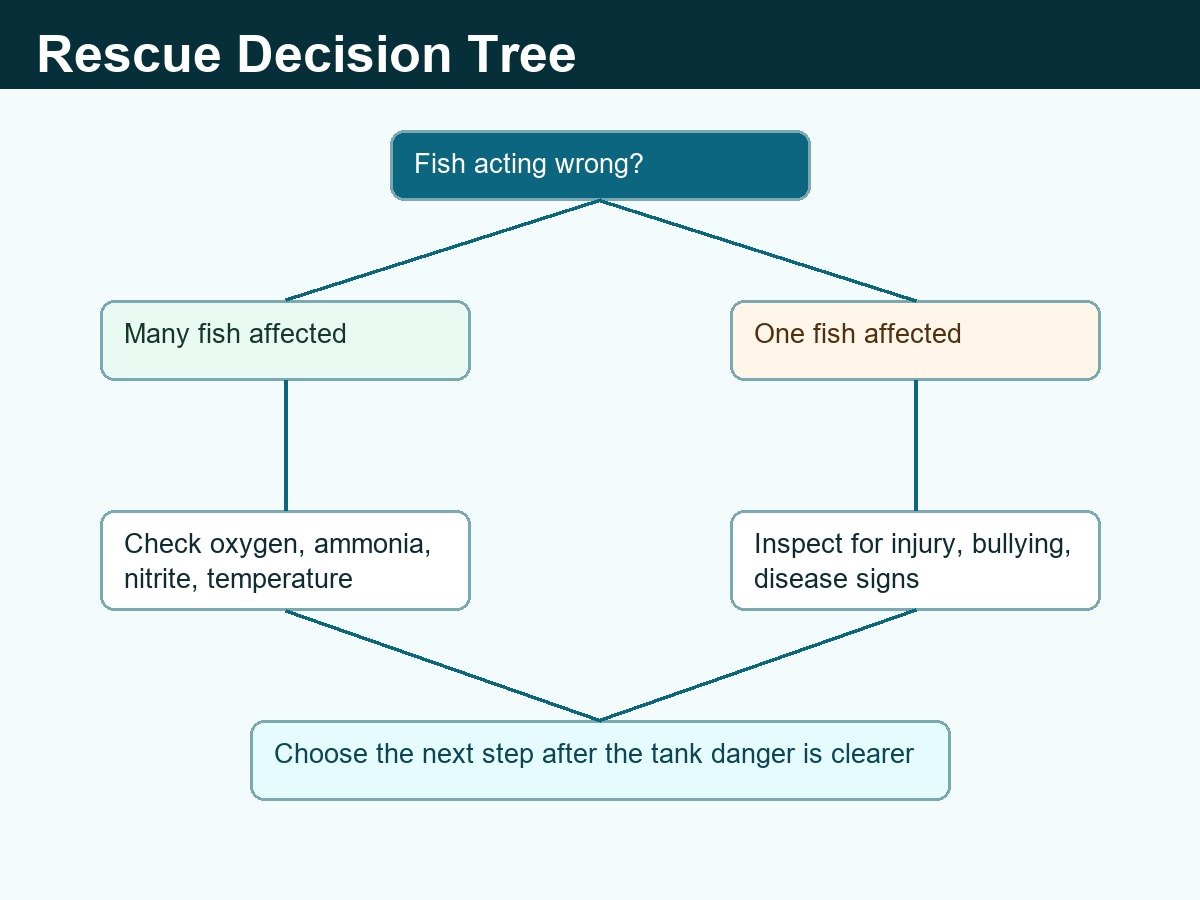
Here is what I would check first in that tank: oxygen, ammonia, nitrite, temperature, and filter flow.
The safer rescue is to increase oxygen, test ammonia and nitrite, use controlled water changes, reduce feeding, and leave the remaining biofilter alone. The tank is not fixed because it looks cleaner. It is recovering when the fish stabilize and repeated tests show ammonia and nitrite staying at 0 ppm.
The Investigation: What Changed?
When a new tank becomes unstable, look for the event that increased waste or reduced biological capacity.
Clue 1: Fish Were Added Too Quickly
Every new fish adds waste. A filter that was handling a tiny load yesterday may not handle a much larger load today.
Clue 2: The Tank Was Fed Heavily
Extra food does not disappear. It becomes waste, directly or after it passes through the fish.
Clue 3: Filter Media Was Replaced
Disposable-cartridge instructions can make beginners believe the entire cartridge must be replaced on a schedule. Replacing all established media at once can remove part of the biofilter.
Clue 4: The Filter Stopped
A power interruption, clogged intake, air lock, or failed pump can reduce circulation and oxygen inside the filter.
Clue 5: Chlorine Reached The Media
Untreated tap water can harm the biological community you are trying to establish.
Clue 6: Medication Or Another Chemical Was Added
Some treatments can affect biofilter performance. Test the water during and after treatment instead of assuming the cycle is unchanged.
Why Ammonia Can Fall Before Nitrite Rises
This is the part that catches many fishkeepers.
You test ammonia and finally see it coming down. That feels like the finish line.
But the ammonia did not vanish. It was processed into nitrite.
If the nitrite-processing side of the biofilter is still developing, nitrite can rise next. Fish may gasp or breathe rapidly even when the surface is moving because nitrite interferes with normal oxygen transport.
That is why one good ammonia result does not close the investigation.
Test both ammonia and nitrite until both remain at 0 ppm.
If nitrite is present, follow the Nitrite Poisoning rescue guide for the complete water-first response.
Does Bottled Bacteria Instantly Cycle A Tank?
Bottled bacteria may help establish a biofilter. It is not proof that the aquarium is ready.
Product, storage, age, temperature, water chemistry, oxygen, and setup can all affect what happens after the bottle is opened. Controlled research has also found that quick-start products do not all perform the same way over short test periods.
Use bottled bacteria as support, not as permission to stop testing.
The test kit decides whether ammonia and nitrite are being controlled.
How Do You Know The Tank Is Becoming Stable?
Look for a pattern, not one lucky reading.
- Ammonia remains at 0 ppm.
- Nitrite remains at 0 ppm.
- Nitrate may begin accumulating, depending on plants, water changes, and the system.
- Fish breathe and behave normally.
- The filter maintains steady flow.
- The current feeding and stocking level does not produce another spike.
Continue testing after a new fish addition, a filter interruption, a medication course, or any major maintenance.
The Nitrogen Cycle Rescue Hub brings the ammonia, nitrite, filter-bacteria, and prevention paths together in one place. For a deeper explanation of how the system works, use the Aquarium Nitrogen Cycle Guide.
What Not To Do
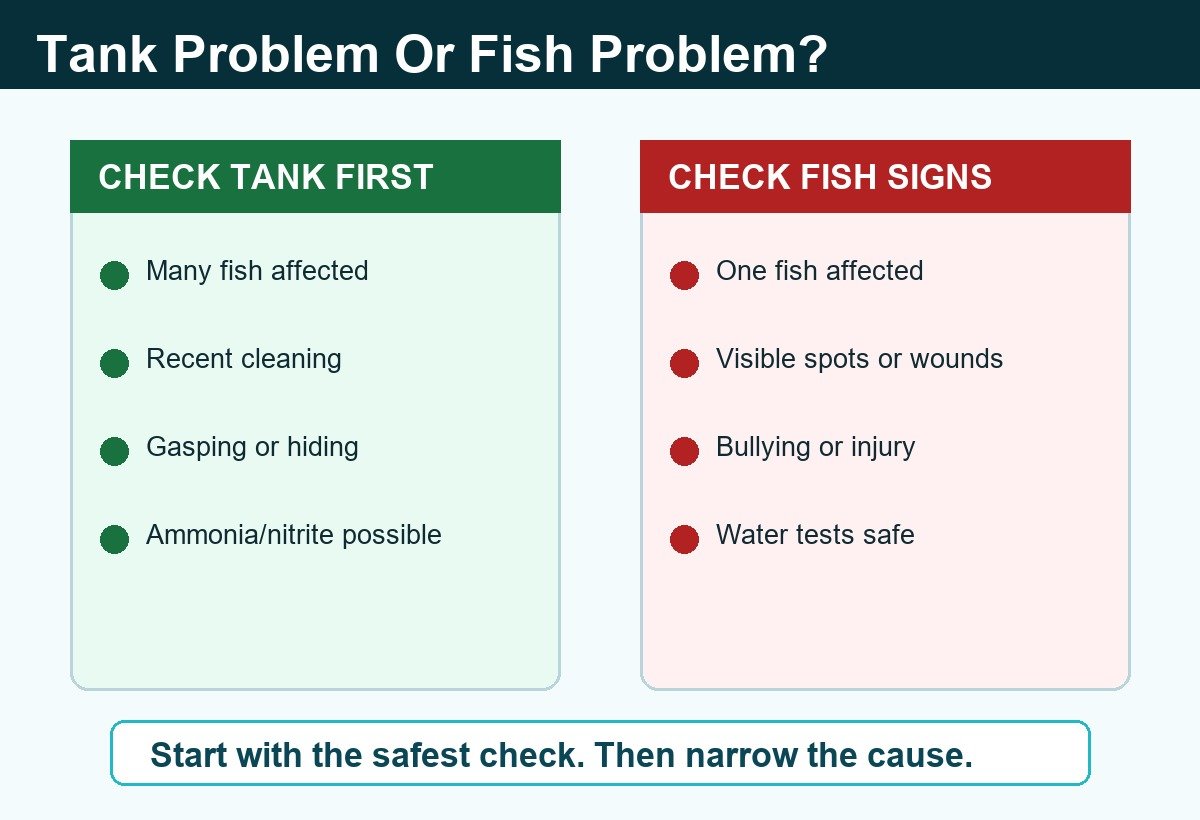
Medication is not the first step in this investigation.
Do not:
- Add medication before checking the water.
- Replace all filter media.
- Rinse biological media under untreated tap water.
- Add more fish to “test” the cycle.
- Feed heavily because the fish look stressed.
- Trust clear water more than the test kit.
- Change the filter, substrate, water, food, and medication all at once.
One measured correction gives you evidence.
Five simultaneous changes create confusion.
How To Prevent The Next Spike
Use the Aquarium Startup Checklist before adding livestock or increasing the bioload.
Then:
- Add fish gradually.
- Feed lightly while the system adjusts.
- Test ammonia and nitrite after each meaningful change.
- Keep filter media wet and protected.
- Avoid replacing all biological media at once.
- Maintain oxygen and steady filter flow.
- Record test results instead of relying on memory.
If the fish are showing symptoms that do not fit a water-quality pattern, use the Fish Symptoms Checker after ammonia, nitrite, oxygen, temperature, and filter flow have been checked.
Bottom Line
New tank syndrome is not a dirty-water problem.
It is a biological-capacity problem.
The aquarium can look clear before it is ready. The filter can run before it is mature. Ammonia can fall before nitrite rises.
Add oxygen. Test ammonia and nitrite. Protect the fish. Protect the filter. Make one controlled correction, then monitor the response.
Clear water is not proof.
The test is the proof.
Once the immediate problem is under control, the Aquarium Rescue Blueprint provides the complete repeatable system for diagnosing, rescuing, monitoring, and preventing aquarium emergencies.
Frequently Asked Questions
How long does new tank syndrome last?
There is no reliable one-size-fits-all number. A new biofilter usually takes weeks to establish, and the timing depends on oxygen, temperature, pH, alkalinity, media, feeding, stocking, and how the aquarium was started. Use repeated ammonia and nitrite results instead of a calendar date.
Can a tank be cycled if the water is cloudy?
Cloudiness alone does not prove whether the tank is cycled. A tank can be cloudy with safe ammonia and nitrite, or clear with unsafe ammonia or nitrite. Test the water.
Can a tank be uncycled if nitrate is present?
Yes. Nitrate can come from source water, fertilizers, seeded material, or partial nitrification. The practical target is repeated evidence that ammonia and nitrite remain at 0 ppm under the tank’s current load.
Should I change the filter cartridge during a new tank syndrome emergency?
Usually not. Replacing all media can remove developing biological capacity. If flow is blocked, gently clear debris while keeping reusable media wet and protected.
Should I use medication when fish are gasping in a new tank?
Test oxygen, ammonia, nitrite, temperature, and filter flow first. Medication cannot correct an immature biofilter and may complicate the investigation.
Can I add more bottled bacteria?
You can use a reputable product according to its label, but do not treat it as proof that the aquarium is safe. Continue testing ammonia and nitrite and protect the fish with water changes and oxygen support when needed.
What should I check first?
Check oxygen, ammonia, nitrite, temperature, conditioner, and recent changes first.
Should I medicate right away?
Not unless the water checks are safe and the symptom pattern clearly points to disease. Medication does not fix ammonia, nitrite, low oxygen, or chlorine exposure.
Can clear water still be dangerous?
Yes. Clear water can still contain ammonia, nitrite, low oxygen, or chlorine. Fish behavior matters more than how clean the tank looks.
When should I use the Aquarium Rescue Blueprint?
Use the Blueprint after the immediate emergency is under control, especially if the tank keeps cycling through the same problems.
Sources
- Merck Veterinary Manual: Disorders and Diseases of Fish
- Merck Veterinary Manual: Environmental Diseases of Aquatic Animals
- Merck Veterinary Manual: Water Quality Tests And Recommended Use
- UF/IFAS: Ammonia In Aquatic Systems
- Journal of Exotic Pet Medicine: Efficacy Of Quick-Start Nitrifying Products
Internal Rescue Path
Use the next DBC guide that matches what you find:
- If ammonia or nitrite is above zero, start with the ammonia spike emergency guide.
- If breathing hard or gasping continues after water checks are safe, use the fish gasping rescue guide.
- If symptoms are unclear, use the DBC Fish Symptoms Checker.
- If this feels like a tank-wide problem, go to the Aquarium Rescue Hub.
Rescue Checklist
Use the Aquarium Survival Checklist to work through the first checks without guessing.
Leave a Reply