Nitrogen Cycle Rescue Hub
The nitrogen cycle is quietly protecting your fish every second of every day.
Most fishkeepers never think about it until it stops working.
That is when ammonia appears.
Nitrite rises.
Fish begin gasping.
And a tank that looked perfectly healthy yesterday can suddenly become an emergency.
Fish acting sick?
Ammonia showing up?
Nitrite rising?
The tank looks clean, but the numbers say something is wrong?
Start here before you deep-clean the filter, replace every cartridge, or reach for medication.
The nitrogen cycle can sound like a science lesson, but in a real aquarium emergency it is much simpler than that. Your tank is either processing waste safely, or it is not. When it is not, fish can start gasping, hiding, clamping their fins, or dying even while the water looks clear.
The good news is that most cycling problems become easier to handle when you follow the right order.
Protect the fish.
Protect the filter bacteria.
Then fix the number.
This hub is the DBC starting point for ammonia, nitrite, filter bacteria crashes, new tank syndrome, and aquariums that become unstable after cleaning, stocking, feeding, or power problems.
If fish are actively gasping, dying, or losing balance right now, also keep the Water Quality Rescue Hub open. That is the broader emergency map.
Think of this page as the map.
If you already know the problem, jump directly to the matching rescue guide below. If you do not know what is happening yet, follow the rescue order from the beginning.
The Five Most Common Nitrogen Cycle Emergencies
- New tank syndrome.
- Ammonia spike.
- Nitrite poisoning.
- Filter bacteria crash.
- Cleaning mistakes that remove too much biological stability.
These emergencies look different at first, but they all come back to the same question: is the aquarium processing waste safely?
Quick Answer
If your aquarium may be cycling, crashing, or showing ammonia or nitrite:
- Increase oxygen and surface movement.
- Stop feeding temporarily.
- Test ammonia and nitrite.
- Keep the filter running.
- Do not replace or deep-clean more filter media.
- Do a controlled water change if ammonia or nitrite is above 0 ppm.
- Protect established filter media.
- Retest daily until ammonia and nitrite stay at 0 ppm.
Do not try to “clean the cycle back into place.”
The rescue is stability.
> The rescue is stability.
THE DBC RULE
Test the water.
Protect the fish.
Protect the filter.
Then choose the next step.
The nitrogen cycle is not something you fix by scrubbing the aquarium spotless. It is something you protect while the bacteria catch up.
The DBC Rescue Philosophy
Most aquarium guides teach the nitrogen cycle as chemistry.
DBC teaches it as a rescue system.
The goal is not memorizing ammonia, nitrite, and nitrate. The goal is knowing what to do when your fish need help.
First 10 Minutes
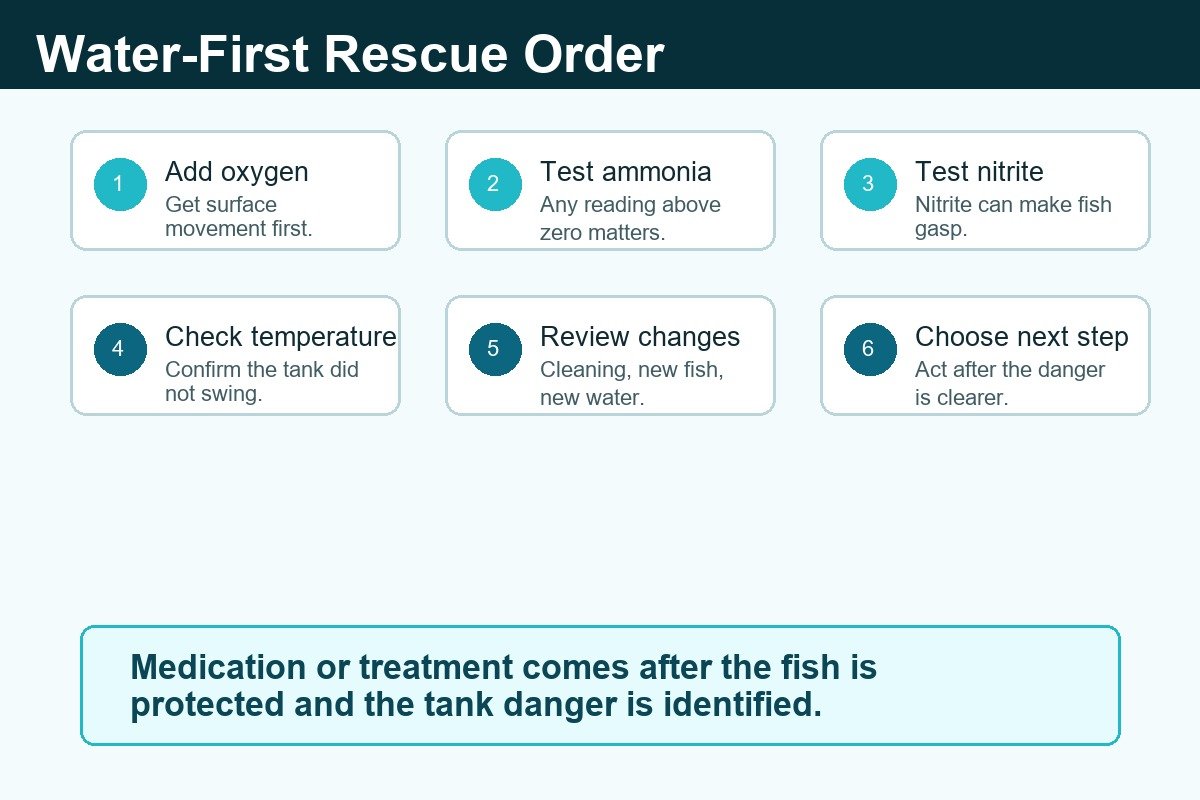
1. Add Oxygen
Aim the filter output toward the surface. Add an air stone if you have one. Make sure the filter is actually moving water.
This does not remove ammonia or nitrite by itself. It supports the fish while you correct the water.
2. Stop Feeding Temporarily
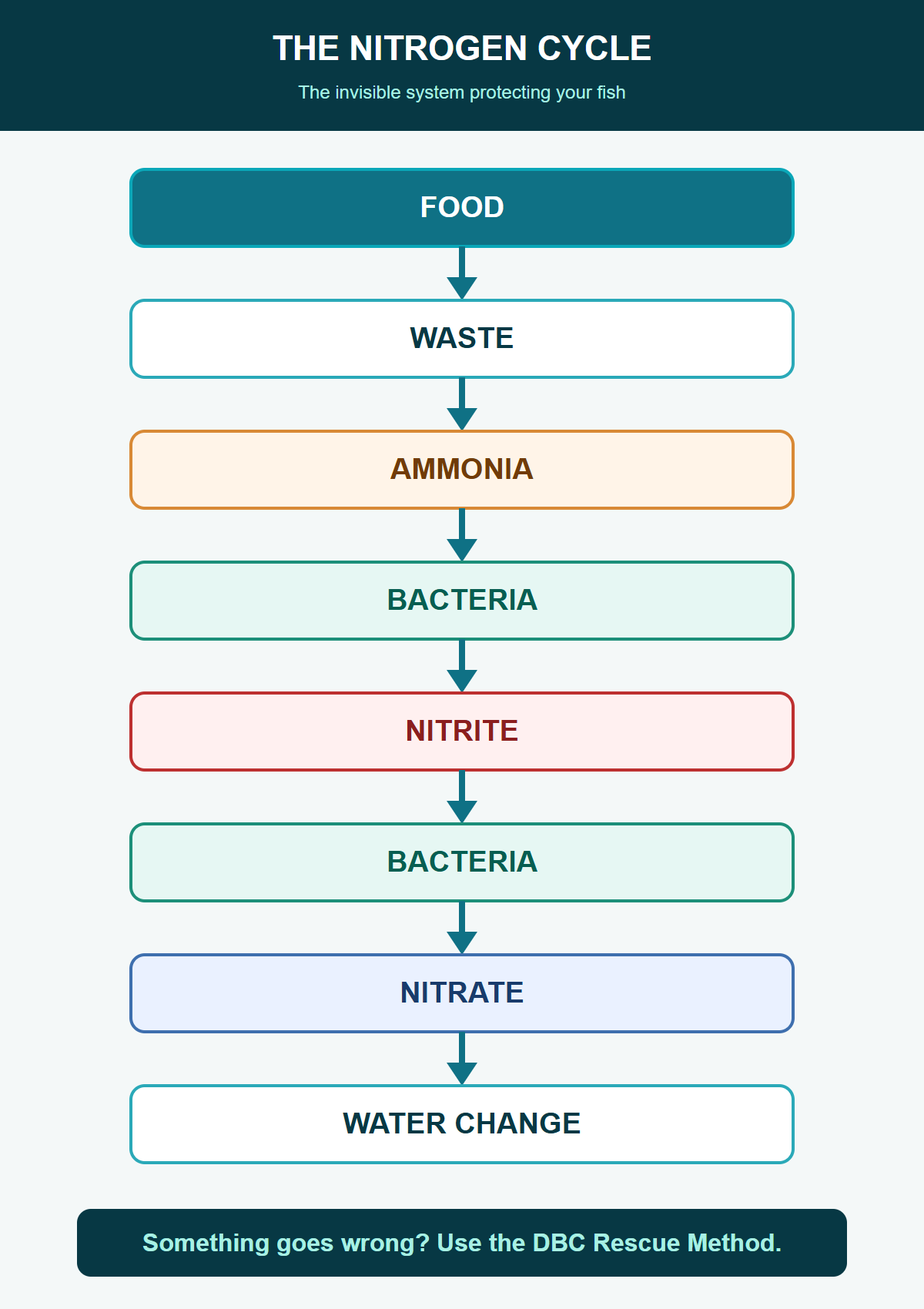
Food becomes waste.
Waste becomes ammonia.
During a cycling problem, extra food can keep feeding the emergency. Skipping food briefly is usually safer than adding more waste because the fish look weak.
3. Test Ammonia And Nitrite
In a stable aquarium, ammonia should be 0 ppm and nitrite should be 0 ppm.
If either one is above zero, treat the tank as unstable.
Use the exact rescue path below based on what your test kit shows.
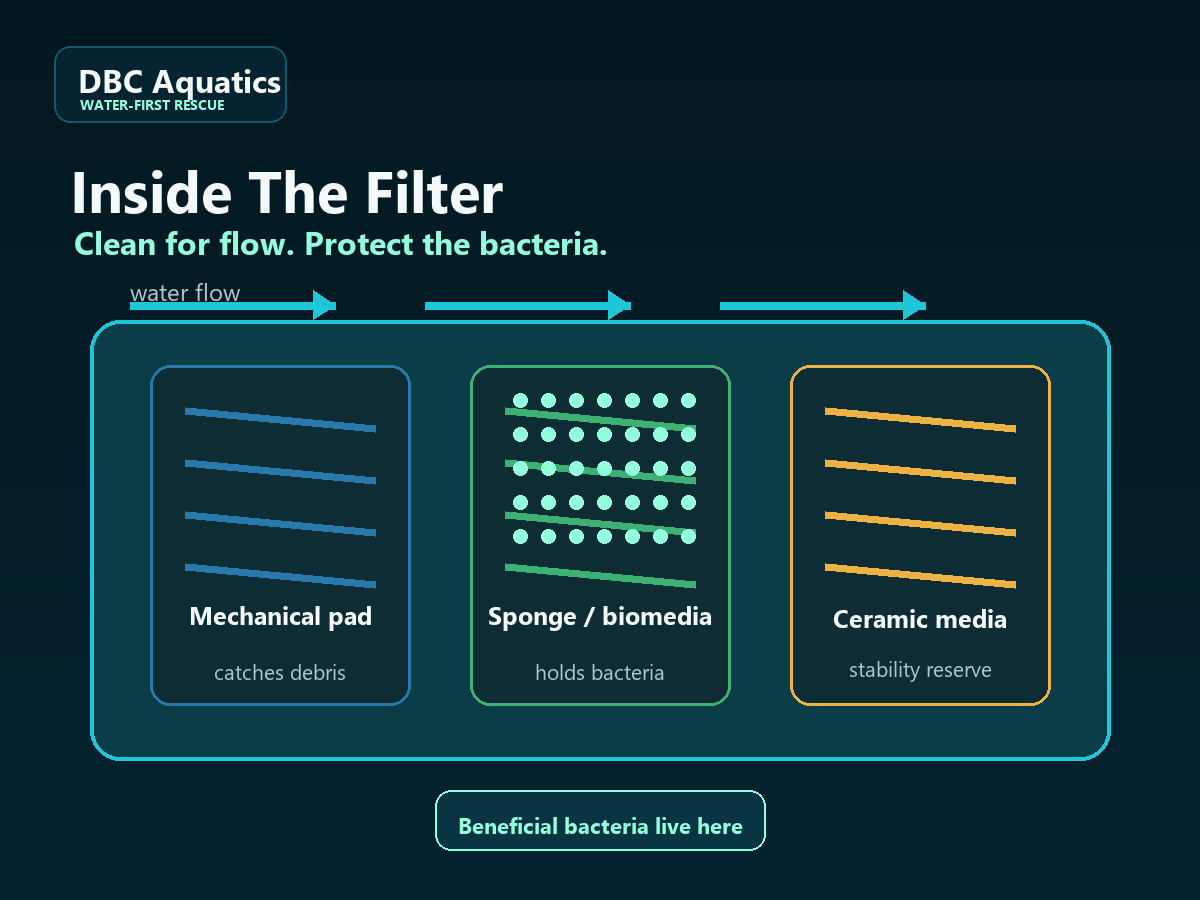
4. Protect The Filter
Keep the filter running. Keep media wet. Do not rinse biological media under untreated tap water. Do not replace every cartridge at once.
Your filter is not just holding dirt.
It is holding part of the rescue.
5. Review What Changed
Ask what happened in the last 48 hours:
- New tank?
- New fish?
- Extra feeding?
- Dead fish, dead snails, or decaying plants?
- Filter media replaced?
- Filter cleaned aggressively?
- Gravel vacuumed heavily?
- Power outage?
- Medication added?
- Dechlorinator missed or underdosed?
Most cycle emergencies are not random. Something usually changed.
What Number Matters Most?
Use this table as a practical guide.
| Test Result | Target | What It Usually Means | First Safe Move |
|---|---|---|---|
| Ammonia | 0 ppm | Waste is not being processed safely | Oxygen, stop feeding, controlled water change, protect filter |
| Nitrite | 0 ppm | The cycle is incomplete or disrupted | Oxygen, stop feeding, controlled water change, protect filter |
| Nitrate | Keep low for your setup | Waste is reaching the later stage | Improve water-change rhythm and stocking/feeding balance |
| pH | Stable | Affects ammonia danger and fish stress | Do not chase perfect pH during an emergency |
| Temperature | Stable and species-appropriate | Warm water holds less oxygen | Correct slowly and increase surface movement |
Clear water does not prove safe water.
The test kit tells you what the fish are living in.
Nitrogen Cycle Rescue Decision Tree
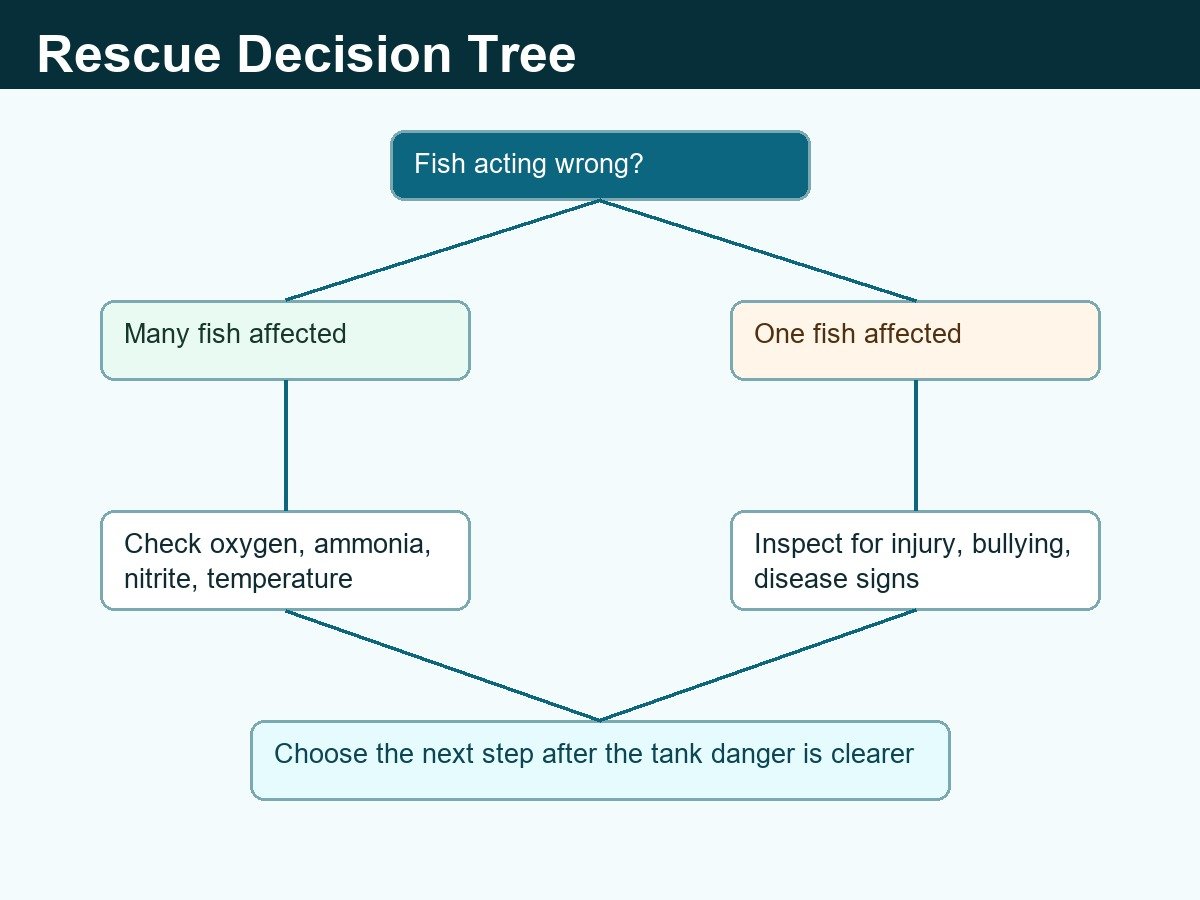
Follow this order when the tank is unstable:
- Fish acting sick, gasping, hiding, or dying? Increase oxygen and stop feeding temporarily.
- Test ammonia and nitrite.
- If ammonia is above 0 ppm, follow the Ammonia Spike Emergency rescue path.
- If nitrite is above 0 ppm, follow the Nitrite Poisoning Rescue Guide.
- If both are 0 ppm, check oxygen, temperature, chlorine, disease, or the Symptoms Checker.
- Review what changed recently: new tank, filter cleaning, new fish, overfeeding, or a power outage.
- Protect the filter bacteria and retest daily.
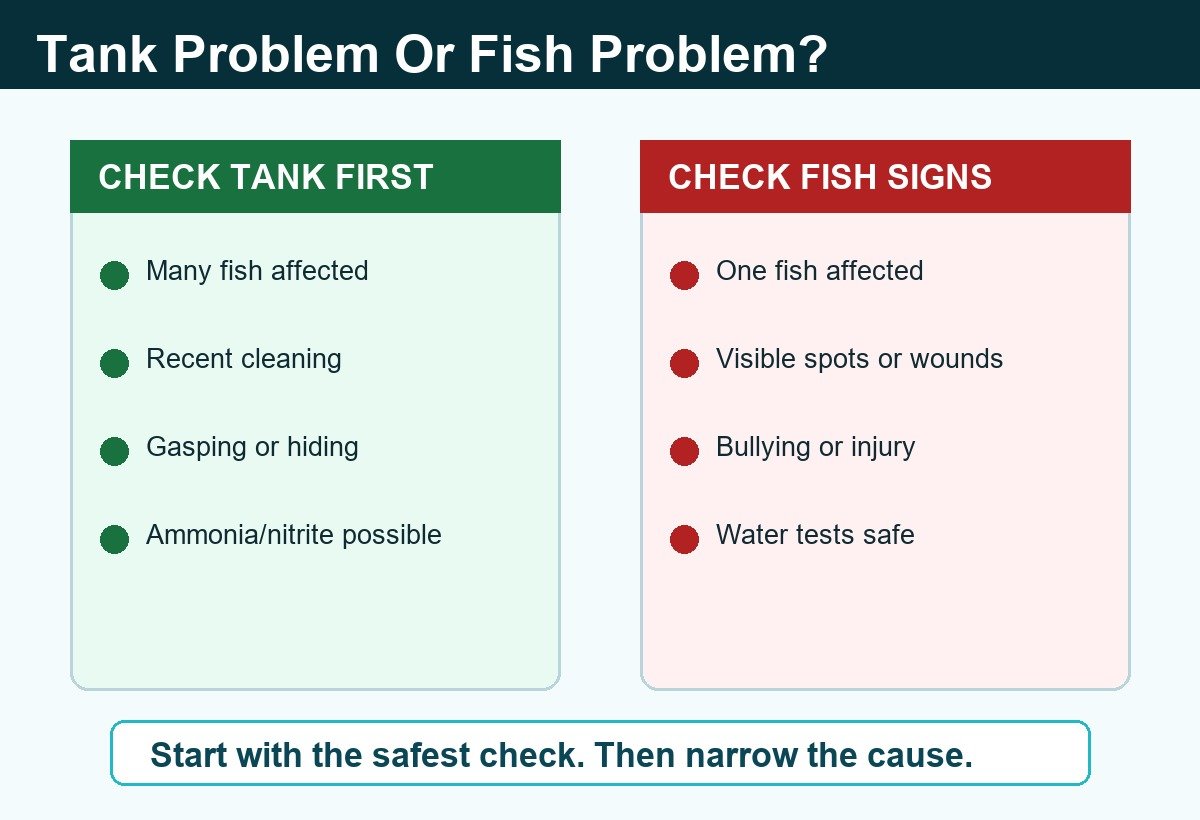
What Changed Recently?
This is often the fastest way to understand the cycle problem.
| Recent Change | Why It Matters | Best Next Guide |
|---|---|---|
| New tank or new filter | Bacteria colonies may not be established yet | Aquarium Nitrogen Cycle Guide |
| New fish added | More waste than the filter can process | Ammonia Spike Emergency |
| Filter cartridge replaced | Bacteria may have been removed | Filter Bacteria Crash |
| Heavy cleaning | Stability may have been disrupted | Fish Dying After Cleaning |
| Nitrite above 0 ppm | Cycle is not fully processing waste | Nitrite Poisoning |
| Cloudy water or bad smell | Waste or bacteria imbalance may be building | Cloudy Water Rescue |
| Fish gasping | Oxygen, ammonia, nitrite, or heat may be involved | Fish Gasping Rescue |
Rescue Paths
Ammonia Above 0 PPM
Ammonia is an emergency because it can irritate or damage the gills and stress fish quickly.
First safe action: add oxygen, stop feeding, do a controlled water change, and protect the filter bacteria.
Use the full guide: Ammonia Spike Emergency: What To Do In The First 30 Minutes
Nitrite Above 0 PPM
Nitrite can make fish struggle to use oxygen properly. Fish may gasp even when the tank has bubbles.
First safe action: add oxygen, stop feeding, change water carefully, and test daily.
Use the full guide: Nitrite Poisoning In Fish? What To Do First
Filter Bacteria Crash
If fish got worse after filter cleaning, cartridge replacement, or a heavy tank cleaning, the filter bacteria may have been damaged or reduced.
First safe action: stop cleaning, keep the filter running, protect remaining media, and test ammonia/nitrite.
Use the full guide: Filter Bacteria Crash? What To Do If You Cleaned Too Much
New Tank Syndrome
In a new aquarium, the bacteria that process ammonia and nitrite may not be strong enough yet.
First safe action: stock slowly, feed lightly, test daily, and do controlled water changes when ammonia or nitrite appears.
Start here: The Nitrogen Cycle Explained: How To Safely Cycle Your Aquarium
Fish Dying After Cleaning
If the tank got worse after cleaning, the problem may be chlorine, temperature shock, stirred waste, oxygen loss, or bacteria disruption.
First safe action: add oxygen, check dechlorinator and temperature, and test ammonia/nitrite before cleaning more.
Use the full guide: Fish Dying After Cleaning The Tank Or Filter? What To Do Now
Emergency Water Change
If ammonia or nitrite is present, a controlled water change may be part of the rescue.
First safe action: use dechlorinated water, match temperature, keep oxygen high, and avoid combining the water change with more filter damage.
Use the full guide: Emergency Water Change? How Much To Change And What To Check First
A Real-World Pattern I See
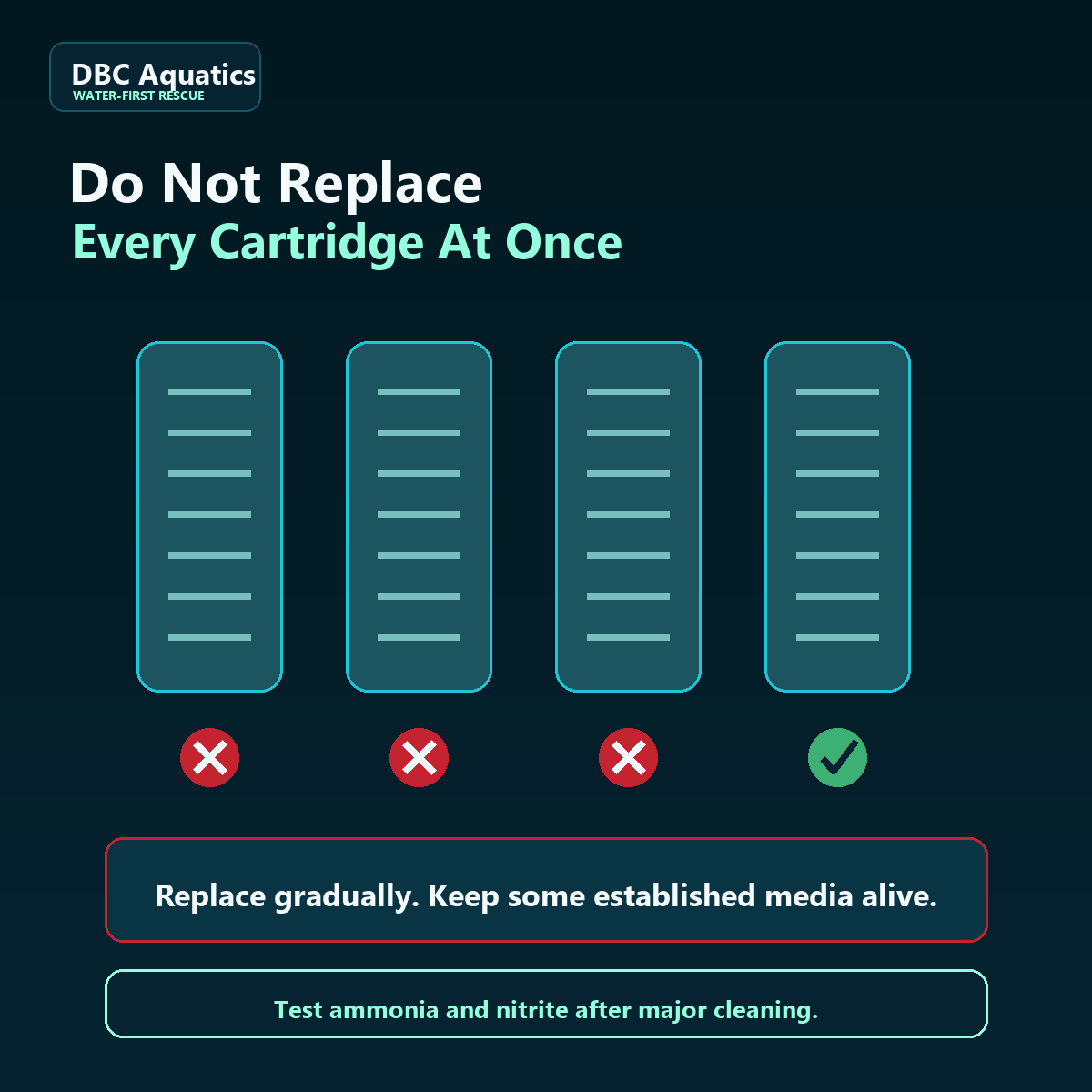
One of the most common patterns I see is someone replacing a dirty-looking cartridge because they think the cartridge is the problem.
The water looks better for a moment.
Then ammonia or nitrite shows up.
The problem was not that the filter looked dirty. The problem was that the cartridge was holding bacteria the tank needed.
That is why DBC keeps repeating this:
Clean for flow.
Do not clean for spotless media.
What Not To Do During A Cycle Problem
Avoid:
- Replacing every filter cartridge.
- Rinsing biological media under untreated tap water.
- Deep-cleaning the filter and gravel on the same day.
- Feeding heavily because fish look weak.
- Adding medication before testing ammonia and nitrite.
- Chasing perfect pH during an emergency.
- Changing five things at once.
- Assuming clear water means safe water.
Chase:
- Strong oxygen.
- Ammonia at 0 ppm.
- Nitrite at 0 ppm.
- Stable temperature.
- Protected filter bacteria.
- Daily test trends.
What Recovery Usually Looks Like
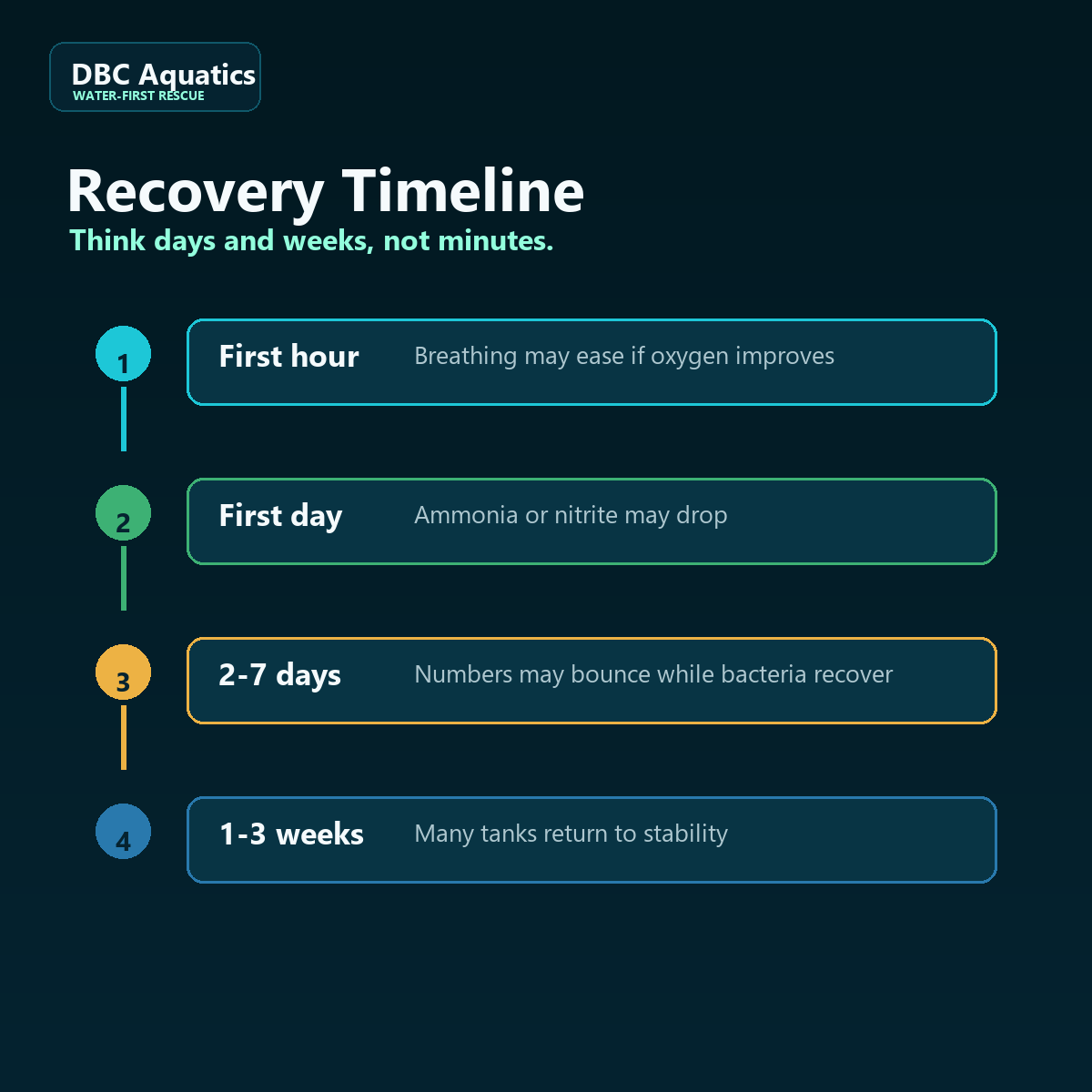
The cycle does not always recover in one afternoon.
| Timeframe | What You Want To See |
|---|---|
| First hour | Fish may breathe easier if oxygen improves. |
| First day | Ammonia or nitrite may drop after controlled water changes. |
| Two to seven days | Numbers may bounce while bacteria recover. |
| One to three weeks | Many tanks become stable if feeding stays light and the filter is protected. |
The goal is not one perfect test.
The goal is a stable trend: ammonia 0, nitrite 0, fish breathing normally, and filter flow strong.
How To Know The Tank Is Recovering
Look for:
- Fish leaving the surface.
- Breathing slowing down.
- Less hiding or clamped fins.
- Ammonia staying at 0 ppm.
- Nitrite staying at 0 ppm.
- Nitrate becoming manageable with normal maintenance.
- Filter flow staying strong.
- No cloudy water or bad smell returning.
If fish still look wrong while ammonia and nitrite are 0 ppm, use the Fish Symptoms Checker to separate water trouble from disease, injury, bullying, or species-specific problems.
Keep The Rescue Order Handy
If your tank is cycling, crashing, or acting unstable, you do not need twenty guesses.
You need the next safe step.
Download the free Aquarium Survival Checklist so the rescue order is in one place when fish start showing stress.
Where This Fits With Water Quality Rescue
The Water Quality Rescue Hub is the main emergency doorway.
Use it when fish are gasping, dying, acting strange, or you do not know where to start.
Use this Nitrogen Cycle Rescue Hub when ammonia, nitrite, new tank syndrome, filter bacteria, or cycling instability is the main issue.
The two hubs should work together.
Water Quality Rescue helps you stabilize the emergency.
Nitrogen Cycle Rescue helps you understand why the invisible waste problem happened and how to stop it from repeating.
When The Blueprint Makes Sense
If your aquarium keeps bouncing from cloudy water to ammonia to nitrite to fish gasping, the problem is usually not one bad test.
It is system stability.
The Aquarium Rescue Blueprint is the deeper path after the immediate rescue. It helps you understand why the tank keeps becoming unstable and how to build a safer routine around oxygen, testing, bacteria, stocking, feeding, and maintenance.
FAQ
What is the nitrogen cycle in simple terms?
The nitrogen cycle is how an aquarium processes waste. Fish waste and leftover food can become ammonia. Bacteria help process ammonia into nitrite, then nitrite into nitrate. Ammonia and nitrite should be 0 ppm in a stable tank.
Is ammonia or nitrite worse?
Both are serious. Ammonia can damage or irritate the gills. Nitrite can interfere with oxygen use. If either one is above 0 ppm, treat the aquarium as unstable and start the rescue order.
Can a tank cycle crash after cleaning?
Yes. Replacing media, rinsing biological media under untreated tap water, deep-cleaning too much at once, or leaving the filter off can reduce bacteria and make the tank act unstable again.
Should I change water during a cycle problem?
If ammonia or nitrite is above 0 ppm, a controlled water change is often part of the rescue. Use conditioner, match temperature, keep oxygen high, and protect the filter media.
Should I replace my filter cartridge if ammonia or nitrite is high?
Usually no. Replacing the cartridge may remove bacteria the tank needs. Restore flow gently, preserve established media, and test daily.
How long does it take a fish tank cycle to recover?
It depends on how much bacteria was lost, how many fish are in the tank, how much you feed, and how stable the filter stays. Some tanks improve in days. Others take one to three weeks or longer to become consistently stable.
Can clear water still have ammonia or nitrite?
Yes. Ammonia and nitrite can be invisible. Clear water does not prove the tank is safe.
When should I use medication?
Use medication after water, oxygen, temperature, and filter stability are checked. Medication does not remove ammonia or nitrite.
Bottom Line
The nitrogen cycle is not just aquarium theory.
It is the invisible system protecting your fish every day.
When that system is new, overloaded, overcleaned, or damaged, fish can suffer even when the tank looks clean.
Start simple:
Add oxygen.
Stop adding waste.
Test ammonia and nitrite.
Protect the filter.
Change water carefully when the numbers say to.
Then give the bacteria time to do their job.
That is how you rescue the tank without accidentally resetting the thing that keeps it alive.
A Real Rescue Example
I have seen fishkeepers reach for medication because the fish looked sick overnight. The test kit told a different story: ammonia or nitrite was not zero. Medication would have felt like helping, but it would not have fixed the real problem. Once oxygen improved, water was corrected carefully, and the filter bacteria were protected, the fish had a better chance to recover.
Internal Rescue Path
Use the next DBC guide that matches what you find:
- If ammonia or nitrite is above zero, start with the ammonia spike emergency guide.
- If breathing hard or gasping continues after water checks are safe, use the fish gasping rescue guide.
- If symptoms are unclear, use the DBC Fish Symptoms Checker.
- If this feels like a tank-wide problem, go to the Aquarium Rescue Hub.
Rescue Checklist
Use the Aquarium Survival Checklist to work through the first checks without guessing.
Leave a Reply