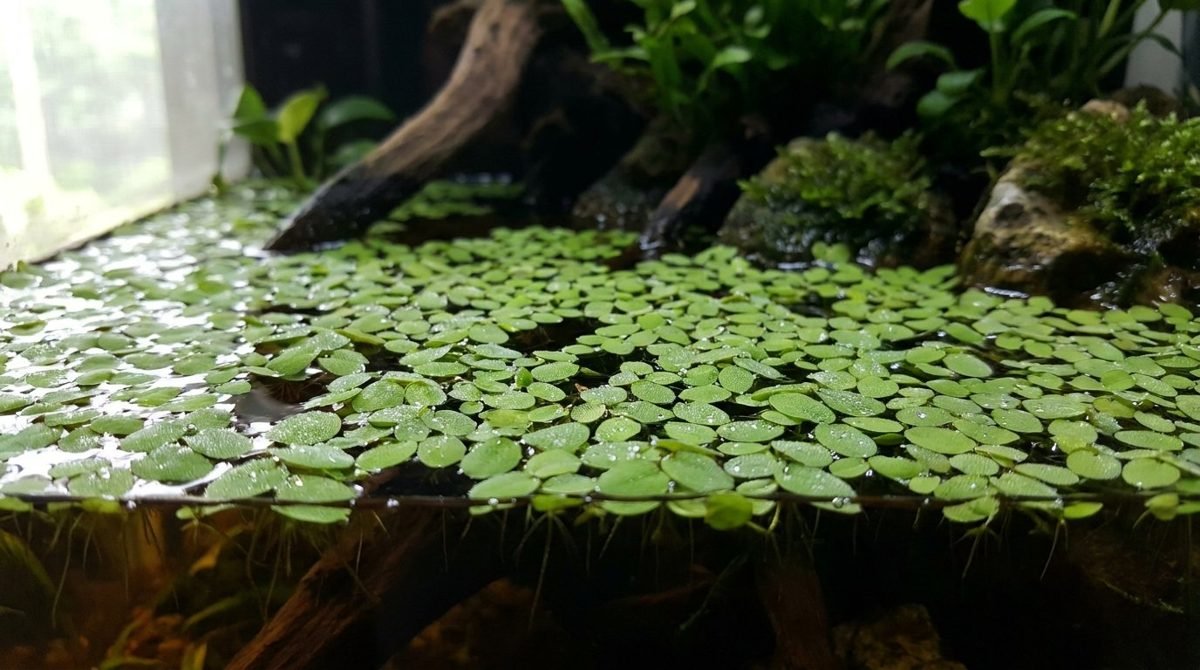
Quick answer: Duckweed is the tiniest, fastest-spreading floating plant in the hobby. It needs no CO2 and runs on any decent light. It’s a superb nutrient exporter — it pulls out nitrate, ammonia, and phosphate while starving algae — and it doubles as free fish food. The catch is real: it multiplies explosively, can blanket your surface, and is famously almost impossible to fully remove once it’s established. Adding it is a commitment, not an experiment.
I have a complicated relationship with duckweed. I keep it on purpose in a few grow-out and fry tanks because nothing exports nutrients as cheaply or feeds my goldfish as reliably. I’ve also spent more hours than I’d admit netting it out of tanks where it arrived uninvited on a new plant and refused to leave. Both are true at once, and that’s the honest frame here: duckweed is one of the most useful plants I know, and one of the few I tell people to think hard about before adding.
Watch: The Truth About Duckweed
What duckweed is
Duckweed (Lemna minor) is a tiny floating plant — each individual is a single rounded leaf, or a small cluster, a few millimeters across with one short root trailing underneath. It floats freely in a loose green film, with no stem to plant and no substrate to worry about. You drop it in and it floats. That’s the whole setup.
What sets it apart from other floaters is speed. Under good conditions a single leaf buds off new ones so fast that a patch can double in days. That growth rate is the source of both its biggest benefit and its biggest headache, so keep it in mind for everything below.
Duckweed care at a glance
Care is almost a non-event. Duckweed is low-tech to the core: no CO2, no fertilizer dosing in a stocked tank, no special substrate. It tolerates a wide temperature band and a wide range of water. Here’s what it wants.
| Requirement | Duckweed needs |
|---|---|
| Light | Any decent light — a basic LED is plenty; brighter light just means faster spread |
| CO2 | None; it pulls carbon from the air at the surface, so injected CO2 is pointless |
| Temperature | Wide tolerance, roughly 59–86°F (15–30°C); fine in unheated and tropical tanks |
| pH | Adapts to most freshwater values; not fussy |
| Substrate | None — it floats and feeds entirely from the water column |
| Fertilizer | Rarely needed in a stocked tank; it lives on fish waste |
| Surface flow | Calm to gentle; constant turbulence and spray push it under and drown it |
The one parameter worth a word is surface movement. Like other floaters, duckweed dislikes a strong outflow or skimmer constantly washing over the leaves, which drowns and rots them. The good news is it’s far more forgiving here than frogbit, which sulks at the first sign of spray. Duckweed tolerates gentle current and just re-colonizes the calm corners. If your surface is churning, baffle the outflow and it’ll settle.
Why duckweed is a nutrient and algae powerhouse
This is why I put up with the downsides. Duckweed is one of the most efficient nutrient exporters you can put in a freshwater tank. It feeds directly from the water column and it’s hungry, pulling out nitrate, ammonia, and phosphate at a serious clip because it grows so fast. When you net out a handful, you’re physically removing that nitrogen and phosphorus from the system for good.
Two payoffs follow. First, it’s a strong algae competitor: algae and duckweed want the same nutrients, and duckweed — sitting at the surface with first claim on light and a faster growth rate — usually wins, so green-water and film problems often fade. Second, a healthy mat can genuinely reduce how often you change water, because it’s exporting the nitrate water changes normally remove. I won’t promise you’ll never change water again — testing still rules — but in my nutrient-heavy goldfish and grow-out tanks it has stretched my schedule noticeably.
The honest downside: controlling and removing duckweed
Here’s the part nobody tells you at the fish store. That same explosive growth also makes duckweed a menace. Left alone, it doesn’t stay a tidy patch — it spreads across the whole surface and forms a thick green blanket. That blanket blocks light to the plants below it and can choke gas exchange at the surface, a real problem in a heavily stocked tank that depends on that surface for oxygen. A duckweed mat isn’t a decorative accent; it’s a fast-moving takeover.
Then there’s removal, which is genuinely the plant’s reputation. Duckweed is famously almost impossible to fully eradicate once it’s established. A single leaf you missed repopulates the whole tank in a couple of weeks, and it hitchhikes on nets, hoses, your hands, and new plants. This is why I keep saying commitment — adding duckweed is a decision you should expect to live with for the life of the tank.
Control is straightforward, but it’s ongoing:
- Skim regularly. The whole job is netting the surface to thin the mat — I run a fine net across the top weekly and pull out maybe half.
- Use the current. A gentle outflow herds floating duckweed to one end, making skimming a thirty-second job instead of a chase across the surface.
- Quarantine new plants. Most invasions arrive as a stowaway. Inspect and rinse anything new before it enters a tank you want to keep duckweed-free.
- Accept “control,” not “cure.” If you truly want it gone, you’ll likely have to strip the tank, scrub everything, and stay vigilant for weeks — and even then it often returns.
Using duckweed as free fish food
The best thing about all that surplus is that you don’t have to throw it away — a lot of fish will eat it. Goldfish, many cichlids, and livebearers like mollies graze duckweed readily, and for vegetarian-leaning fish it’s a free, living green that’s always fresh. Instead of buying veggie pellets, I scoop excess from one tank into another as a snack. It turns a control chore into a feeding.
It’s also a neat way to keep a problem patch in check: grow a dedicated patch in a corner or a small lit container and harvest it for your grazers. The fish thin it for you, and the nutrients cycle back as food instead of waste.
Is duckweed right for your tank
This one comes down to your goals more than your skill. Duckweed is a tool with a sharp edge.
- Add it if you have a nutrient-heavy tank fighting nitrate or algae, you keep fish that graze, or you want cheap surface cover for shrimp and fry — they love the shade and somewhere to hide and graze.
- Think twice if you run a planted aquascape with demanding plants below — the blanket will shade them out and you’ll fight it constantly. A pristine display where you want a clean, open surface is no place for it either.
- Don’t add it if you’re not prepared to skim every week, forever. If you want a set-and-forget tank, duckweed takes over the moment you stop managing it.
And the standard floater warning applies: never dump duckweed or any aquarium plant into a pond, lake, ditch, or storm drain. It’s exactly the kind of fast-spreading plant that wrecks wild waterways. Bag it and bin it, compost it, or pass it to another keeper.
Duckweed Care FAQ
Does duckweed need CO2 or fertilizer?
No to CO2 — duckweed floats at the surface and takes carbon straight from the air, so injected CO2 does nothing for it. Fertilizer is rarely needed either. In a stocked tank it lives on fish waste, pulling nitrate, ammonia, and phosphate out of the water. Only in a very lean, lightly stocked tank would a small dose of liquid fert help, and even then it usually finds enough to spread.
How do I get rid of duckweed, and can you fully remove it?
You control it by skimming or netting the surface regularly — I pull out about half the mat once a week. Herding it to one end with a gentle outflow makes that quick. Fully removing it is the hard part: duckweed is famously almost impossible to eradicate because a single missed leaf repopulates the whole tank in a couple of weeks. Truly clearing it usually means stripping and scrubbing the tank, and even then it often returns. Plan to manage it, not beat it.
Does duckweed reduce nitrates and algae?
Yes, strongly. Duckweed is one of the best nutrient exporters in the hobby — it grows fast and feeds directly from the water, pulling out nitrate, ammonia, and phosphate. Every handful you net out removes those nutrients for good, which can stretch your water-change schedule. Because it starves algae of the same nutrients while shading the surface, it’s also a powerful algae competitor.
Will fish eat duckweed?
Many will. Goldfish, plenty of cichlids, and livebearers like mollies graze it readily, so it doubles as free, fresh fish food. Instead of binning your surplus, scoop it from one tank into another as a green snack. Some keepers grow a dedicated patch just to harvest for their grazers, which also keeps the plant under control.
Does duckweed block light and harm other plants?
It can, if you let it. Left unmanaged, duckweed forms a thick blanket across the surface that blocks light to plants below and can reduce gas exchange. In a planted tank with demanding plants underneath, that’s a real problem — you’ll be shading them out. The fix is simple but constant: skim regularly to keep the mat thin and the surface partly open.
Is duckweed good for shrimp and fry?
Yes — it’s excellent for both. A floating layer of duckweed gives shrimp and baby fish shade and cover to hide in, and the dangling roots and leaves are a grazing surface for microorganisms shrimp pick at. It also helps keep their water clean by exporting nutrients. Just skim it enough that it doesn’t seal off the whole surface.
Keep reading
Educational guidance from a freshwater keeper — not a substitute for testing your own water.
Author and editorial note
Written and maintained by Benjamin Thoden, founder of DBC Aquatics. This shrimp guide is reviewed through DBC Aquatics’ stability-first lens: cycle maturity, mineral consistency, molt safety, copper risk, grazing surfaces, and slow acclimation matter more than quick fixes. See our editorial standards for how guides are created, reviewed, and updated.
Leave a Reply