Goldfish Gasping After A Water Change? Do This First
Watching your goldfish gasp right after a water change can make your stomach drop.
If your goldfish started gasping immediately after a water change, do not assume you poisoned the whole tank.
Most cases come down to oxygen, chlorine or chloramine, temperature shock, stirred-up waste, or a disruption to the biological filter.
The first few minutes matter.
The good news is that this is usually much easier to handle when you work through the checks in the right order.
Quick Answer
If your goldfish are gasping after a water change:
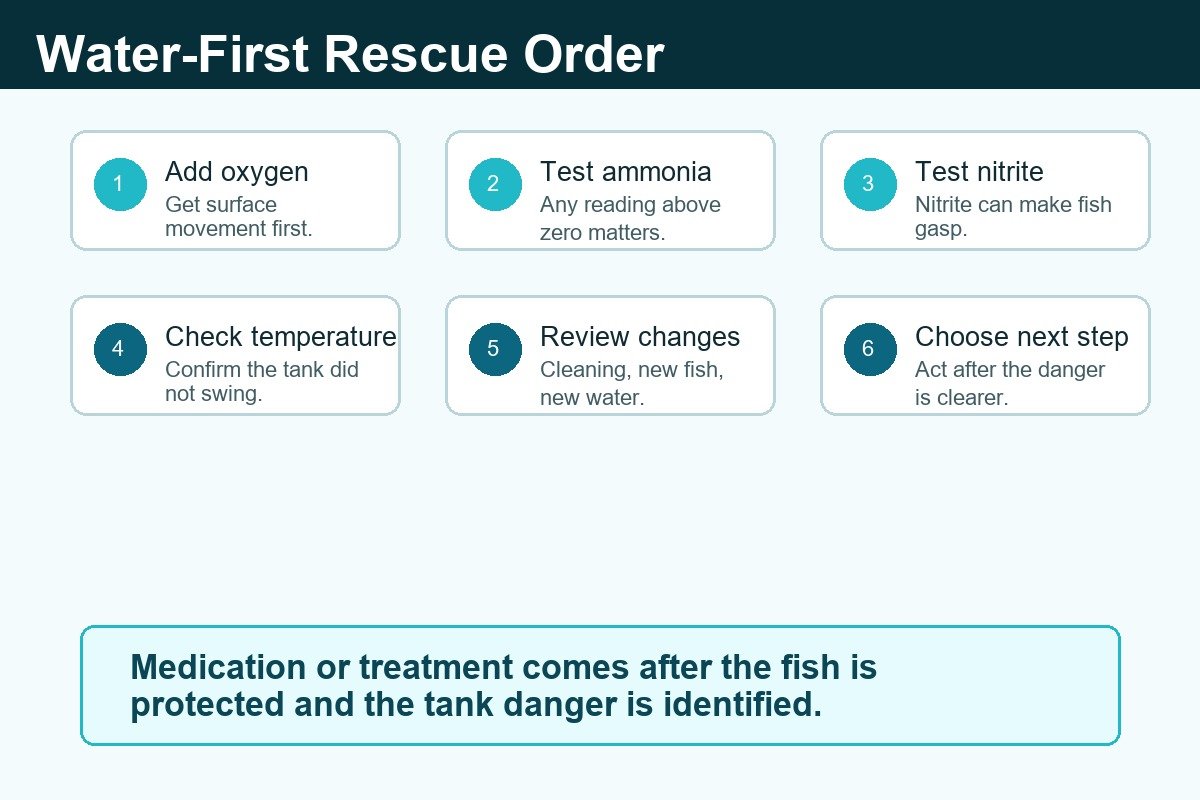
- Increase oxygen immediately.
- Confirm you used enough dechlorinator.
- Check the water temperature.
- Test ammonia and nitrite. Both should be 0 ppm.
- Protect the filter. Do not deep-clean it again.
Then use the sections below to identify the cause.
Goldfish produce significantly more waste than many tropical community fish, so small mistakes during maintenance can affect water quality faster than many beginners expect.
> Emergency > > If multiple goldfish are rolling over, unable to stay upright, or rapidly losing balance, increase aeration immediately and start testing the water before attempting any other treatment.
The goal of this guide is not to sell you another product. It is to help you make the next safe decision for your fish.
> THE DBC RULE > > Test the water. > > Protect the fish. > > Then choose the next step.
Most Likely Cause
Use this table to decide what to check first instead of guessing.
| Cause | Common? | Check First |
|---|---|---|
| Low oxygen after the water change | Very common | First |
| Forgot dechlorinator or under-dosed conditioner | Common | Yes |
| Temperature mismatch | Common | Yes |
| Stirred-up waste during gravel vacuuming | Sometimes | Yes |
| Ammonia spike | Common in unstable tanks | Test |
| Nitrite spike | Sometimes | Test |
| Disease unrelated to the water change | Less common | Later |
Disease can still happen, but a goldfish gasping right after a water change is a water-first problem until the basic checks prove otherwise.
First: Add Oxygen
Goldfish need strong oxygen and steady filtration.
Do this now:
- point the filter output at the surface
- add an air stone
- remove anything blocking flow
- open the lid if the tank is warm
- keep the filter running
This buys time while you figure out whether the problem is chlorine, temperature, ammonia, nitrite, or filter damage.
Increasing oxygen does not remove ammonia, nitrite, chlorine, or waste from the water.
It helps your goldfish while you correct the real problem. Fish under stress may struggle to use oxygen efficiently, so stronger surface movement gives them the best chance while you test, condition, and stabilize the tank.
Check Dechlorinator
Untreated tap water can irritate gills quickly. Chlorine and chloramine exposure can make goldfish gasp, dart, clamp fins, or sit weakly after a water change.
Ask:
- Did you use conditioner?
- Did you dose for the whole amount of new water?
- Did you add more water than usual?
- Did someone else refill the tank?
If conditioner was missed, dose the tank correctly now and keep oxygen high. Do not add medication for chlorine exposure. Stabilize the water.
Check Temperature
Goldfish can handle cooler water, but quick temperature swings are still stressful.
Use a thermometer. If the new water was much colder or warmer than the tank, the fish may gasp, sit low, dart, or act shocked.
Correct slowly. Do not make another big swing trying to fix the first one.
Test Ammonia And Nitrite
Goldfish tanks can build waste quickly, especially if the tank is small, overstocked, overfed, or under-filtered.
Ammonia and nitrite should both be 0 ppm.
If either is above zero:
- keep oxygen high
- stop feeding temporarily
- do a controlled partial water change with conditioned, temperature-matched water
- protect the filter media
- retest
If you changed water and cleaned the filter on the same day, ammonia or nitrite can rise because the tank lost bacteria.
One Pattern I See A Lot
In my experience, one of the most common patterns is someone changing 70 to 90 percent of the water, deep-cleaning the filter, and gravel vacuuming heavily all in the same afternoon.
Each step sounds reasonable by itself.
Together, they can temporarily destabilize the aquarium.
The tank loses old water, stirred waste enters the water column, oxygen demand rises, and the filter bacteria may get disturbed right when the fish need stability most.
That is why I would rather see a careful rescue order than one more big cleaning session.
A Real Rescue Example
I have seen goldfish start gasping after a big cleanup even though the water looked clearer than it had in weeks.
The fishkeeper thought the clean water proved the tank was safer.
The test kit told a different story: nitrite was not zero, oxygen was low, and the filter had been rinsed too aggressively.
The rescue was not medication. It was oxygen, conditioned water, protected filter media, no feeding for a short period, and daily testing until the tank stabilized.
Clear water can still be dangerous if the invisible water chemistry is wrong.
Do Not Deep-Clean The Filter Again
If goldfish are gasping after a water change, it is tempting to clean more.
Do not tear the filter apart unless flow is blocked.
If flow is weak:
- swish media gently in old tank water
- clear the intake
- keep biological media wet
- restart the filter quickly
Do not rinse media under untreated tap water. Do not replace all cartridges or sponges at once.
What The Symptom Usually Means
| What Happened | Likely Problem | First Check |
|---|---|---|
| Gasping right after refill | Chlorine/chloramine or temperature shock | Conditioner and thermometer |
| Gasping a few hours later | Low oxygen, ammonia, nitrite, stirred waste | Oxygen and tests |
| Gasping after gravel vacuum | Waste released, oxygen drop, ammonia | Test ammonia/nitrite |
| Gasping after filter cleaning | Bacteria loss or reduced flow | Test toxins, protect filter |
| Gasping with cloudy water | Bacterial bloom, overfeeding, waste | Oxygen, stop feeding, test |
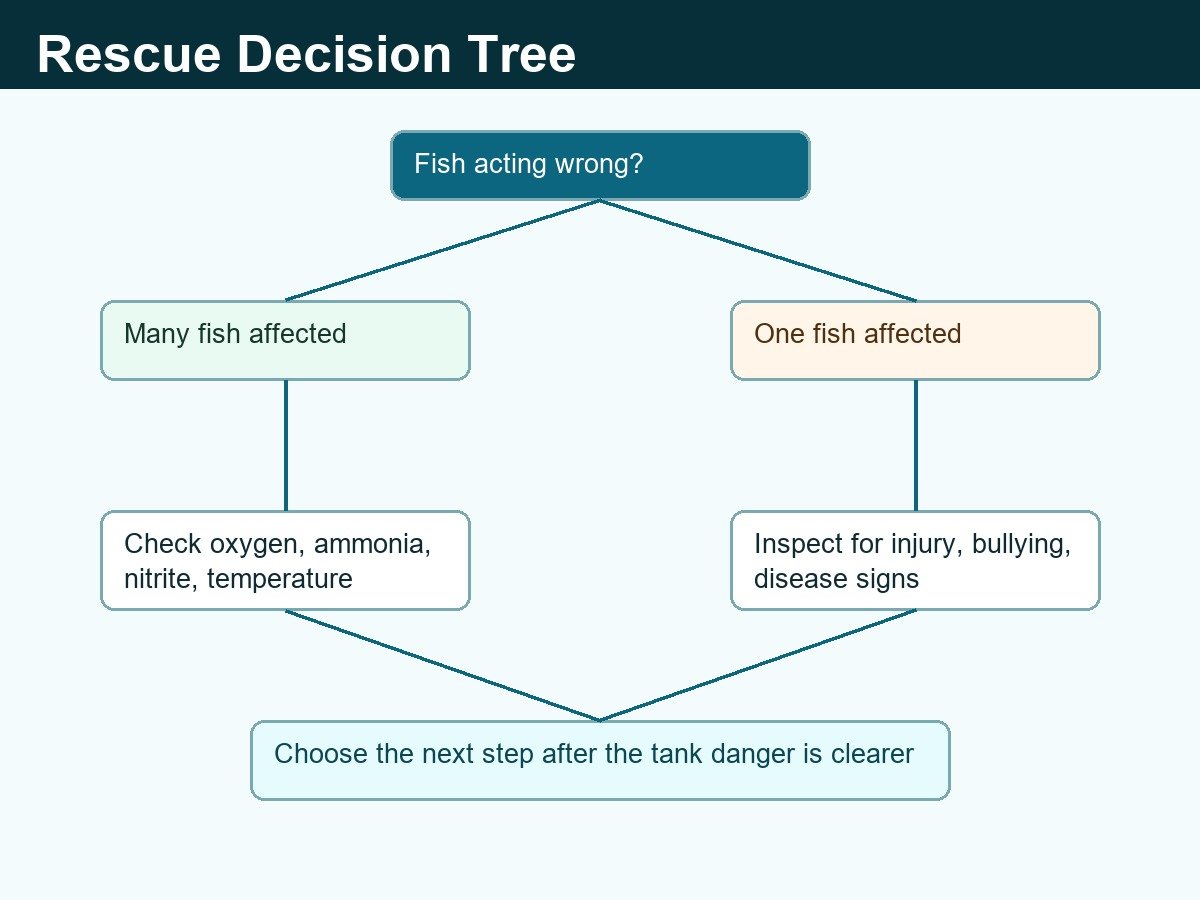
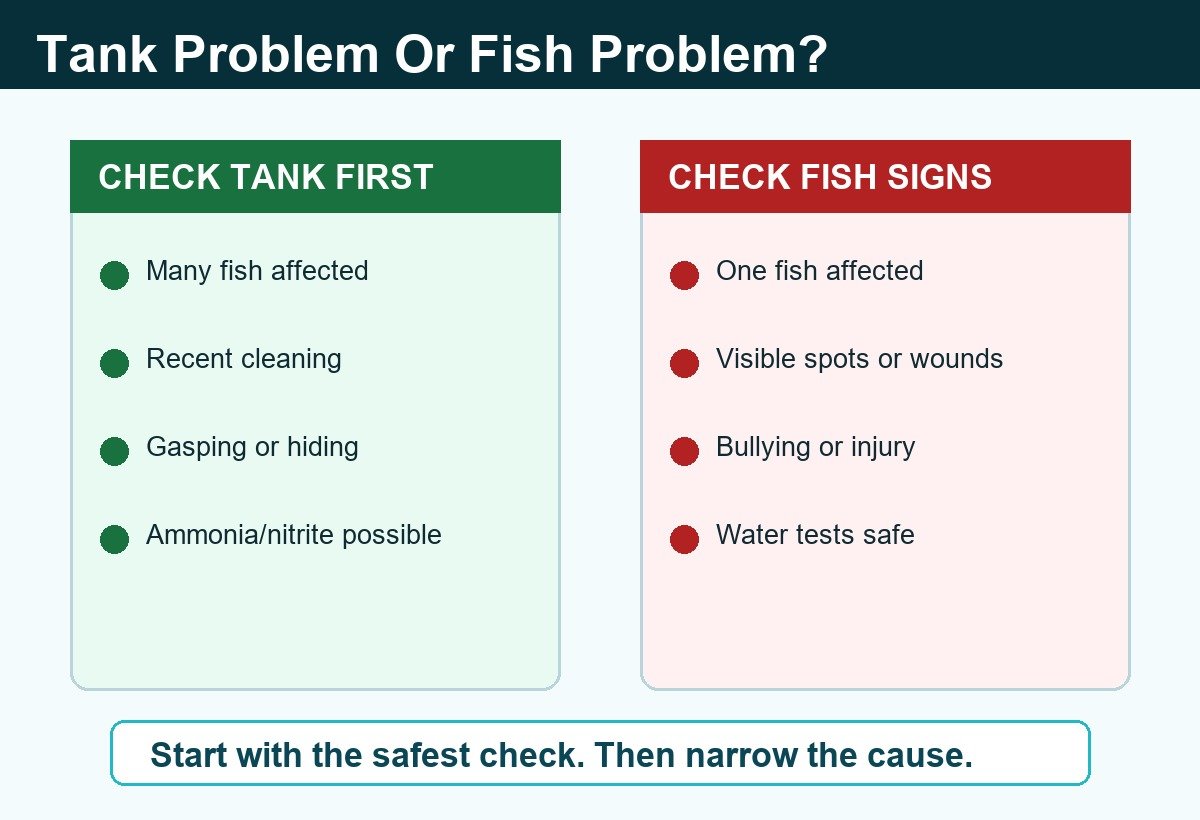
| Only one goldfish gasping | Individual illness or injury possible | Still test water first |
What Recovery Usually Looks Like
| Timeframe | What To Expect |
|---|---|
| First 10 minutes | Increase aeration, confirm the filter is running, and check that conditioner was used. |
| First hour | If oxygen, chlorine exposure, or temperature stress was the main issue, breathing may begin to look easier. |
| First 24 hours | Keep testing ammonia and nitrite while watching breathing, balance, clamped fins, and bottom sitting. |
| Next several days | Fish should gradually return to normal if the underlying water-quality problem has been corrected. |
Most water-change stress does not mean the tank is ruined. The bigger risk is missing the real cause and making five more changes before the fish have a chance to stabilize.
When This Is Not From The Water Change
The water change may not be the main cause if:
- only one goldfish is affected
- symptoms started before the water change
- white spots appear
- ulcers, wounds, or red patches develop
- the fish cannot stay upright
- the fish is bloated, pineconing, or floating sideways
Still test the water first, because water problems can make every disease worse.
But if the water checks are safe and the symptoms point to one fish, use the DBC Fish Symptoms Checker next.
What Changed In The Last 48 Hours?
Write this down:
- water change percentage
- conditioner brand and dose
- tank temperature before and after
- ammonia
- nitrite
- nitrate
- filter cleaning
- media replacement
- gravel vacuum depth
- feeding amount
- any new fish
- any dead fish or decaying food found
Those facts matter more than guessing.
Visual Rescue Timeline
Use this order as the simple rescue flow:
Water Change
     |
Fish Gasping
     |
Increase Oxygen
     |
Check Dechlorinator
     |
Check Temperature
     |
Test Ammonia
     |
Test Nitrite
     |
Protect Filter
     |
Retest
This is the visual that should go beside this guide: a simple goldfish water-change rescue timeline with clear arrows, minimal text, and the DBC line: Test water first. Protect the fish.
When To Use DBC Aquarium Tools
Use DBC Aquarium Tools if you want to save the tank numbers and see the danger level:
- tank size
- temperature
- ammonia
- nitrite
- nitrate
- water-change notes
- recent filter cleaning
If the goldfish are gasping plus showing red gills, clamped fins, flashing, or bottom sitting, use the Symptoms Checker next.
What Not To Do
Avoid:
- another huge water change without checking conditioner and temperature
- deep-cleaning the filter again
- replacing filter media
- adding medication before testing water
- feeding to calm the fish
- chasing pH during the first rescue step
The goal is to protect the fish and protect the bacteria.
Keep The Rescue Order Handy
If you are already worried about your goldfish, this is the moment when a simple checklist helps.
Download the free Aquarium Survival Checklist so you have the first rescue checks in order before the next emergency.
FAQ
Why are my goldfish gasping after a water change?
Common causes include chlorine or chloramine exposure, temperature shock, low oxygen, ammonia, nitrite, stirred-up waste, or filter bacteria damage.
Should I do another water change?
Only after checking conditioner, temperature, ammonia, and nitrite. If ammonia or nitrite is present, a controlled partial water change can help. Use conditioned water close to tank temperature.
Can cleaning the filter make goldfish gasp?
Yes. If filter media is rinsed under tap water or replaced, beneficial bacteria can be damaged. That can lead to ammonia or nitrite spikes.
Should I add medicine?
Not first. Gasping after a water change is usually a water or oxygen problem until tests prove otherwise.
How long does it take a goldfish to recover after a water change?
If oxygen, conditioner, or temperature was the main issue, breathing may start improving within the first hour. If ammonia, nitrite, or filter bacteria are involved, recovery can take several days of careful testing and stable water.
Why is only one goldfish gasping after the water change?
If only one fish is affected, still test the water first. If ammonia and nitrite are 0 ppm and the other fish are acting normal, the problem may be injury, infection, buoyancy trouble, or another individual health issue.
Can a big water change shock goldfish?
Yes. A large water change can stress goldfish if the new water is not conditioned, is much warmer or colder, has different chemistry, or happens alongside heavy gravel vacuuming and filter cleaning.
Bottom Line
Goldfish do not care whether the problem started with chlorine, temperature, ammonia, nitrite, oxygen, or the filter.
They only care that they can breathe and that the water is safe.
That is why the safest rescue starts the same way every time: add oxygen, test the water, protect the filter, and then decide what comes next.
Internal Rescue Path
Use what you found to choose the next DBC guide:
| If you discovered… | Go here next |
|---|---|
| Ammonia above 0 ppm | Ammonia Rescue Guide |
| Nitrite above 0 ppm | Nitrite Rescue Guide |
| Normal water tests but continued gasping | Fish Gasping Guide |
| Only one goldfish affected | DBC Fish Symptoms Checker |
| Multiple water problems or you are not sure where to start | Water Quality Rescue Hub |
| Tank-wide stress after cleaning or maintenance | Aquarium Rescue Hub |
Next Step After The Emergency
If your tank keeps having repeat emergencies, the Aquarium Rescue Blueprint gives you the bigger recovery plan after the fish are stable.
Rescue Checklist
Use the Aquarium Survival Checklist to work through the first checks without guessing.
Leave a Reply