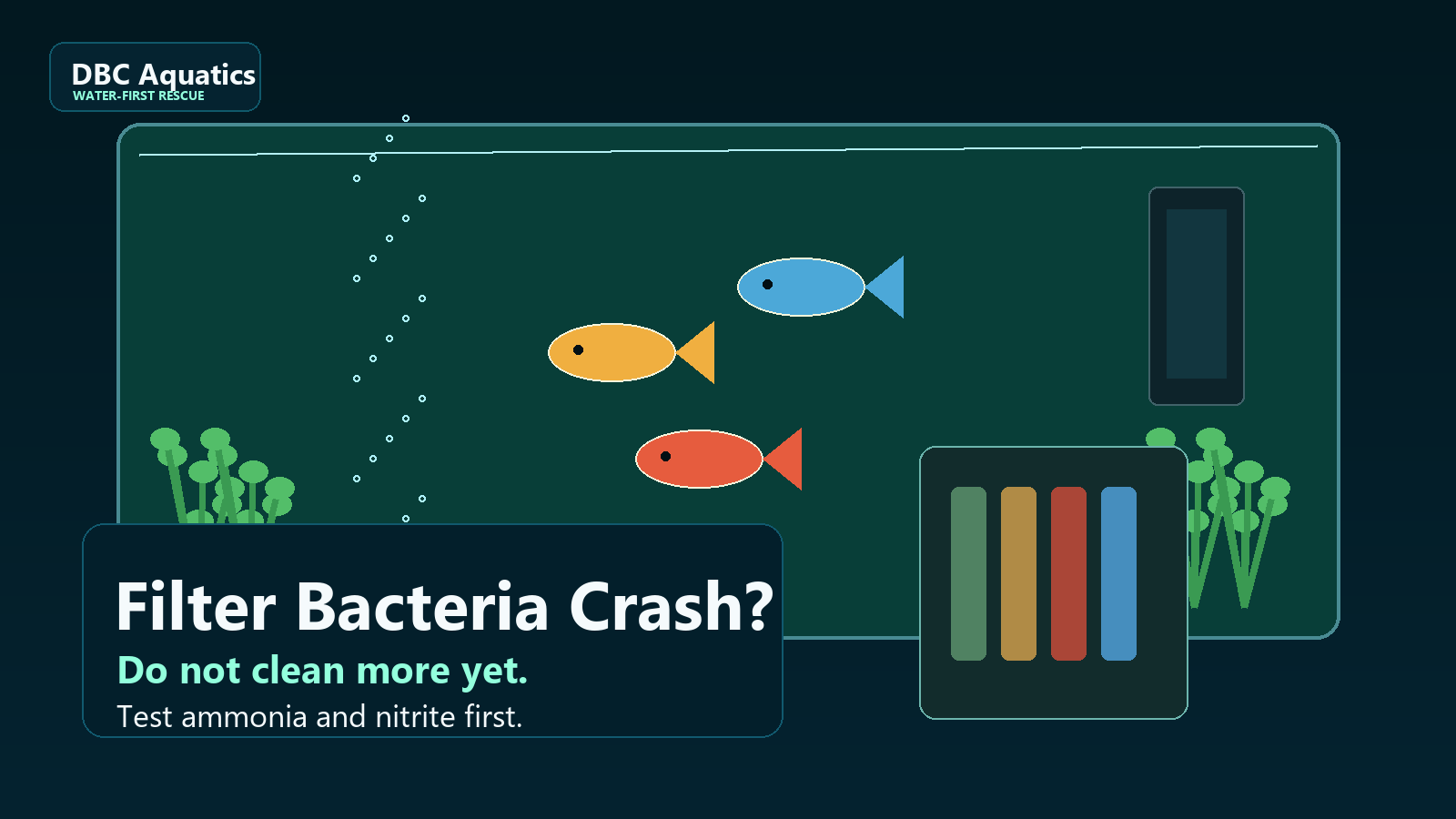
Filter Bacteria Crash? What To Do If You Cleaned Too Much
If your fish started acting wrong after you cleaned the filter, replaced the cartridge, scrubbed the tank, or changed a lot of water, it can feel like you broke the aquarium.
That is a scary moment because the tank may look cleaner than it did before.
But cleaner does not always mean safer.
Sometimes the problem is not dirt. Sometimes the problem is that too much of the bacteria protecting the tank was removed at once. Before you clean more, add medication, or replace another cartridge, slow down and protect the fish first.
Quick Answer
If you think the aquarium had a filter bacteria crash:
- Increase oxygen and surface movement.
- Keep the filter running.
- Do not replace more filter media.
- Stop feeding temporarily.
- Test ammonia and nitrite.
- Do a controlled water change if either ammonia or nitrite is above 0 ppm.
- Protect any remaining established media.
- Retest daily until ammonia and nitrite stay at 0 ppm.
Video support: If you are about to change more water, watch Ben walk through the controlled rescue order: Fish Dying? Do This Before You Change More Water.
If fish are gasping at the surface, add oxygen immediately and use the Fish Gasping At The Top rescue guide after the first water-quality checks.
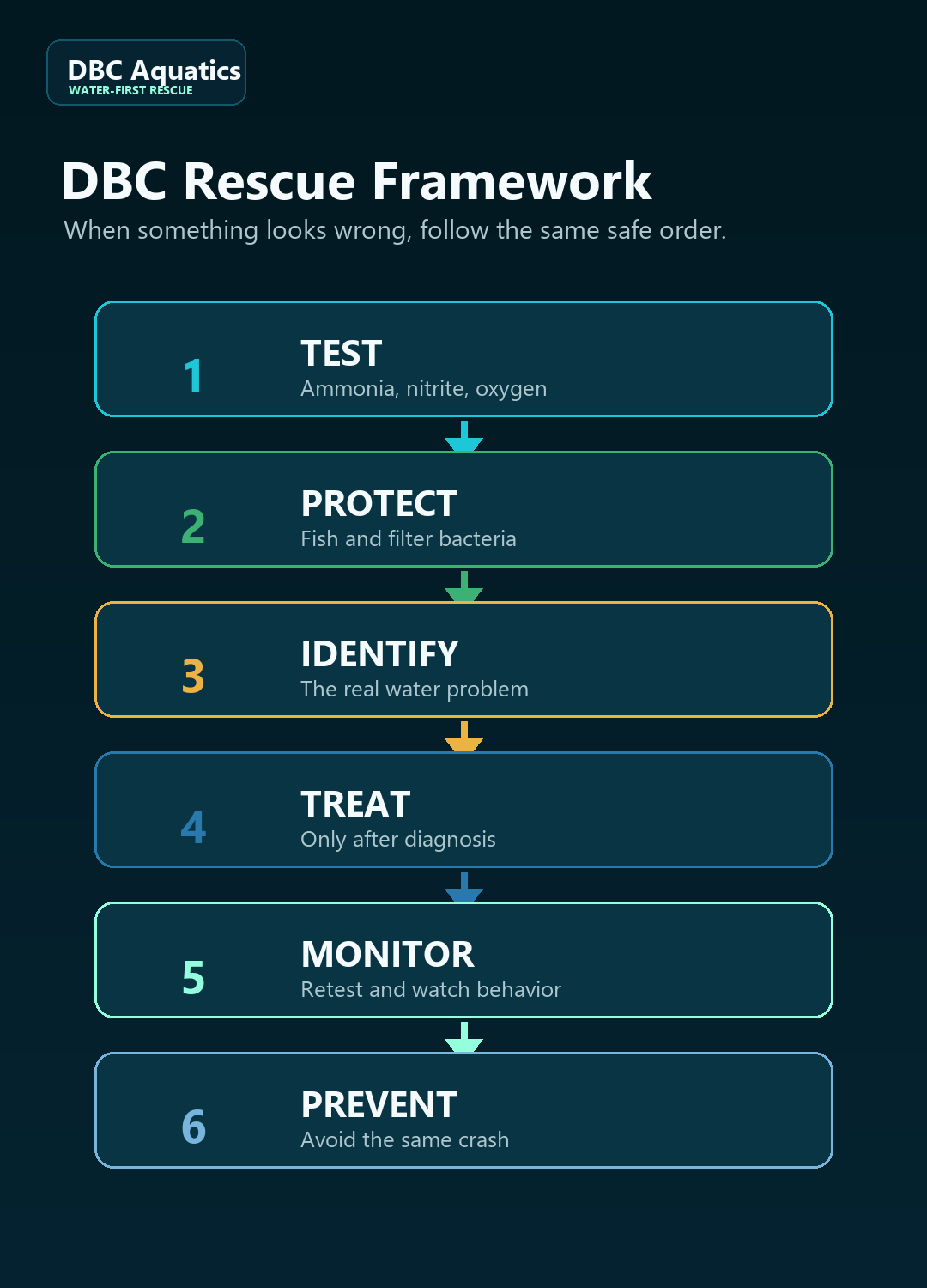
THE DBC RULE
Test the water.
Protect the fish.
Protect the filter bacteria.
Then choose the next step.
A filter bacteria crash is not fixed by making the filter look spotless. It is fixed by keeping fish safe while the biological filter catches up again.
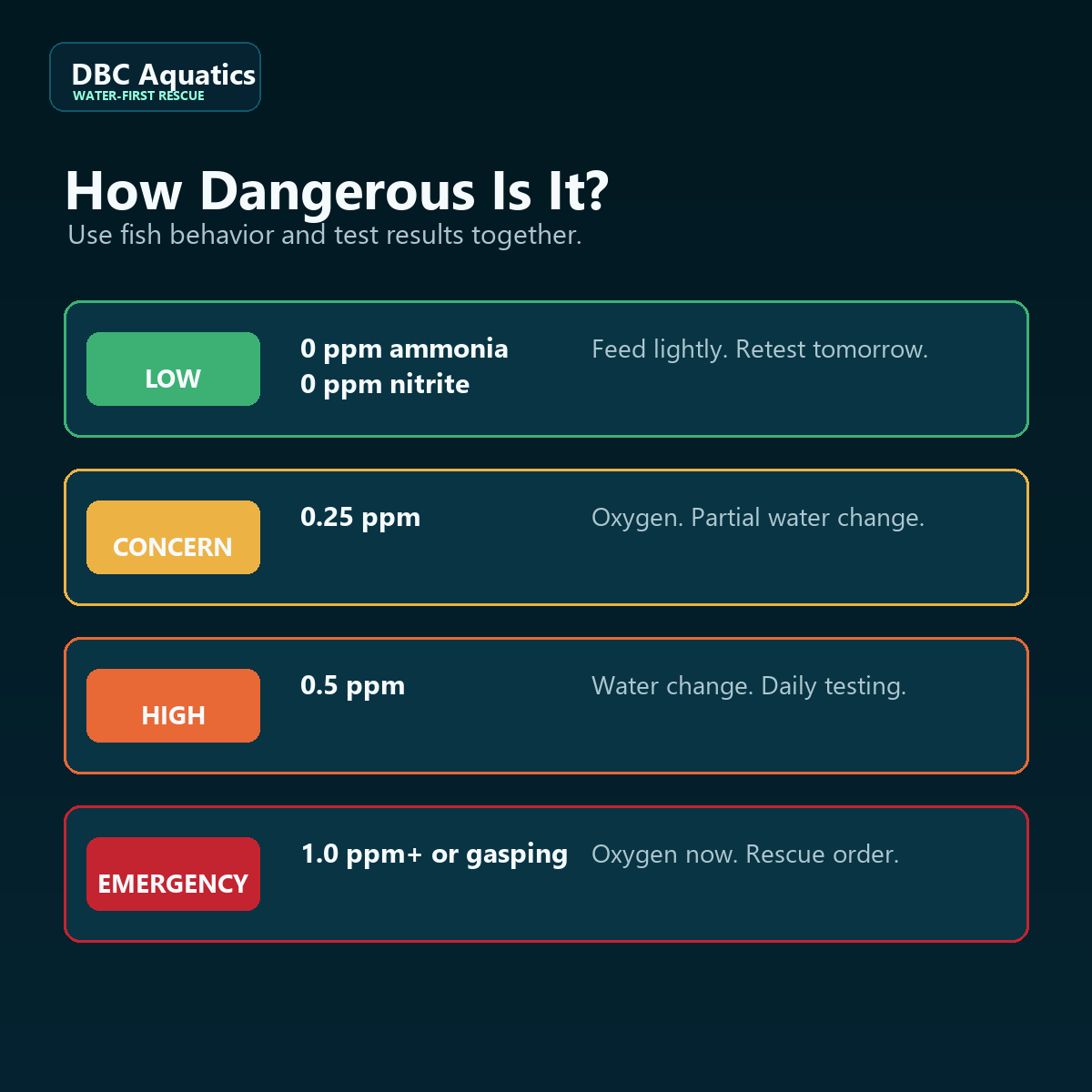
How Dangerous Is My Filter Bacteria Crash?
Use the test results and fish behavior together.
| What You See | Risk | What To Do First |
|---|---|---|
| Fish acting normal, ammonia 0 ppm, nitrite 0 ppm | Low | Keep filter running, feed lightly, retest tomorrow. |
| Mild stress, ammonia or nitrite near 0.25 ppm | Concern | Increase oxygen, stop feeding, partial water change, retest. |
| Fish breathing fast, ammonia or nitrite around 0.5 ppm | High | Oxygen, controlled water change, protect media, daily testing. |
| Fish gasping, ammonia or nitrite near 1.0 ppm or higher | Emergency | Oxygen now, emergency water-change order, monitor closely. |
| Filter cartridge replaced and fish are dying | Emergency | Treat as a water-quality rescue until testing proves otherwise. |
Clear water does not rule out a bacteria crash. Ammonia and nitrite can be invisible.
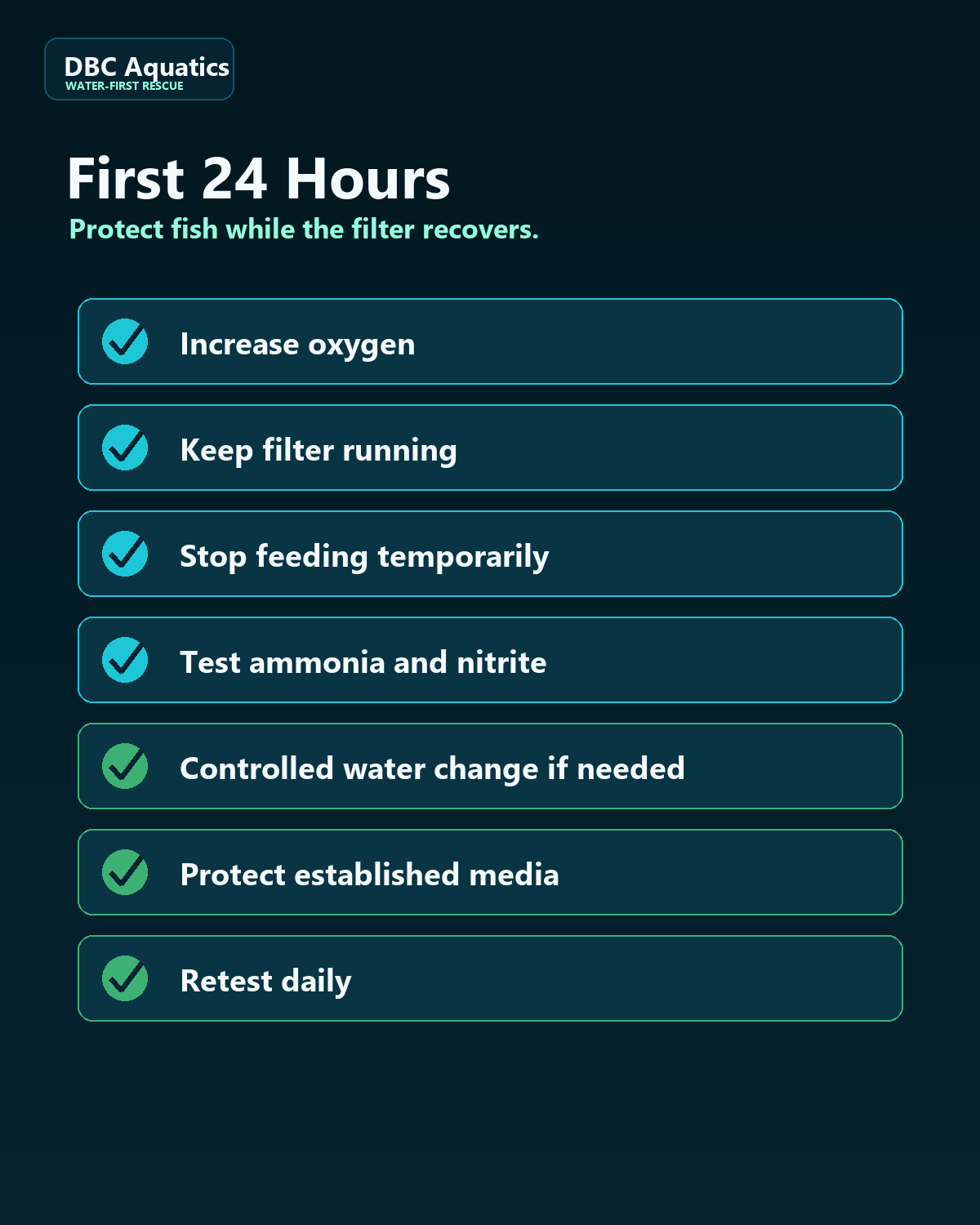
First 24 Hours
During the first day, your job is not to make the aquarium look perfect.
Your job is to keep fish breathing while the filter recovers.
| Step | Action | Why It Matters |
|---|---|---|
| 1 | Add oxygen | Helps fish handle ammonia, nitrite, and stress while you diagnose. |
| 2 | Keep filter running | Remaining bacteria need oxygen and water flow. |
| 3 | Stop feeding temporarily | Less food means less new ammonia. |
| 4 | Test ammonia and nitrite | These numbers tell you whether the tank is unstable. |
| 5 | Change water if needed | Dilutes ammonia or nitrite without resetting the tank again. |
| 6 | Protect media | Do not rinse, replace, dry out, or scrub remaining biological media. |
| 7 | Retest daily | A bacteria crash can show up over several days. |
Keep this rescue order handy. Download the free Aquarium Survival Checklist so you always know what to check when fish show signs of stress.
What A Filter Bacteria Crash Actually Means
Your filter is not just a machine that catches dirt.
It is also a home for beneficial bacteria that help process fish waste.
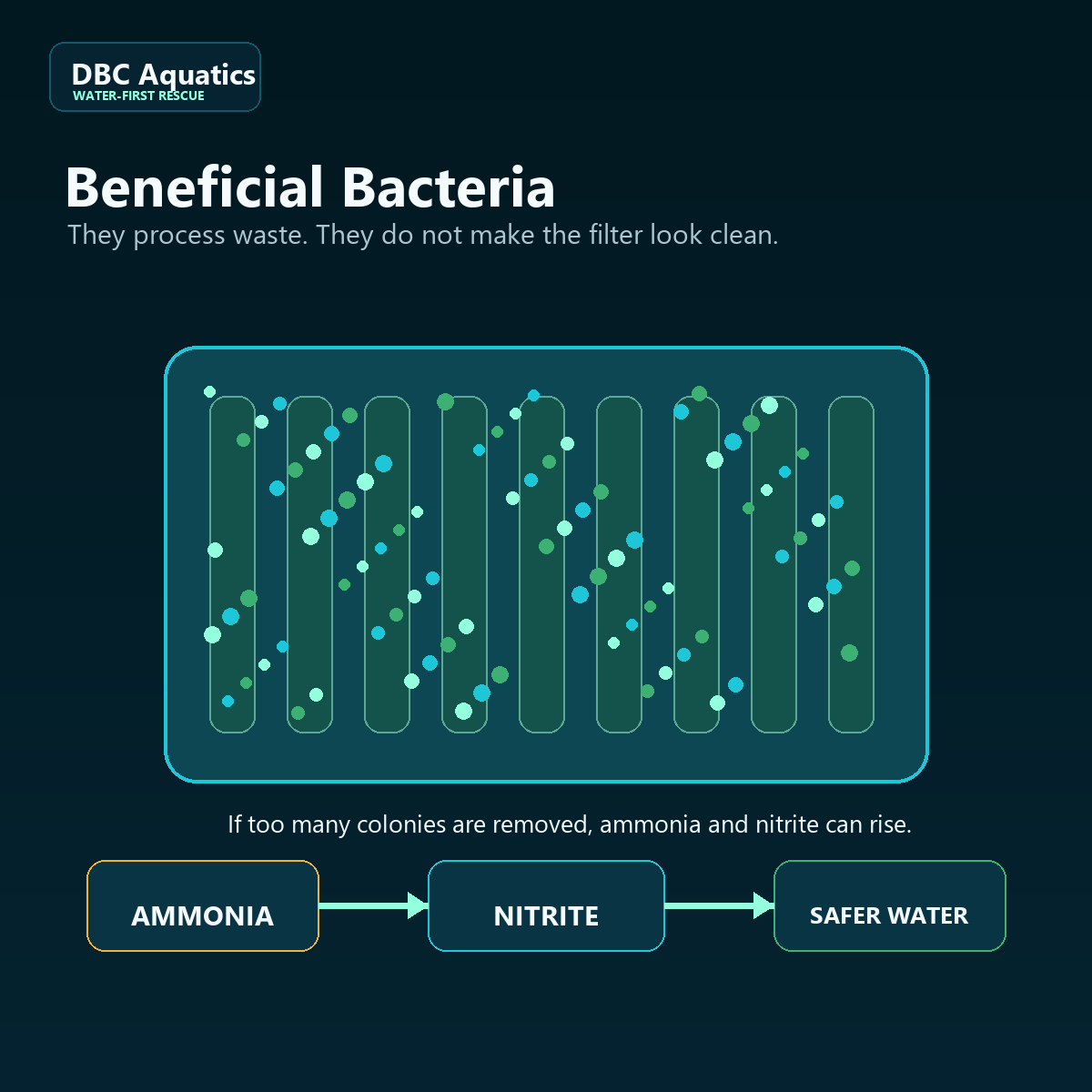
When fish produce waste, uneaten food breaks down, or something dies in the tank, ammonia can build up. In a stable aquarium, bacteria help process ammonia and then nitrite. If too much of that bacteria is removed or damaged at once, the aquarium can temporarily act like a new tank again.
That is why fish may look worse after a filter cleaning even though the filter looks cleaner.
The fish are not reacting to a dirty-looking sponge. They are reacting to an unstable system.
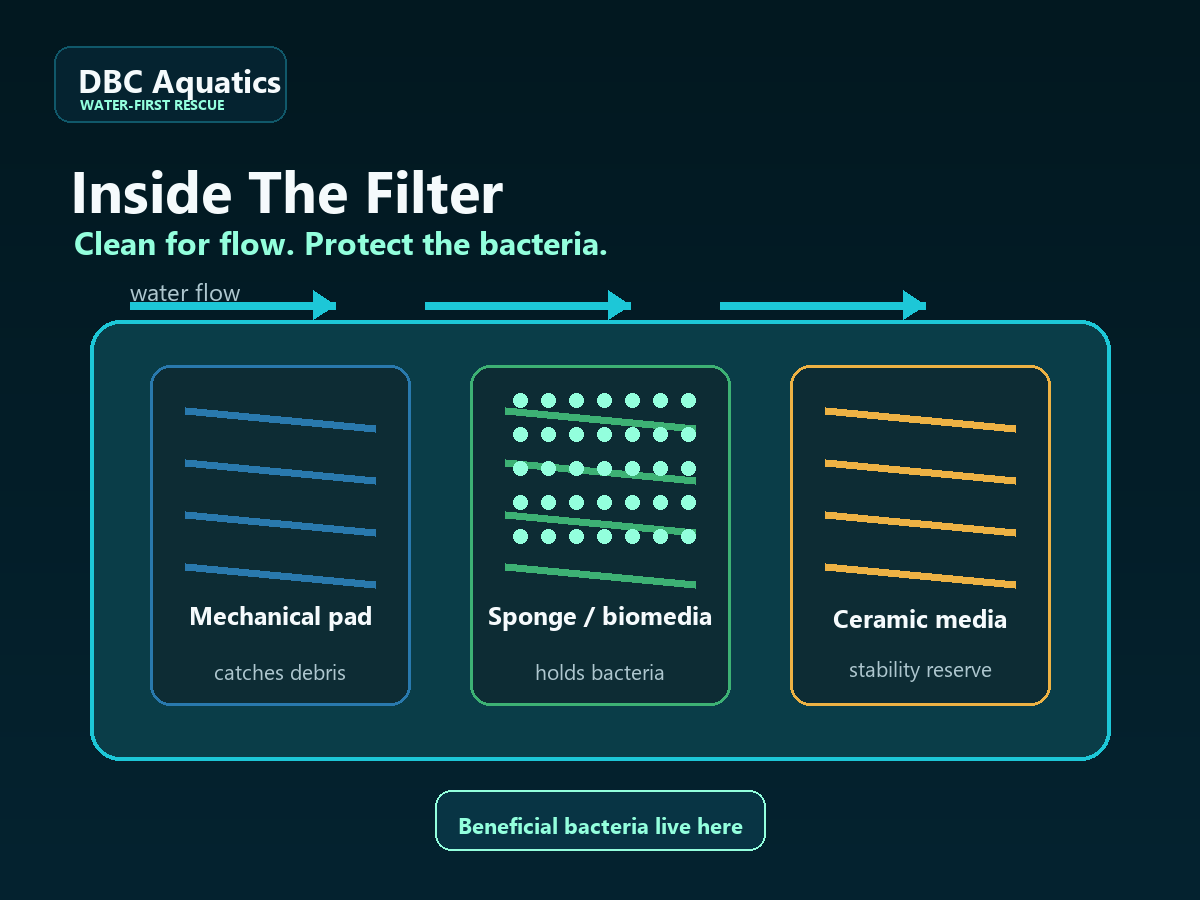
Why Clear Water Can Still Be Dangerous
A filter bacteria crash is easy to miss because the aquarium may look better right after cleaning.
That is the hidden problem.
Clear water only tells you what the tank looks like. It does not tell you whether the bacteria are still processing waste. Ammonia and nitrite can rise in water that looks perfectly clear, especially after filter media was replaced, scrubbed, rinsed under tap water, or left without flow.
In my experience, this is one of the most confusing emergencies for beginners because the tank looks cleaner at the exact moment the biological filter may be weaker.
Real Rescue Example
I have seen tanks where the owner did a big water change, replaced the filter cartridge, gravel-vacuumed heavily, and then watched the fish start breathing harder the next day.
Each step seemed reasonable by itself.
Together, those steps removed too much stability at once.
The rescue was not more cleaning. The rescue was oxygen, light feeding, daily ammonia and nitrite testing, controlled water changes when the numbers required it, and protecting whatever established media was left.
That is why this guide keeps coming back to the same idea: the filter does not need to look brand new. It needs to stay biologically alive.
What Usually Causes It?
| Recent Change | Why It Can Cause Trouble | What To Check |
|---|---|---|
| Replaced all filter cartridges | Removed too much established bacteria | Ammonia, nitrite, fish breathing |
| Rinsed media under tap water | Chlorine/chloramine may harm bacteria | Conditioner use, ammonia, nitrite |
| Scrubbed the filter spotless | Reduced bacteria and biofilm | Filter flow, water tests |
| Deep-cleaned gravel and filter together | Removed stability from multiple places | Cloudy water, ammonia, nitrite |
| Filter was off for hours | Bacteria lost oxygen and flow | Filter restart, fish behavior |
| Added too many fish after cleaning | More waste than bacteria can process | Ammonia, nitrite, stocking |
One pattern I see a lot is someone replacing every cartridge because the tank looked dirty. The intention is good. The problem is that the cartridge may have been holding the bacteria the tank needed most.
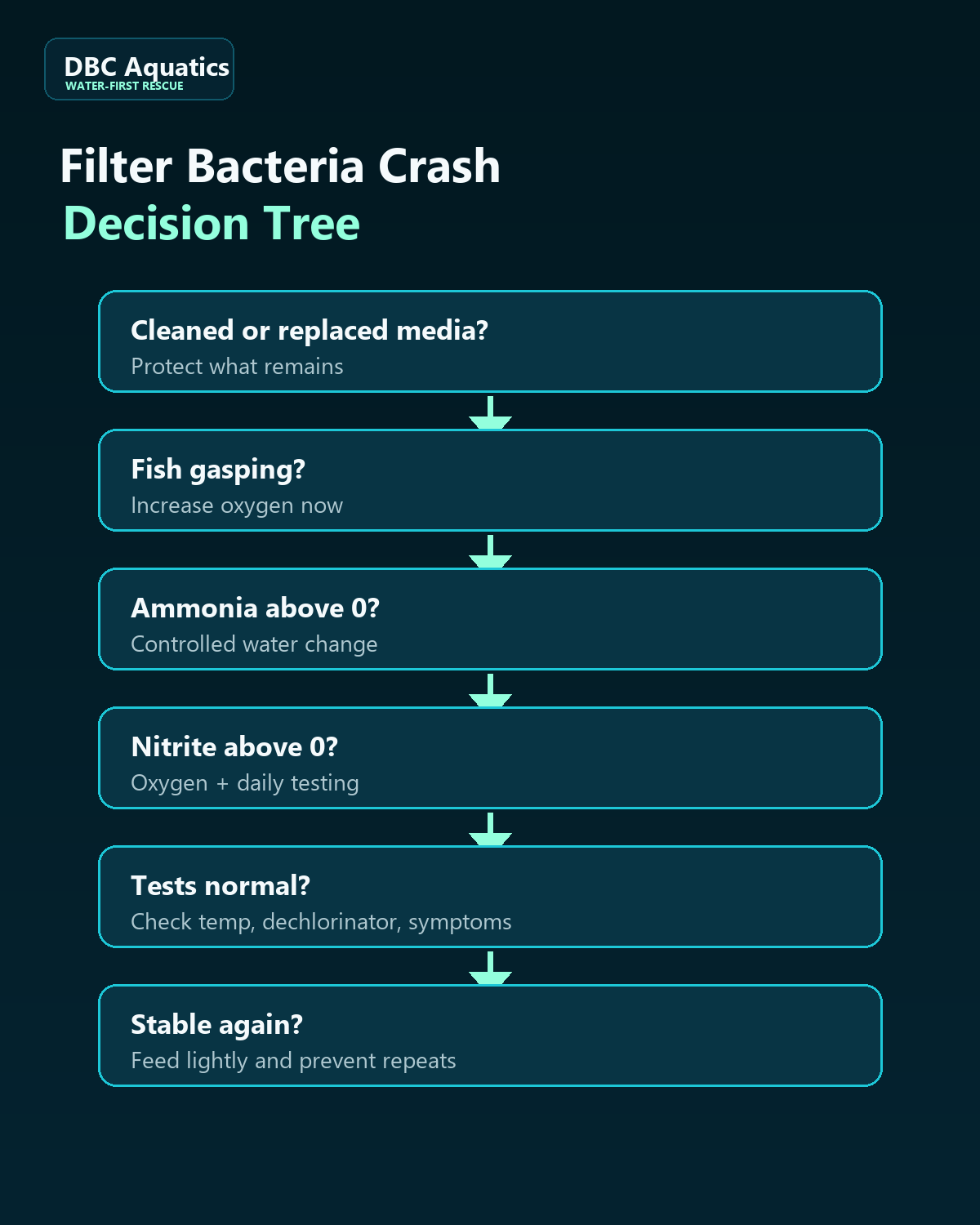
Filter Bacteria Crash Decision Tree
Start with what changed.
- Did you replace or rinse filter media?
Protect whatever established media remains and test ammonia and nitrite.
- Are fish gasping or breathing fast?
Increase oxygen now, then follow the water-quality rescue order.
- Is ammonia above 0 ppm?
Use a controlled water change and go to the Ammonia Spike Emergency guide.
- Is nitrite above 0 ppm?
Increase oxygen, reduce feeding, and use the Nitrite Poisoning rescue guide.
- Are tests normal but fish still look wrong?
Check temperature, dechlorinator, oxygen, and visible symptoms before medication.
For the full cluster path, start at the Water Quality Rescue Hub.
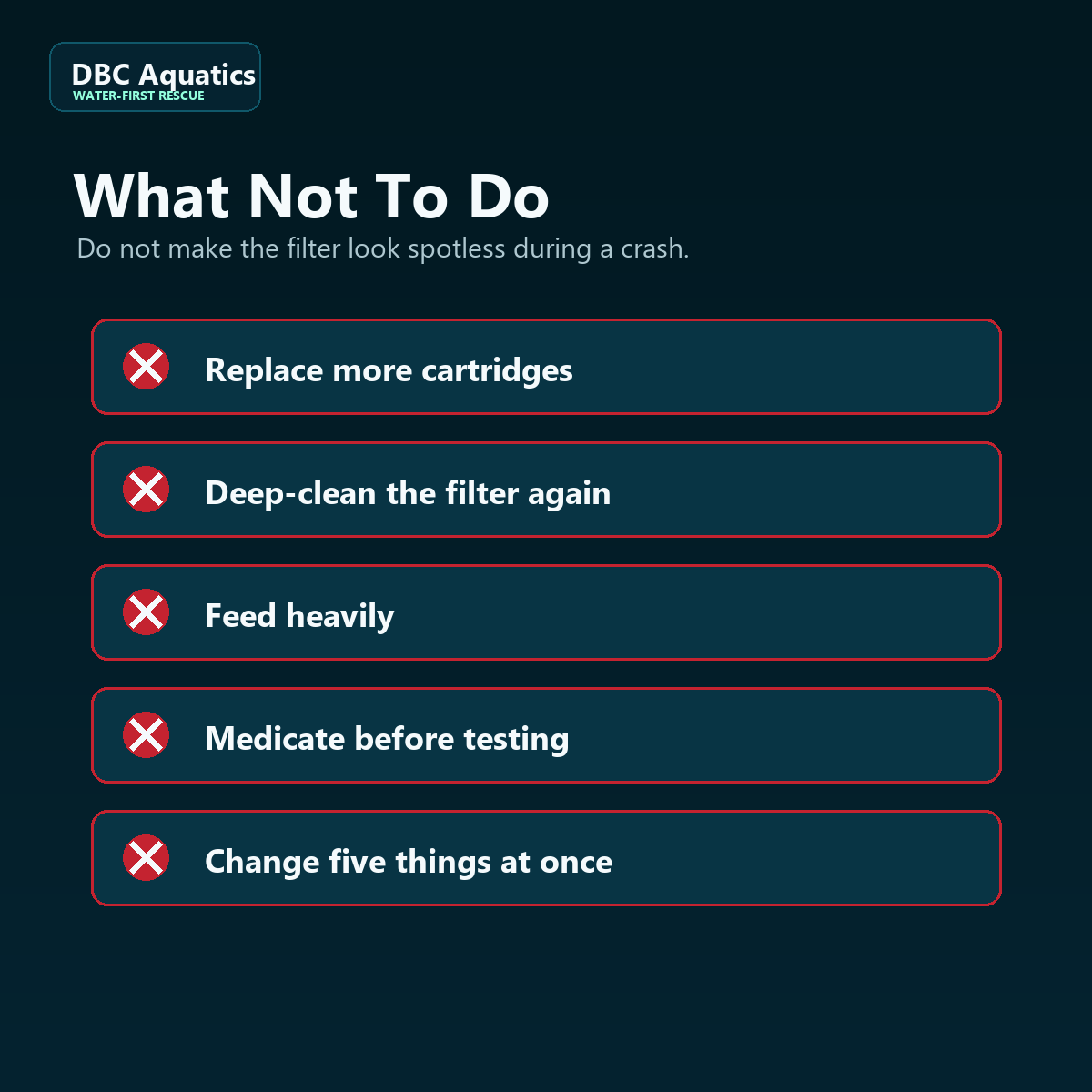
What Not To Do
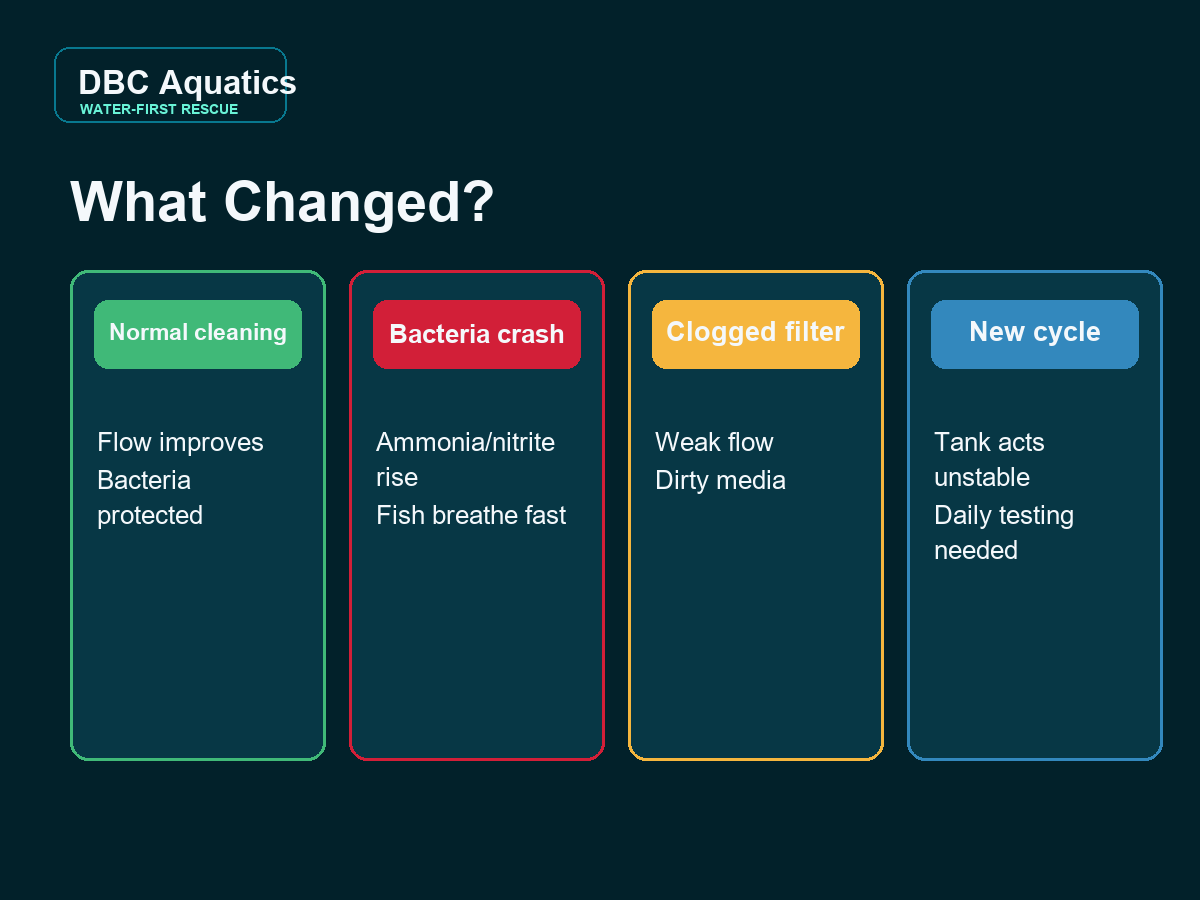
Do not chase a clean-looking filter during a bacteria crash.
Avoid:
- Replacing more cartridges.
- Rinsing biological media under tap water.
- Turning the filter off for long periods.
- Deep-cleaning gravel and filter again.
- Feeding heavily because fish look weak.
- Adding medication before checking water.
- Changing five things at once.
Chase:
- Stable oxygen.
- Ammonia at 0 ppm.
- Nitrite at 0 ppm.
- Strong filter flow.
- Protected established media.
- Daily test results trending better.
Should I Add Bottled Bacteria?
Bottled bacteria may help in some situations, especially if the tank lost a lot of established media.
But do not treat it like a magic undo button.
Even if you add bacteria, you still need oxygen, water testing, controlled water changes when ammonia or nitrite is present, and protected filter media. The fish need safe water now while the tank becomes stable again.
If you use bottled bacteria, follow the product directions and keep testing. The test kit tells you whether the tank is actually recovering.
If Ammonia Shows Up
Ammonia above 0 ppm means the tank is not processing waste safely.
Start with:
- Add oxygen.
- Stop feeding temporarily.
- Do a controlled water change based on the level and fish behavior.
- Protect the filter media.
- Retest after the water has mixed.
Use the Ammonia Spike Emergency guide for the full rescue order.
If Nitrite Shows Up
Nitrite above 0 ppm means the tank is still unstable.
Fish under nitrite stress may breathe harder because nitrite can interfere with oxygen use. Oxygen support matters while you correct the number.
Start with:
- Increase surface movement.
- Stop feeding temporarily.
- Do a controlled water change.
- Protect filter media.
- Retest daily until nitrite is 0 ppm.
Use the Nitrite Poisoning rescue guide if nitrite is present.
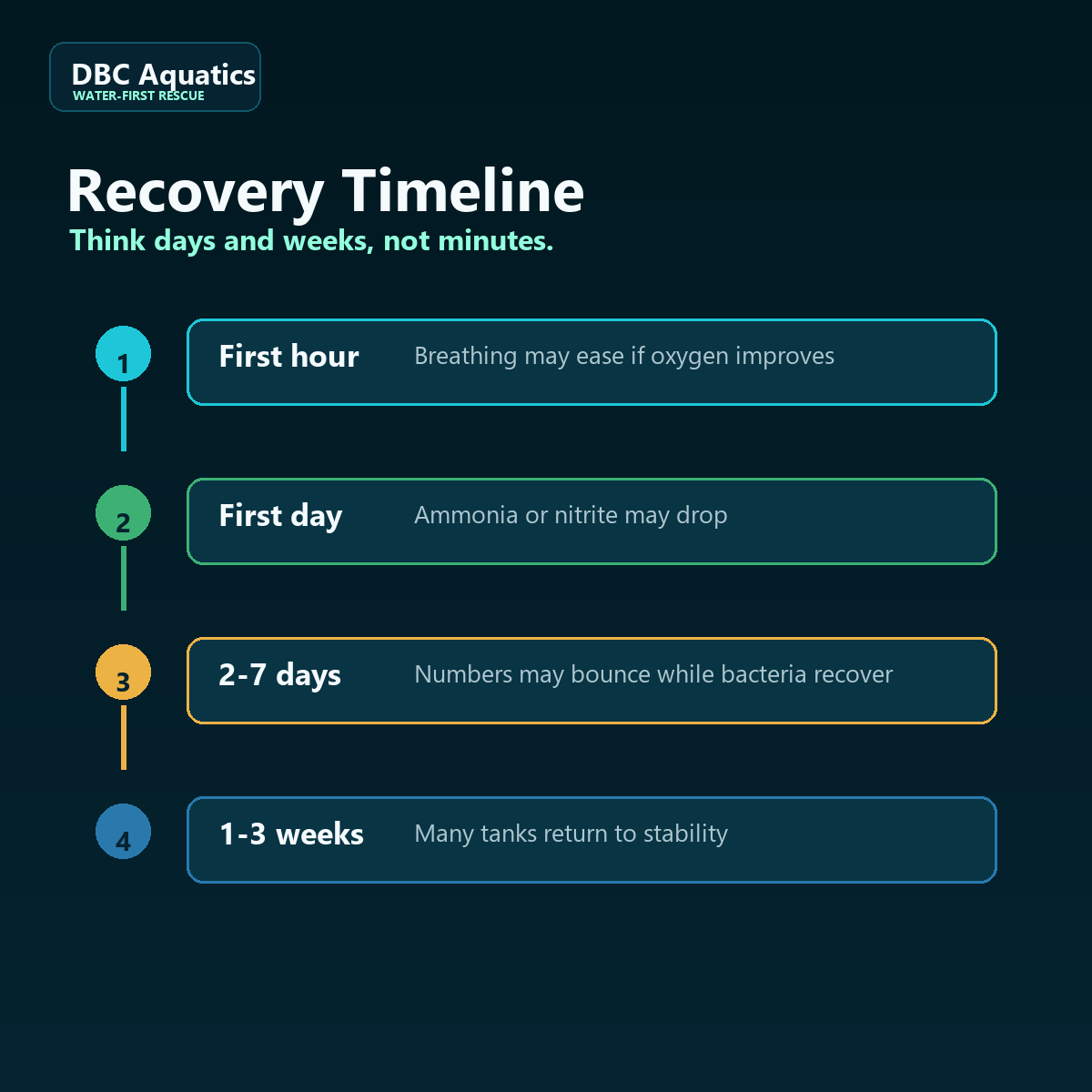
What Recovery Usually Looks Like
Recovery is usually measured in days and weeks, not minutes.
| Timeframe | What You May See |
|---|---|
| First hour | Fish may breathe easier if oxygen improves. |
| First day | Ammonia or nitrite may drop after controlled water changes. |
| Two to seven days | Test results may bounce while bacteria recover. |
| One to three weeks | Many tanks stabilize if feeding stays light and filter media is protected. |
Do not panic if the tank is not perfect the next morning. Panic cleaning is how many bacteria crashes get worse.
When The Rescue Is Not Working
If ammonia or nitrite keeps returning:
- Confirm the filter is running with strong flow.
- Check whether any established media remains.
- Look for hidden dead fish, food, plant matter, or snails.
- Reduce feeding further.
- Check stocking level.
- Test tap water for ammonia or nitrite.
- Verify dechlorinator is being used correctly.
- Make sure the test kit is not expired.
If fish symptoms do not match the water tests, use the DBC Symptoms Checker after you stabilize oxygen and water quality.
How To Prevent The Next Crash
The safest filter cleaning rule is simple:
Clean for flow, not for spotless media.
Do this next time:
- Rinse sponge or biomedia gently in old tank water.
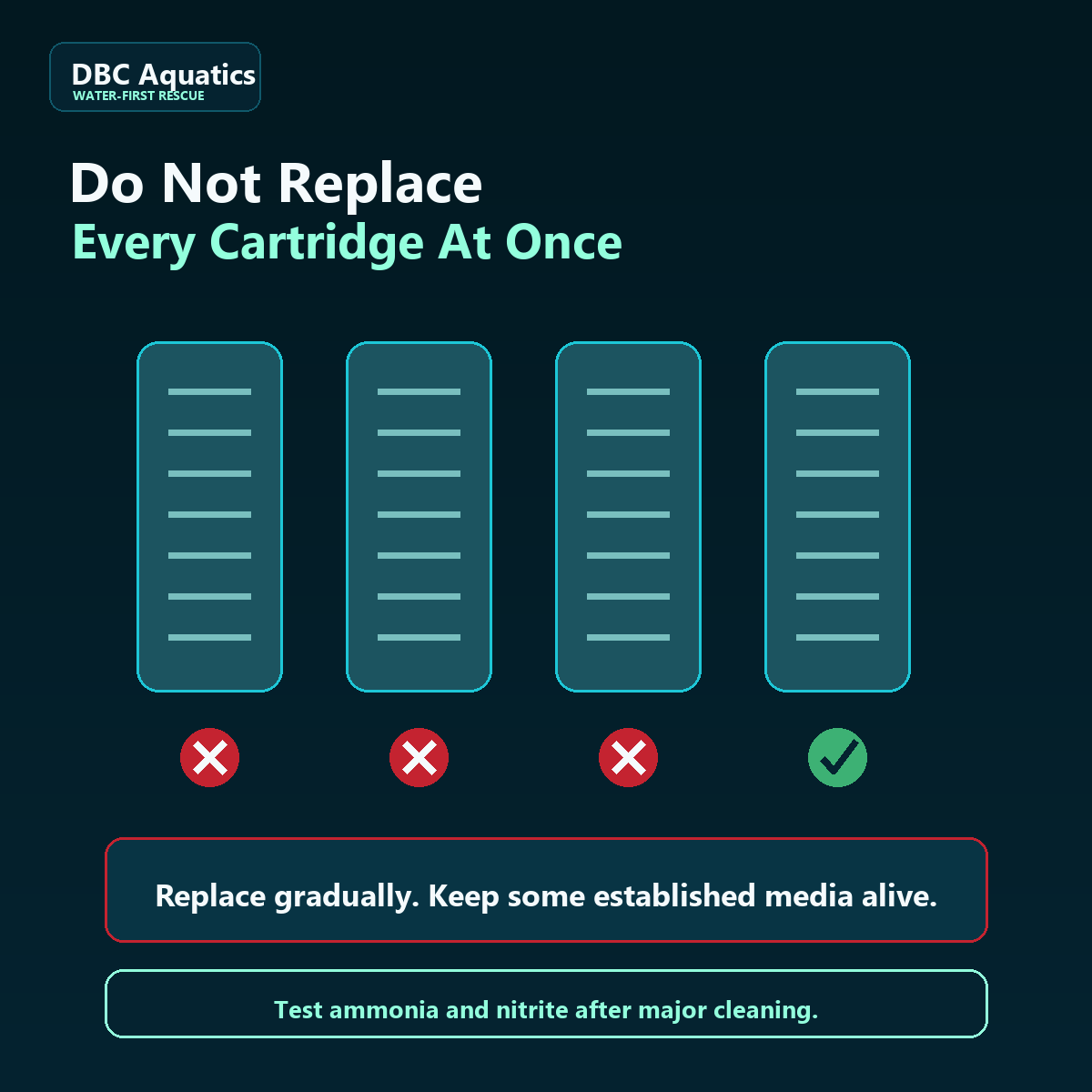
- Replace media gradually when possible.
- Never replace every cartridge at the same time unless it is unsafe or falling apart.
- Avoid deep-cleaning the filter and gravel on the same day.
- Keep media wet during maintenance.
- Test ammonia and nitrite after major cleaning.
For the maintenance version, use the guide to clean aquarium filters without killing beneficial bacteria.
Internal Rescue Path
If you discovered:
- Fish gasping: use the Fish Gasping At The Top rescue guide.
- Ammonia above 0 ppm: use the Ammonia Spike Emergency guide.
- Nitrite above 0 ppm: use the Nitrite Poisoning rescue guide.
- Cloudy water or bad smell: use the Cloudy Water rescue guide.
- Fish got worse after cleaning: use Fish Dying After Cleaning The Tank Or Filter.
- You need water-change help: use the Emergency Water Change guide.
- You need the full map: start at the Water Quality Rescue Hub.
The Next Step If This Keeps Happening
If the tank keeps bouncing between cloudy water, ammonia, nitrite, gasping fish, and filter trouble, the problem is usually not one cleaning mistake.
It is tank stability.
The Aquarium Rescue Blueprint is the deeper system for learning how to stabilize the aquarium so you are not reacting to a new emergency every week.
FAQs
Can you kill beneficial bacteria by cleaning the filter?
You can remove or damage a lot of beneficial bacteria if you replace all media, rinse biological media under untreated tap water, scrub the filter spotless, or let media dry out. The safer goal is to restore flow while preserving established media.
How do I know if my aquarium bacteria crashed?
The strongest clues are recent filter media replacement, aggressive cleaning, fish gasping, cloudy water, and ammonia or nitrite above 0 ppm. The test kit matters more than how clean the filter looks.
Will beneficial bacteria come back?
Usually yes, if the filter is running, oxygen is available, media stays wet, and the tank is not repeatedly overcleaned. Recovery can take days to weeks depending on how much bacteria was lost and how much waste the tank produces.
Should I change water during a bacteria crash?
If ammonia or nitrite is above 0 ppm, a controlled water change can help protect fish. Do not combine the water change with more filter media replacement or deep cleaning unless there is a specific safety reason.
Should I replace the filter cartridge again?
Usually no. Replacing more media can remove more bacteria. If the cartridge is physically blocking flow, gently restore flow while preserving as much established media as possible.
Can bottled bacteria instantly fix ammonia or nitrite?
No product should be treated as an instant guarantee. Bottled bacteria may support recovery, but fish still need oxygen, testing, controlled water changes when needed, and protected filter media.
How long should I test after a filter bacteria crash?
Test ammonia and nitrite daily until both stay at 0 ppm and fish behavior is normal. Continue checking after feeding or maintenance until the tank proves stable again.
Bottom Line
A filter bacteria crash is frightening because the tank can look cleaner while the water becomes less safe.
The safest rescue is not more cleaning.
Add oxygen. Test ammonia and nitrite. Protect the filter media. Change water carefully when the numbers say to. Then give the bacteria time to recover.
That is the DBC rescue order: protect the fish, protect the water, and solve the real problem instead of chasing the symptom.
Leave a Reply