Added Too Many Fish At Once? Check Ammonia And Nitrite First
Quick Answer
If you added several fish and the aquarium looked fine at first but the fish are now gasping, hiding, clamping fins, eating poorly, or acting stressed, treat it like a shared water-quality problem until testing proves otherwise.
The first move is not medication. The safe rescue order is oxygen first, then ammonia and nitrite testing, then reducing new waste, controlled water changes when justified, biofilter protection, and retesting.
A tank can look clear and still become temporarily unstable because the biological load changed faster than the existing filter bacteria could safely process it.
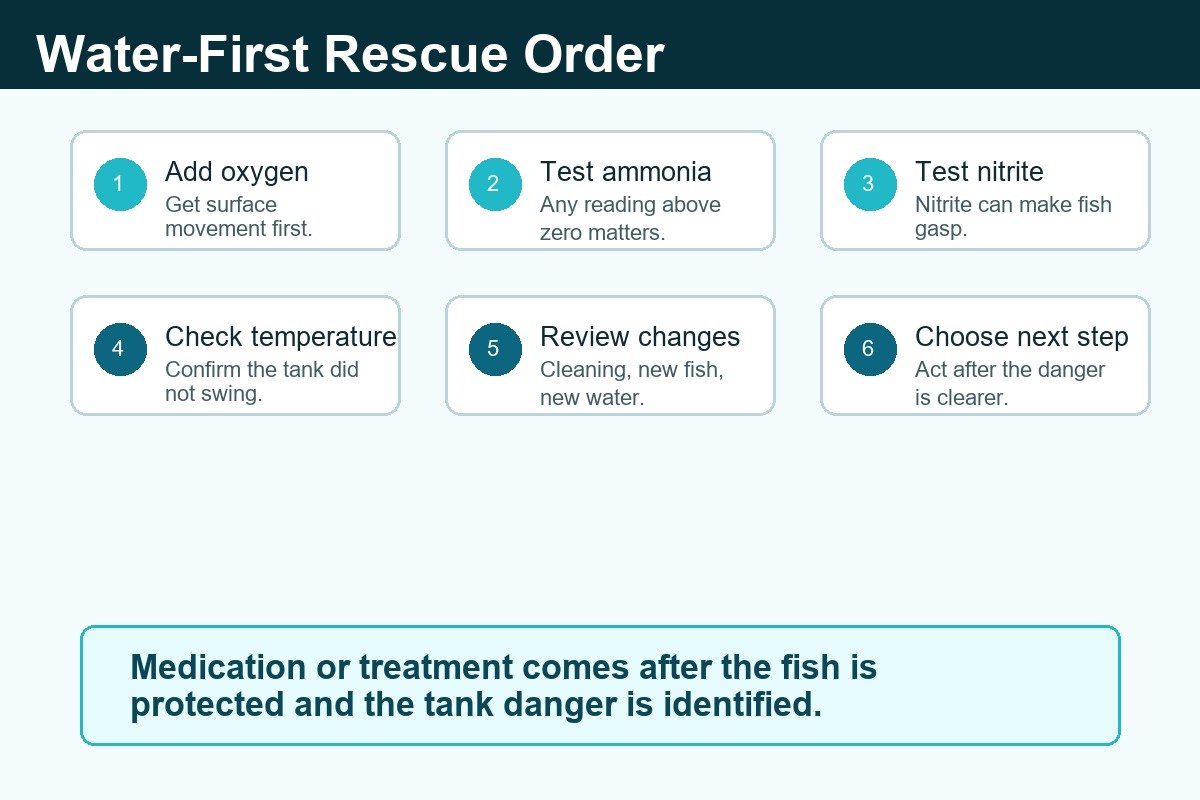
First 10 Minutes
Do these in order:
- Increase oxygen. Add an air stone, raise surface movement, or aim the filter return so the surface ripples.
- Test ammonia and nitrite. These are the two numbers that matter most after adding fish.
- Reduce new waste. Stop feeding for now or feed much less until the tank is stable.
- Check temperature and filter flow. Stress gets worse when temperature is unstable, water is too warm, or the filter is barely moving water.
- Use one measured conditioned water change if the fish or test results justify it. Do not keep changing water blindly without retesting.
- Protect the biofilter. Do not replace cartridges, rinse biological media under tap water, or reset the tank.
Why Clear Water Can Still Be Unsafe
Clear water tells you almost nothing about ammonia or nitrite.
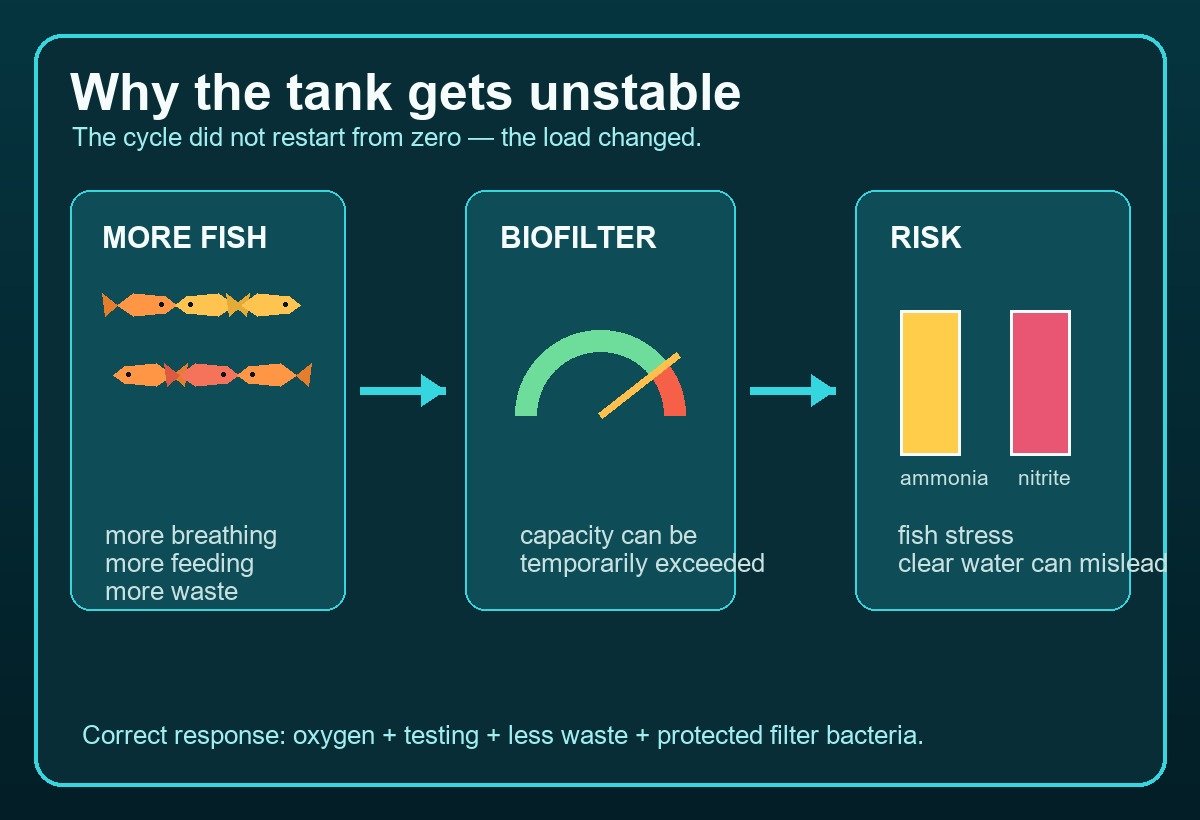
When you add more fish, you add more breathing, more waste, more food demand, and more pressure on the biofilter. If the tank was lightly stocked before, the bacteria colony may not be large enough yet for the new load.
That does not mean the aquarium is ruined. It means the tank needs time and careful support while the biofilter catches up.
The Recent-Change Clue
This problem usually starts after one of these changes:
- Several fish were added in one day or one weekend.
- Feeding increased because there are more fish now.
- The tank was newly cycled and barely stable before stocking.
- The filter was cleaned or changed near the same time.
- The water still looks clear, so the problem feels confusing.
If multiple fish are acting wrong at the same time, start with the shared environment before treating one fish as sick.
What Your Tests Mean
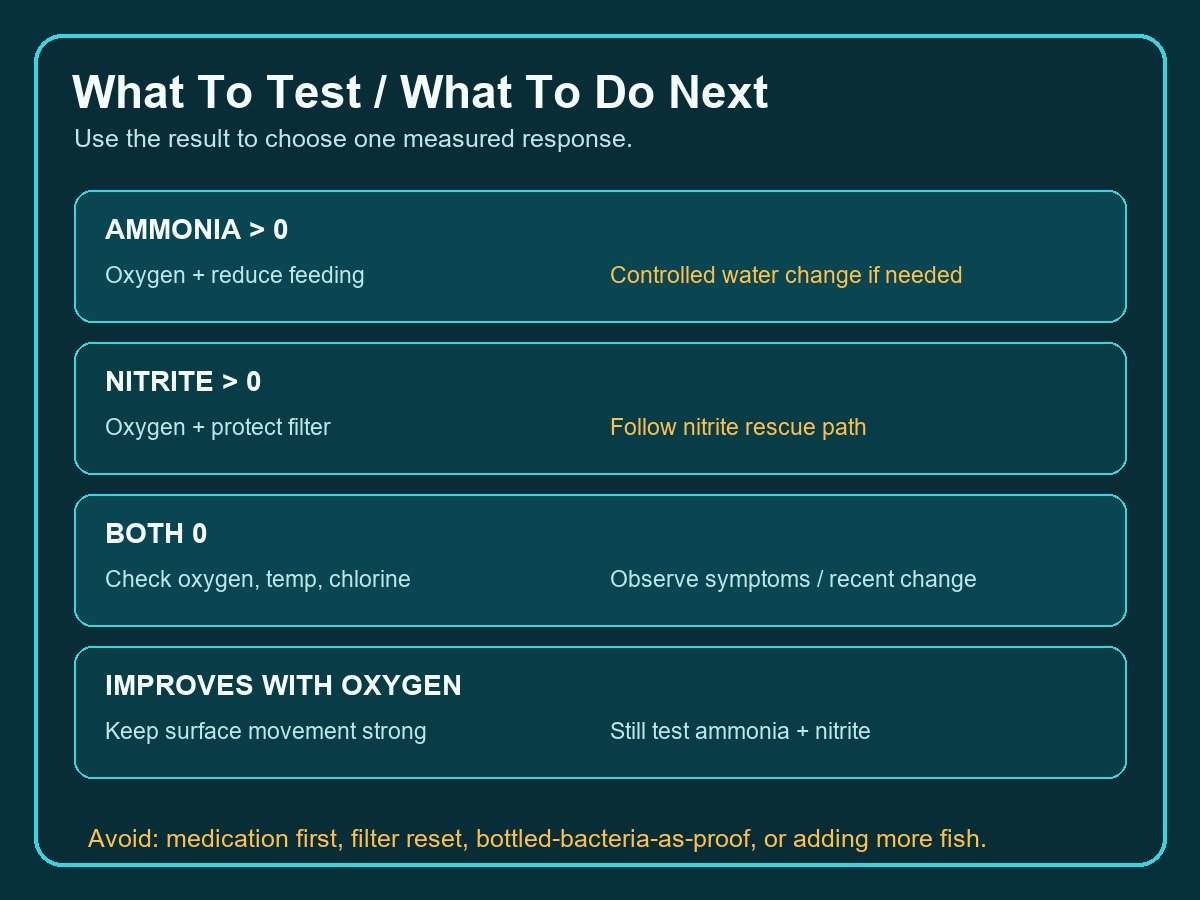
| What You Find | What It Means | First Safe Move |
|---|---|---|
| Ammonia above 0 ppm | The tank is not processing waste safely under the current load. | Increase oxygen, reduce feeding, use conditioned water changes as needed, and retest. |
| Nitrite above 0 ppm | The biofilter is not yet processing nitrite fast enough for the current waste load. | Increase oxygen, reduce feeding, protect filter media, and follow nitrite rescue guidance. |
| Ammonia and nitrite both 0 ppm | The visible problem may be oxygen, temperature, chlorine/chloramine, aggression, acclimation stress, or disease. | Keep observing and check the next most likely recent change. |
| Fish improve after added oxygen | Oxygen demand may be part of the problem. | Keep surface movement strong and still test ammonia/nitrite. |
| Fish get worse after feeding | Waste load may be outrunning the biofilter. | Stop feeding temporarily and retest daily. |
One Measured Action
If ammonia or nitrite is above zero, do not try to fix everything at once.
Pick one measured rescue action:
- Increase oxygen.
- Reduce feeding temporarily.
- Use a controlled conditioned water change when needed.
- Retest the same day or the next day.
- Keep filter media wet, dirty enough to stay alive, and untouched unless flow is actually blocked.
The goal is not to make the tank look cleaner. The goal is to keep fish alive while the biofilter catches up.
Protect The Biofilter
This is the part beginners often get backward.
When fish look stressed, it feels logical to deep-clean the filter. But in hobby shorthand, a “mini-cycle” means temporary instability after the biofilter is overloaded — not that a mature aquarium restarted from zero. The filter bacteria that still exist are part of the rescue team. Replacing cartridges, rinsing media under tap water, or scrubbing everything clean can make the tank less stable.
If the filter is flowing, leave the biological media alone. If flow is blocked, gently swish media in old tank water, not untreated tap water.
What Not To Do
Avoid these moves while the tank is unstable:
- Do not add more fish.
- Do not feed extra to help new fish settle in.
- Do not replace filter media because the tank looks dirty.
- Do not add medication before checking ammonia, nitrite, oxygen, and temperature.
- Do not assume bottled bacteria means the tank is instantly safe.
- Do not keep doing large water changes without testing and observing the fish.
When Can You Add More Fish?
Wait until the tank proves it can handle the current fish load.
A safer rule is:
- Ammonia stays at 0 ppm.
- Nitrite stays at 0 ppm.
- Fish are breathing normally.
- Feeding is normal again.
- The filter is flowing and has not been replaced or sterilized.
- The tank remains stable for several days under the current stock.
Then add slowly, not all at once.
Internal Rescue Path
Use the next DBC guide that matches what you find. Do not open every guide at once — pick the one that fits your test result or recent change:
- If ammonia is above zero, use the ammonia spike emergency guide.
- If nitrite is above zero, use the nitrite poisoning rescue guide.
- If fish are gasping, use the fish gasping rescue guide.
- If a controlled water change is justified, use the emergency water change guide.
- If this is a new or newly stocked tank and the water looks clear, read New Tank Syndrome: Why Clear Water Can Still Be Dangerous.
- If you need the bigger biofilter explanation, use the Nitrogen Cycle Rescue Hub or the Aquarium Nitrogen Cycle Guide.
- If you are planning the next stocking step after this stabilizes, use the Aquarium Startup Checklist.
Save The Rescue Order
If you are trying to stabilize the tank right now, use the Aquarium Survival Checklist so you do not skip oxygen, ammonia, nitrite, temperature, conditioner, filter flow, or recent changes under stress.
Use the Checklist first. The Blueprint is for building repeatable rescue judgment after the immediate problem is under control.
Frequently Asked Questions
Can adding too many fish cause an ammonia spike?
Yes. More fish create more waste and usually more feeding. If the biofilter is not ready for that load, ammonia can rise even when the water still looks clear.
Can adding too many fish cause nitrite?
Yes. Nitrite can appear after the tank starts processing ammonia but cannot yet process nitrite fast enough. Nitrite problems often show up after the first warning signs have already started.
Should I add bottled bacteria?
You can use a reputable product according to its label, but do not treat it as proof that the aquarium is safe. Keep testing ammonia and nitrite, keep oxygen strong, and protect the filter media.
Should I move the new fish out?
Maybe, but do not move fish blindly if the second tank is uncycled or stressful. First confirm the problem with ammonia, nitrite, oxygen, temperature, and fish behavior. If fish are collapsing or the readings are severe, get experienced fish-health help.
Should I medicate the tank?
Not until water and oxygen problems are checked. Medication does not fix ammonia, nitrite, low oxygen, chlorine/chloramine, temperature shock, or a damaged biofilter.
How many fish can I add at once?
There is no universal safe number. Tank size, filter maturity, fish size, feeding, temperature, and species all matter. A safer approach is to add slowly and test after each stocking change.
A Real Rescue Example
I have seen fishkeepers reach for medication because the fish looked sick overnight. The test kit told a different story: ammonia or nitrite was not zero. Medication would have felt like helping, but it would not have fixed the real problem. Once oxygen improved, water was corrected carefully, and the filter bacteria were protected, the fish had a better chance to recover.
THE DBC RULE
Test the water.
Protect the fish.
Then choose the next step.
Bottom Line
If fish look worse after you added several new fish, the biofilter may be overloaded under the new waste load.
Do not panic-clean the filter. Do not add more fish. Do not medicate before testing.
Increase oxygen, test ammonia and nitrite, reduce feeding, protect the biofilter, and use measured conditioned water changes only when the fish or test results justify them.
After the tank is stable, use the Aquarium Rescue Blueprint only if you want a repeatable system for preventing this kind of crash from happening again.
Leave a Reply